
The short answer: AGI would change almost every job, and it would replace some of them. But it won’t happen overnight, and it isn’t only an AGI question. Today’s AI is already reshaping work, one task at a time. The real risk for most organizations is not a sudden wave of job losses. It’s failing to redesign roles, protect the entry-level pipeline and upskill people fast enough.
This is the question behind the question.
When leaders ask me about AGI, they often start with the technology. When the people in the audience ask, they start somewhere else. “Will I still have a job?”
It’s a fair question, and it deserves an honest answer, not empty reassurance and not doom. In this article, I’ll walk you through what AI is already doing to work, how AGI would change the picture, which roles are most and least exposed, and what leaders should do right now.
AI Replaces Tasks First, Not Whole Jobs
Here’s the most important idea in this whole debate. Jobs are bundles of tasks.
A marketing manager writes briefs, analyzes data, manages people, negotiates budgets and builds relationships. AI might take over the first two. It is much further from taking over the last three.
So the right question isn’t “Will AI replace this job?” It’s “Which tasks in this job will AI take over, and what happens to the rest?”
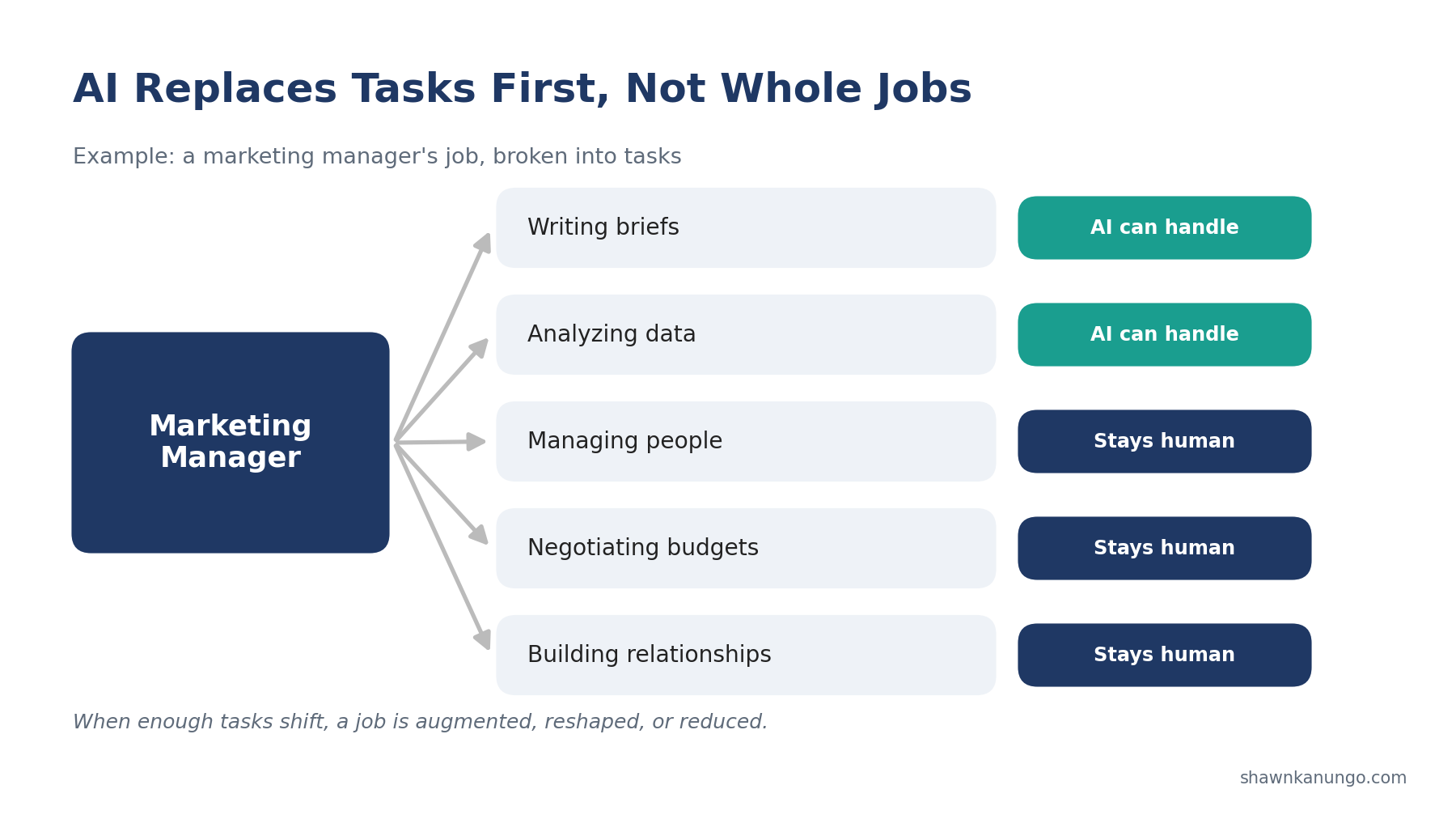
AI replaces tasks first, not whole jobs: a marketing manager’s tasks split into what AI can handle and what stays human
When enough tasks shift, three things can happen:
The job is augmented. People do the same role with AI handling the routine parts, so they can focus on higher-value work.
The job is reshaped. The role changes so much it becomes something new.
The job is reduced or removed. If most of the tasks can be automated, fewer people are needed.
The scale is big. The International Monetary Fund has estimated that around 60% of jobs in advanced economies are exposed to AI in some way. Exposure doesn’t mean replacement. But it does mean change is coming to most roles.
What AI Is Already Doing to Work
We don’t have to guess about everything. Some patterns are already showing up in 2026:
Experienced workers are being augmented. Economic research suggests AI tends to boost people whose value comes from experience and judgment, the kind of knowledge that is hard to write down.
Entry-level roles are under pressure. The tasks juniors traditionally learned on, like research, drafting and basic analysis, are exactly what AI does well. Studies have found early hiring declines for younger workers in the most AI-exposed jobs.
Organizations are redesigning work, not just cutting. Most companies are still in the early stages, using AI to change how work gets done rather than making large-scale cuts.
That entry-level point worries me most. If AI does the work juniors used to learn on, where will tomorrow’s experienced leaders come from? I call this the missing first rung. Organizations that cut the bottom of the ladder today may find they have no one ready to climb it in ten years.
How AGI Would Change the Picture
Today’s AI handles specific tasks, often with a human checking the work. AGI, as I explain in AGI vs AI: What’s the Difference?, would be able to learn and handle almost any thinking task, more like a capable colleague.
That changes the job conversation in three ways:
Much broader reach. Instead of automating parts of some jobs, AGI could take on large parts of most knowledge work.
Less oversight needed. Today, a human usually reviews AI output. A truly general system would need less checking, which changes how teams are structured.
Faster change. The speed of transition could outpace how quickly people and institutions usually adapt.
I believe AI agents will soon outnumber human employees in most organizations. I said this in What AGI Means for Leaders. If AGI follows, the question is no longer whether machines can do the work. It’s what kind of people, and what kind of culture, you want leading alongside them.
But remember, AGI doesn’t exist yet, and no one knows when it will. I cover the timeline debate in When Will AGI Arrive? That gives leaders time, but only if they use it.
Which Jobs Are Most and Least Exposed?
No job is fully safe and few jobs will vanish entirely. But exposure varies a lot. Here’s a practical way to think about it.
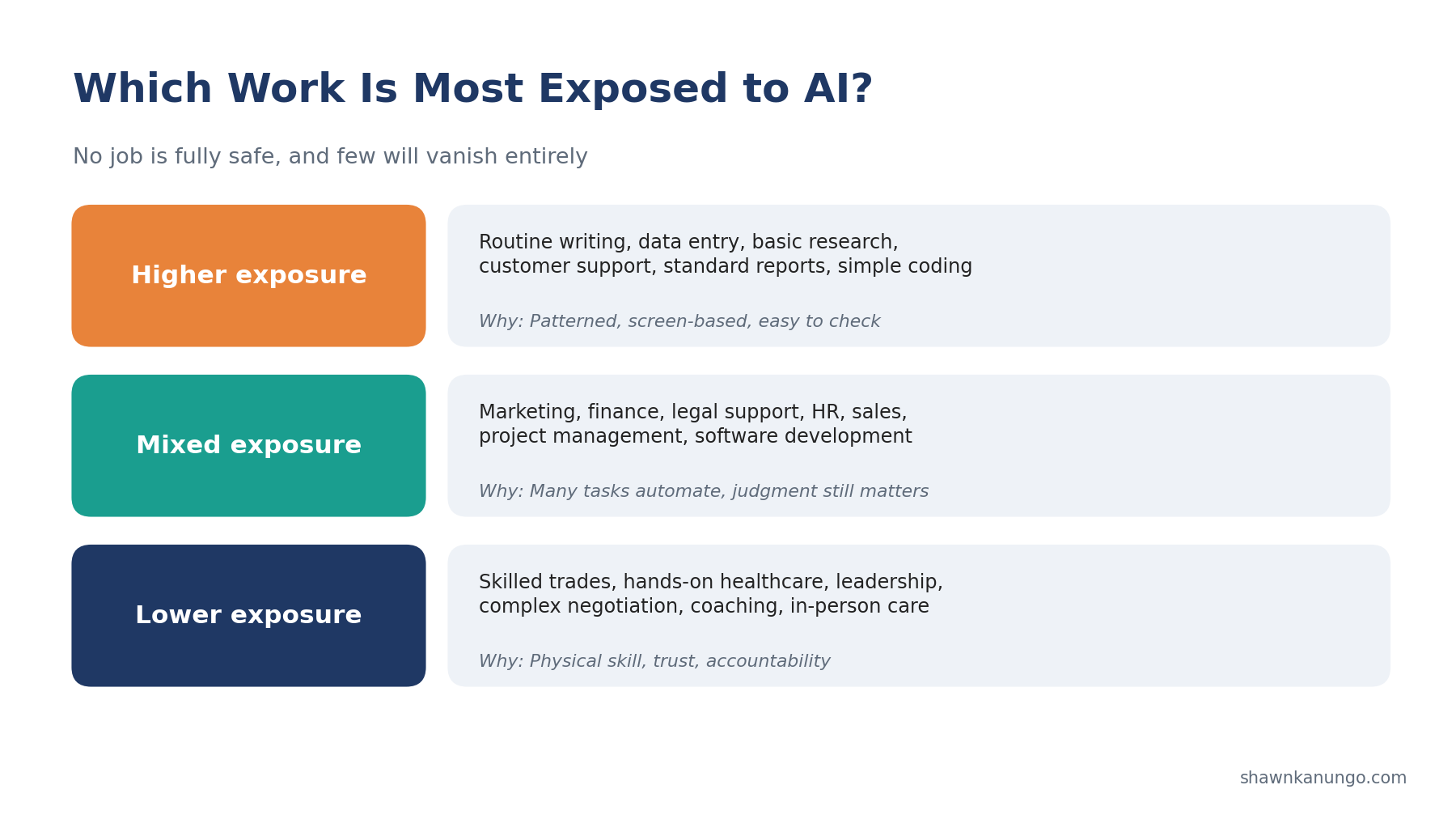
Which work is most exposed to AI: higher, mixed and lower exposure roles
Higher exposure
Types of work: Routine writing and editing, data entry, basic research, customer support, standard reports, simple coding, transcription, scheduling
Why: Tasks follow patterns, live on a screen, and have clear right answers
Mixed exposure
Types of work: Marketing, finance, legal support, HR, sales, project management, software development
Why: Many tasks can be automated, but judgment, relationships and context still matter
Lower exposure
Types of work: Skilled trades, hands-on healthcare, leadership, complex negotiation, coaching, roles built on trust and in-person care
Why: Require physical skill, real-world presence, deep trust or accountability for hard calls
Notice a pattern? The work that holds up best combines judgment, relationships and real-world presence. The work most at risk is routine, screen-based and easy to check.
One caution. AGI could push into the middle category much faster than today’s AI. That’s why I’d encourage every leader to plan for the mixed-exposure roles now, not later.
The Skills That Will Matter More, Not Less
Every time machines get better at something, the human skills around it become more valuable. Here’s what I tell audiences to double down on:
Judgment. Knowing what to do when the data doesn’t give you a clean answer.
Connecting ideas across fields. As AI covers specialist tasks, people who connect the dots become more valuable. This is the deep generalist advantage.
Trust and relationships. When anything can be generated by a machine, trust becomes scarce, and people who earn it win.
Creativity and taste. AI can produce endless options. Humans still decide what’s good, what’s right and what’s worth doing. I explore this in What Happens to Human Creativity in an AI World?
Working with AI. Knowing how to direct, check and improve AI’s work will become a core skill in almost every role.
What Leaders Should Do Now
I spent 12 years at Deloitte helping leaders plan for disruptive innovation. The organizations that handled disruption best didn’t protect the old way of working. They redesigned it, and they brought their people with them.
Here’s my playbook for leaders:
Map tasks, not titles. Break key roles into tasks. Identify which ones AI can handle, which it can support, and which must stay human.
Redesign roles before you cut them. Ask what people could do with the time AI frees up. Often the answer is better service, faster innovation or deeper customer relationships.
Protect the first rung. Rethink entry-level roles so juniors still learn. Pair them with AI as apprentices, not replacements.
Invest in upskilling, at scale. Here’s how to close the AI skills gap without replacing your workforce.
Be honest with your people. Silence breeds fear, and fear kills adoption. Tell people what’s changing, what isn’t, and how you’ll support them.
Set clear rules on human decisions. Decide which decisions stay with people and who is accountable when AI acts. That’s the core of AI governance.
Build the leadership muscles AI can’t replace. I outline them in What Leadership Capabilities Matter Most When Your Organization Is Disrupted by AI?
What This Means for You Personally
If you’re worried about your own role, here’s my advice:
Use AI every day. The people most at risk aren’t those whose work AI can do. They’re the people who refuse to learn how to work with it.
Move toward judgment. Look for work that requires decisions, relationships and accountability.
Stay curious, not scared. Curiosity makes you experiment. Fear makes you wait. If you want to go deeper on the mindset of people who thrive in disruption, my book unpacks the DNA of disruptors: The Bold Ones.
Conclusion: The Future of Work Will Be Designed, Not Just Disrupted
Will AGI take our jobs? It will change nearly all of them, and replace some. But the outcome isn’t set by technology alone. It’s set by the choices leaders make between now and then.
Organizations can use AI to cut costs and hollow out their talent pipeline. Or they can use it to redesign work, grow their people and create value that wasn’t possible before. Both paths are open today. Only one builds an organization that’s ready for whatever AGI brings.
The future of work won’t just happen to us. We get to design it.
If your organization or audience needs a practical, hopeful conversation about AI and the future of work, explore my AI keynote, watch me on stage, or book a conversation.
Frequently Asked Questions About AGI and Jobs
Will AGI replace jobs?
AGI would change almost every job and replace some, especially roles made up mostly of routine thinking tasks. Most experts expect a mix of jobs being augmented, reshaped and removed, rather than a single wave of losses.
What jobs will AI replace first?
Roles heavy in routine, screen-based tasks are most exposed. Examples include data entry, basic writing and editing, simple customer support, transcription and standard reporting.
What jobs are safe from AI and AGI?
No job is completely safe, but roles that rely on physical skill, real-world presence, deep trust, leadership and accountability are the least exposed. Skilled trades, hands-on care and complex negotiation are good examples.
Is AI already taking jobs?
AI is already changing work, especially for entry-level roles in AI-exposed fields. So far, most organizations are redesigning tasks more than making large-scale cuts, but pressure on early-career hiring is growing.
How will AGI affect employment differently from today’s AI?
Today’s AI automates specific tasks, usually with human oversight. AGI could handle almost any thinking task with less oversight, so its impact on employment would be broader and faster.
How can workers prepare for AGI?
Use AI tools daily, build judgment and relationship skills, learn to connect ideas across fields, and move toward work that involves decisions and accountability. Curiosity is your biggest advantage.
What should leaders do about AI and jobs right now?
Map tasks instead of titles, redesign roles before cutting them, protect entry-level learning, invest in upskilling, communicate openly, and set clear rules on which decisions stay human.