
The short answer: AI is any technology that performs tasks we usually link to human thinking, like writing, spotting patterns or answering questions. AGI, or artificial general intelligence, is a future form of AI that could learn and reason across almost any task the way a capable person can. AI is here today. AGI is not, at least not yet.
That is the dictionary version. Here is the version I give on stage.
AI is a brilliant specialist. AGI would be a brilliant colleague who can pick up anything.
When I speak to leadership teams, I notice something. People use “AI” and “AGI” as if they mean the same thing. They don’t. And mixing them up leads to two expensive mistakes. Some leaders overreact and freeze, because they think a machine that can do everything is arriving next quarter. Others underreact, because they think AGI is science fiction, so AI must be hype too.
Both groups are wrong. In this guide, I’ll walk you through what each term actually means, where the line between them is getting blurry, and why the difference matters for the decisions you make this year.
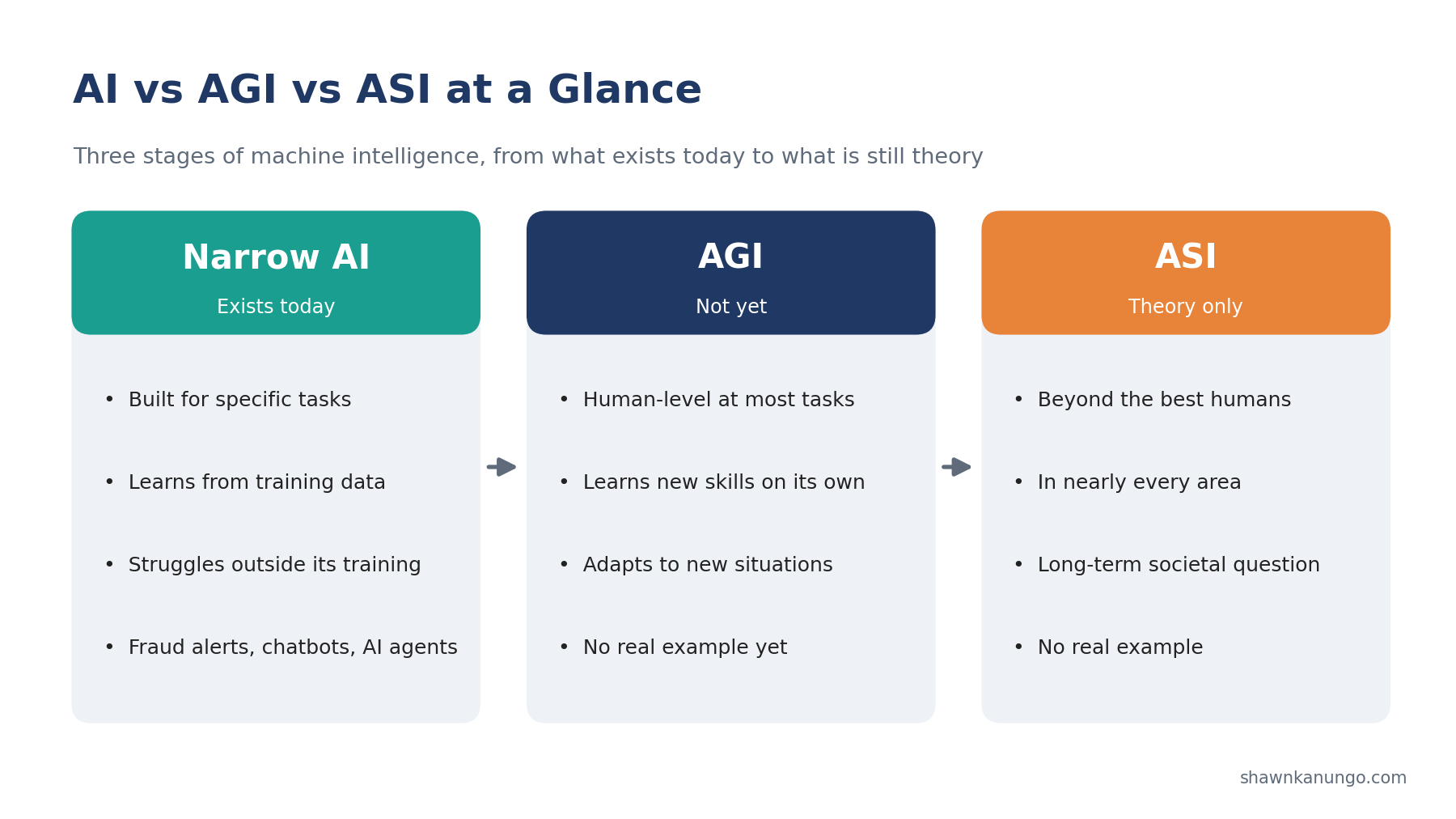
AI vs AGI vs ASI: narrow AI exists today, AGI does not exist yet, and ASI is still theory
What Is AI?
Artificial intelligence is the broad field of building machines that can do things we normally associate with human intelligence. That includes recognizing images, understanding language, making predictions and, more recently, creating content and taking action.
The term is not new. It was coined at a research workshop in 1956. For most of the decades since, AI meant systems built for one job. A program that plays chess. A model that flags fraudulent transactions. A filter that catches spam.
That is what experts call narrow AI, sometimes written as ANI (artificial narrow intelligence). It can be superhuman at its one task and useless at everything else. A chess engine can beat a grandmaster and still cannot book you a flight.
Today, AI shows up in three forms you probably already use:
Predictive AI spots patterns and forecasts outcomes. Think fraud detection, demand forecasting and recommendations.
Generative AI creates new content. Text, images, code, audio and video.
Agentic AI takes action toward a goal. You give it an outcome and it plans the steps and completes them. I explain this shift in Agentic AI Explained for Business Leaders.
What Is AGI?
Artificial general intelligence is AI that could understand, learn and apply knowledge across almost any intellectual task a human can do. Google Cloud describes AGI as the hypothetical intelligence of a machine that can learn any intellectual task a person can, and notes that true AGI does not exist yet.
The key word is general. An AGI system would not need to be rebuilt for every new problem. It could:
Learn a new skill from a few examples, the way you learn a new app.
Transfer what it knows from one field to another.
Reason through situations it has never seen before.
Plan over long periods and adjust when things go wrong.
Know what it doesn’t know, and ask.
I wrote a leader-focused introduction in What AGI Means for Leaders (And What to Do Before It Arrives). If you are new to the topic, start there.
AGI vs AI: The Core Difference Is Generality
The simplest way to separate the two is one word: scope.
AI is built and trained for a set of tasks. AGI would handle almost any task, including ones nobody trained it for.
Here is a side-by-side comparison, including the third term people often confuse with both: superintelligence.
AI (narrow AI)
What it is: AI built for specific tasks
Does it exist? Yes, everywhere
How it learns: Trained on data for its tasks
Handles new situations: Often struggles outside its training
Everyday example: Fraud alerts, chatbots, AI writing tools, AI agents
What it means for leaders: A tool and teammate to deploy now
AGI (general AI)
What it is: AI that matches human ability across almost any task
Does it exist? No, not by most definitions
How it learns: Would learn new skills on its own, with little data
Handles new situations: Would adapt like a capable person
Everyday example: None yet
What it means for leaders: A shift in how work and decisions are divided
ASI (superintelligence)
What it is: AI that exceeds the best humans in nearly every area
Does it exist? No, purely theoretical
How it learns: Unknown
Handles new situations: Would adapt beyond human ability
Everyday example: None
What it means for leaders: A long-term societal question
Why the Line Between AI and AGI Is Getting Blurry
This is the part most articles miss, and it is the part that matters most.
The old explanation says AI is narrow, like a chess program. That was true for decades. It is not the full picture anymore.
Today’s leading AI models can write, summarize, code, analyze data, translate and reason through problems, all in one system. That is not narrow in the chess-engine sense. It is broad. But it is not truly general either, because these systems still:
Make confident mistakes a careful person would catch.
Struggle with long, open-ended work that runs for days or weeks.
Don’t reliably learn from experience after they are deployed.
Can be strong at a hard task and fail at an easy one.
So I describe today’s AI as broad but brittle. It covers a lot of ground, but it can’t yet be trusted to work like a fully capable colleague without oversight.
Researchers at Google DeepMind captured this middle ground in a 2023 framework that treats AGI as a set of levels rather than a single finish line. Their levels run from emerging, to competent, expert, virtuoso and superhuman. At the time, they placed the most advanced chatbots at the first rung, “emerging AGI,” and said no higher level had been reached.
I like this framing because it matches what I see in business. AGI will probably not arrive as one dramatic announcement. It will show up gradually, one capability at a time, and many organizations will only notice once it is already changing their industry. That is the same pattern I describe in why disruption always starts as a joke.
Where Agentic AI Fits
If you want one concept that connects today’s AI to tomorrow’s AGI, it is agentic AI.
I think about the journey in three waves:
Generative AI helps you create. You ask, it produces, and a human decides what happens next.
Agentic AI acts on your behalf. You set a goal, it plans and executes the steps inside a defined area.
AGI would think across everything. Almost any goal, in almost any area, adapting on its own.
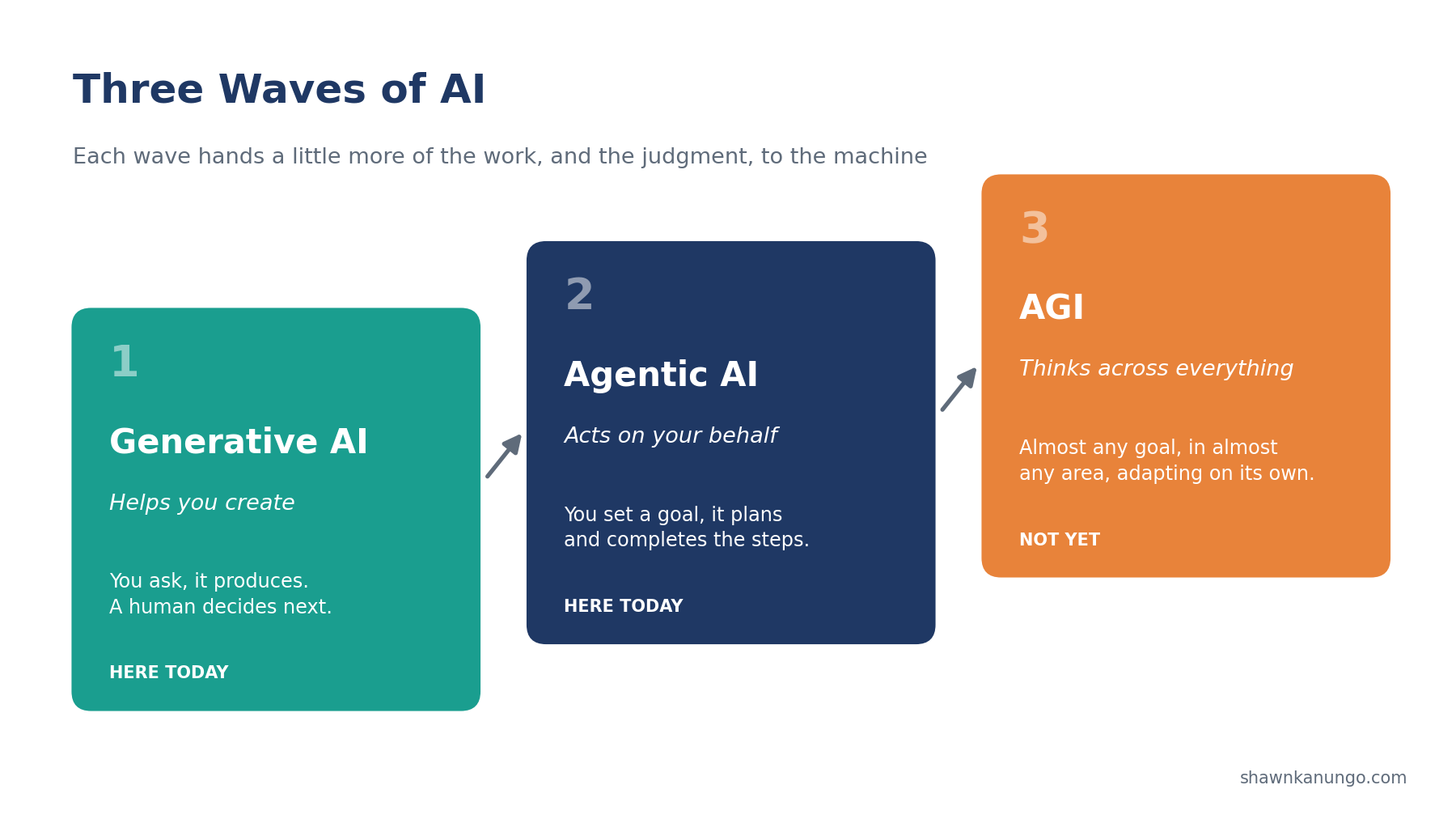
The three waves of AI: generative AI helps you create, agentic AI acts on your behalf, and AGI would think across everything
I have seen the second wave up close. I built an AI agent that now handles customer inquiries in my own business. It did more than save time. It changed how my team works. AGI would push that shift much further, from one workflow to almost any workflow.
I explain where agents are heading in this video: Why AI Agents Are the Future.
Common Myths About AGI vs AI
Myth 1: “Today’s AI is basically AGI.” It isn’t. Impressive output is not the same as general, reliable intelligence. If a system needs human review to catch its mistakes, it is not yet a general replacement for human judgment.
Myth 2: “AGI means the AI is conscious.” No. AGI is about capability, what a system can do. Consciousness and feelings are a separate debate, and most AGI definitions don’t require them.
Myth 3: “AGI and superintelligence are the same thing.” They are different stages. AGI is roughly human-level across tasks. Superintelligence would go far beyond the best humans.
Myth 4: “If AGI is years away, I can ignore AI for now.” This is the most costly myth of all. The organizations building AI skills today are the ones that will be ready for whatever comes next. I tackle the hype question directly in Is AI Overhyped? What Leaders Should Actually Believe.
Why the Difference Matters for Leaders
I spent 12 years at Deloitte helping leaders plan for disruptive innovation. One lesson stuck with me. Confusion about a technology is more dangerous than the technology itself.
Here is why getting AI vs AGI right changes your decisions:
Investment. AI delivers value now, through specific use cases you can measure. AGI is a strategic horizon, not a line item. Fund them differently.
Governance. Today’s AI needs clear rules on accuracy, privacy and accountability. More general systems will need sharper lines on which decisions stay human. I cover this in What Is AI Governance and Why Does It Matter for Executives.
Talent. As AI covers more specialist work, people who connect ideas across fields become more valuable. That is the deep generalist advantage.
Communication. If your leadership team uses these words loosely, your people will hear either panic or complacency. Shared language is step one.
How to Explain AGI vs AI to Your Team in 30 Seconds
If you need a simple script for your next meeting, use this:
“AI is the technology we use today. It’s very good at specific jobs and getting broader every year. AGI is a future version that could learn and handle almost any job the way a person can. It doesn’t exist yet and nobody knows exactly when it will. Our job is to get very good at today’s AI, because that’s how we’ll be ready for whatever comes next.”
Conclusion: Don’t Wait for AGI to Take AI Seriously
The difference between AI and AGI is the difference between a powerful specialist and a general-purpose colleague. One is already reshaping your industry. The other is a horizon that is getting closer, one capability at a time.
Here is my advice. Stop asking “When will AGI arrive?” and start asking “Are we getting better at AI every quarter?” The leaders who build that muscle now, with real use cases, clear governance and curious teams, will not be scrambling when the next wave hits. They will be the ones setting the pace.
The future does not reward the people who predicted it. It rewards the people who prepared for it.
If your leadership team or conference audience needs a clear, practical way to think about AI, agents and AGI, explore my AI keynote or book a conversation. You can also watch my keynote clips to see how I bring these ideas to life on stage.
Frequently Asked Questions About AGI vs AI
What is the main difference between AI and AGI?
The main difference is scope. AI performs specific tasks it was built or trained for. AGI would learn and reason across almost any intellectual task, including new ones, the way a capable person can.
Are today’s AI chatbots the same as AGI?
No. Today’s chatbots and AI assistants are broad and impressive, but they still make confident mistakes, struggle with long open-ended work and need human oversight. Most experts do not consider them AGI.
What is the difference between AGI and ASI?
AGI would match human ability across most tasks. ASI, or artificial superintelligence, would exceed the best humans in nearly every area. AGI is a stage, while ASI is a further, purely theoretical one.
What is narrow AI vs general AI?
Narrow AI is built for a specific job, like fraud detection or image recognition. General AI, or AGI, would handle almost any job and adapt to new situations without being rebuilt.
Does AGI exist yet?
Not by most definitions. Today’s AI is getting broader, but it has not reached reliable, human-level performance across tasks. I break down where things stand in Does AGI Exist Yet?
Is agentic AI the same as AGI?
No. Agentic AI takes action toward goals you set within a defined area, and it exists today. AGI would take on almost any goal in any area. Agentic AI is best seen as a step on the path. Read more in From AI Agents to AGI.
Why should business leaders care about AGI vs AI?
Because the confusion leads to bad decisions. Treating AI as AGI causes panic, and dismissing AGI as fiction causes complacency. Clear language helps leaders invest, govern and train their people at the right pace.