
The short answer: No. As of now, artificial general intelligence does not exist by most serious definitions. Today’s AI is broader and more capable than ever, but it still cannot reliably learn and work across almost any task the way a capable person can. Some tech leaders say AGI has already arrived. Most researchers, and the major technology companies’ own explainers, still describe it as hypothetical.
So why does it feel like everyone is arguing about it?
Because “Does AGI exist?” sounds like a yes-or-no question. It isn’t. The answer depends almost entirely on how you define AGI. And right now, the definitions are moving faster than the technology.
More and more, leaders ask me some version of this question: “Is it here? Did we miss it?” My answer is always the same. You didn’t miss AGI. But you might be missing what today’s AI can already do. In this article, I’ll show you exactly where things stand, why smart people disagree, and how to judge the next “AGI is here” headline for yourself.
What Would Count as AGI?
Before we can answer whether AGI exists, we need to agree on what we are looking for.
Google Cloud defines AGI as the hypothetical intelligence of a machine that can understand or learn any intellectual task a human can. Its explainer, updated in January 2026, states plainly that true AGI does not exist yet.
In practice, most definitions boil down to a system that can:
Learn new skills quickly, from a few examples, without being rebuilt.
Transfer knowledge from one field to another.
Handle the unfamiliar, reasoning through situations it has never seen.
Work on its own over long periods, planning, checking its work and recovering from mistakes.
Perform reliably, not just impressively on a good day.
If you want the basics first, read AGI vs AI: What’s the Difference?
Why Some People Say AGI Is Already Here
You may have seen headlines in 2026 claiming AGI has arrived. Some came from prominent technology executives. It is worth understanding why they say this, because the argument is not crazy.
Their case goes like this:
Today’s AI is no longer narrow. One system can write, code, analyze, translate and reason. That is a big jump from AI that did one job.
AI agents can now complete multi-step work. They can research, use software tools and finish tasks with less hand-holding.
On many tests, AI now matches or beats the average person. If AGI means “as good as a typical human at most thinking tasks,” some argue we are close or already there.
This view often relies on a looser definition, sometimes called “functional AGI”: AI that is useful enough across enough tasks to change how work gets done.
Why Most Experts Say AGI Isn’t Here Yet
The other side has stronger evidence, in my view. Here is what today’s AI still struggles with:
Reliability. AI still makes confident mistakes that a careful person would catch. It can solve a hard problem and then fail an easy one.
Learning on the job. People get better with experience. Most AI systems do not truly learn from their own work after they are deployed.
Long, open-ended work. AI handles tasks that take minutes or hours far better than projects that take weeks and need constant judgment.
Truly new problems. Tests designed to measure abstract reasoning on unfamiliar puzzles still show a clear gap between AI and people.
Real-world impact. Under the more ambitious definition, AI that outperforms humans at most economically valuable work, the labor market would look very different than it does today.
There is also a telling detail. Even the companies racing to build AGI still describe it as hypothetical in their own public explainers. When the builders say “not yet,” that is worth noting.
Where AI Really Stands Today
Here is my honest snapshot of what today’s AI can and cannot do, compared with what AGI would require.
Language and writing
Where AI stands today: Strong, often better than average human writers
What AGI would require: Human-expert level, reliably
Coding and analysis
Where AI stands today: Strong and improving fast
What AGI would require: Able to own complex projects end to end
Multi-step tasks (agents)
Where AI stands today: Works well in defined areas with guardrails
What AGI would require: Works across almost any area with little oversight
Learning new skills
Where AI stands today: Needs training or careful instructions
What AGI would require: Learns from a few examples, on its own
Reliability
Where AI stands today: Inconsistent, needs human review
What AGI would require: Consistent enough to trust like a skilled colleague
Long-term projects
Where AI stands today: Limited
What AGI would require: Plans and adapts over weeks or months
Novel reasoning
Where AI stands today: Improving but uneven
What AGI would require: Handles the truly unfamiliar
So where does that leave us? Researchers at Google DeepMind proposed a useful way to think about it in 2023. Instead of a single finish line, they described levels of AGI, from emerging to competent, expert, virtuoso and superhuman. At the time, they placed the most advanced chatbots at the first level, emerging AGI.
That is roughly how I see it today. We are somewhere past “just a tool” and well short of “a general-purpose colleague you can trust with anything.”
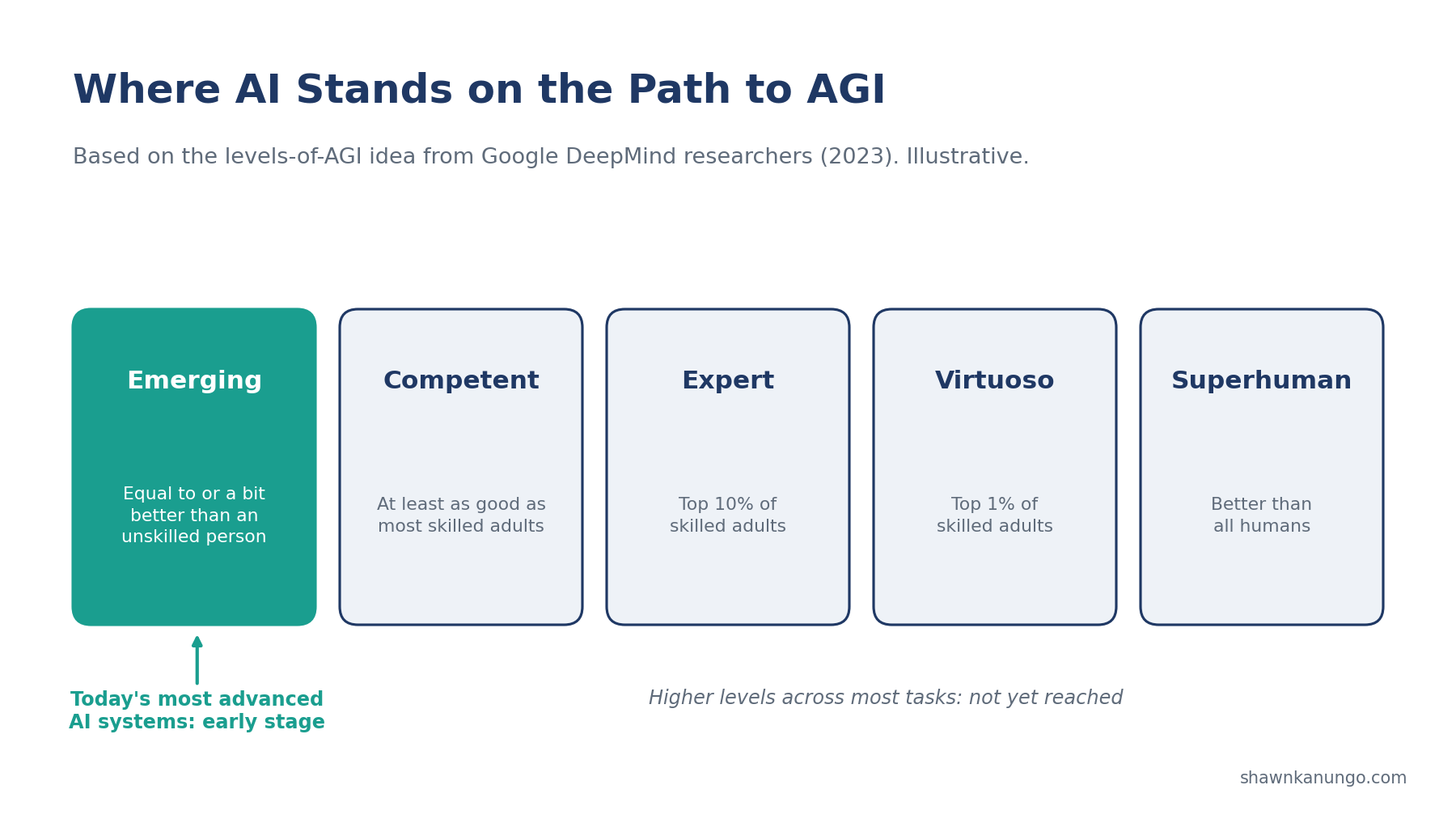
Levels of AGI from emerging to superhuman, with today’s most advanced AI at an early stage
Why the Definition Keeps Moving
Here is something leaders should understand. The goalposts for AGI have moved for decades, and they move in both directions.
Years ago, people said a machine that could hold a natural conversation would count as intelligent. Then machines did it, and the bar moved. The same happened with passing professional exams and writing working code.
At the same time, some people now lower the bar, because declaring AGI has real commercial and reputational value. A bold claim can raise money, attract talent or grab headlines.
This is why I tell leaders not to anchor on the word itself. I say more about separating signal from noise in Is AI Overhyped? What Leaders Should Actually Believe.
How to Judge Any “AGI Has Arrived” Claim
The next AGI headline is coming. Probably soon. Use these five questions to judge it:
Which definition are they using? “As good as an average person at many tasks” and “better than humans at most valuable work” are very different claims.
Who benefits from the claim? If the person announcing AGI is also selling the product, raising money or buying hardware, weigh the claim carefully.
Is it reliable or just impressive? A great demo is not the same as consistent performance in messy, real conditions.
Can it learn and adapt on its own? If it needs to be retrained or heavily guided for each new type of task, it is not general yet.
Is it showing up in real-world results? True AGI would show up in productivity, jobs and business outcomes, not just test scores.
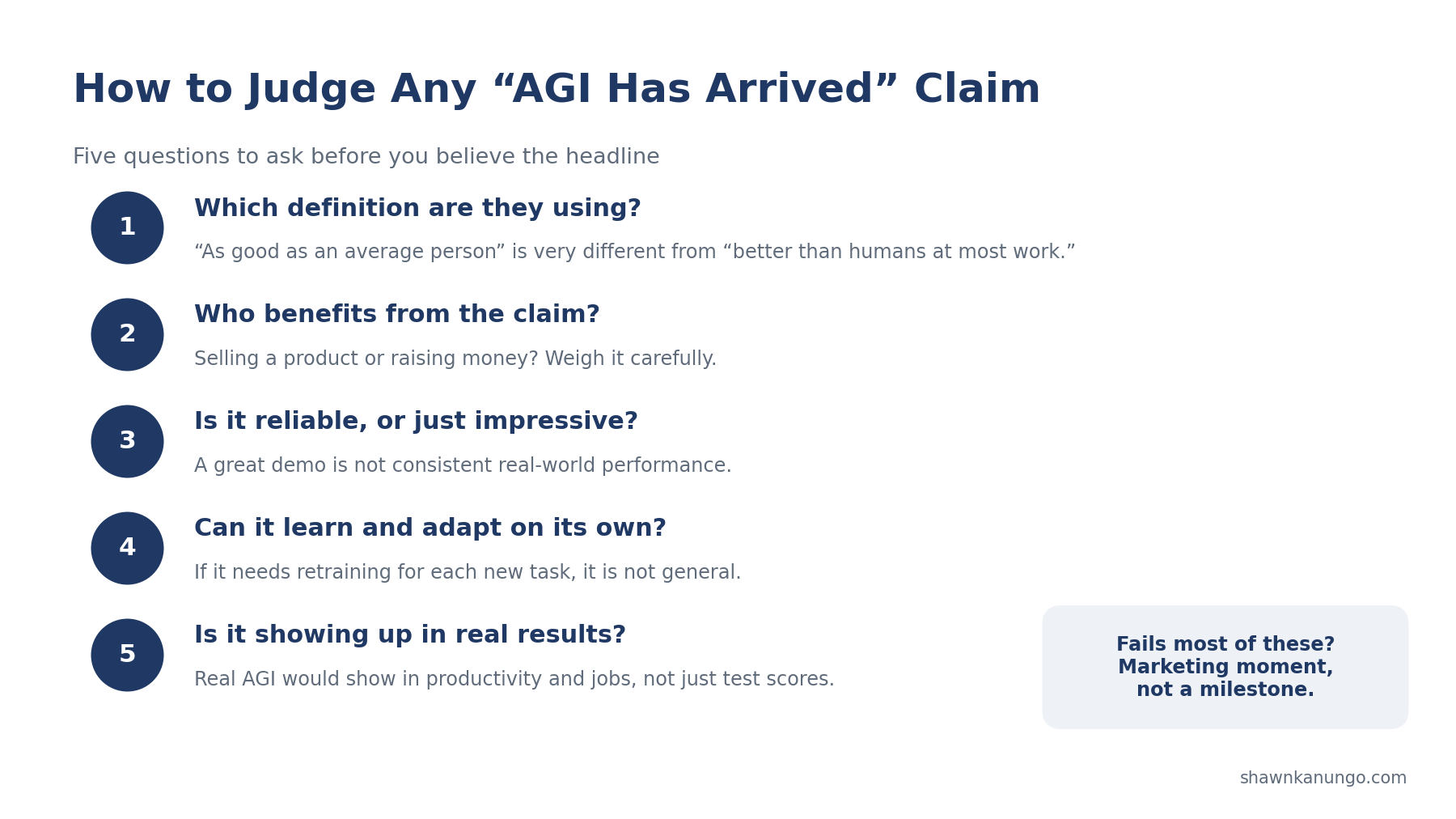
Five questions to judge any claim that AGI has arrived
If a claim fails most of these, it is a marketing moment, not a milestone.
What This Means for Leaders
I spent 12 years at Deloitte helping leaders plan for disruptive innovation. The biggest risk was rarely the technology itself. It was leaders waiting for a clear signal that never came, while the change happened gradually around them.
AGI will likely work the same way. There may never be a single day when everyone agrees it has arrived. Capabilities will keep building, quietly, and your industry will feel it before the headlines settle the debate.
That is why I don’t spend much time on “Is it here yet?” I focus on three things:
Get good at today’s AI. Especially AI agents, which are the training ground for whatever comes next. I built an AI agent that now handles customer inquiries in my own business. That experience taught me more than any forecast.
Set clear rules on which decisions stay human. That is the heart of AI governance, and it belongs with leadership.
Invest in your people. The organizations that win will upskill their teams, not just replace them. Here is how to close the AI skills gap without replacing your workforce.
I share the bigger picture in What AGI Means for Leaders.
Conclusion: You Didn’t Miss AGI, But Don’t Miss What’s Already Here
AGI does not exist yet. Not by most definitions, and not by the standard of a system you could trust to learn and work across almost anything like a capable person.
But here is the twist. Waiting for AGI is the wrong game. The AI we already have is powerful enough to reshape how your organization works, competes and serves customers. The leaders who are learning by doing today will be ready for each new capability as it lands. The ones waiting for a clear announcement will be explaining themselves later.
So the next time someone asks “Is AGI here?”, try a better question: “Are we getting the most out of the AI that’s here now?”
If you want your leadership team or audience to leave with that mindset, explore my AI keynote, watch me on stage, or reach out to book me.
Frequently Asked Questions About Whether AGI Exists
Does AGI exist yet?
No, not by most definitions. Today’s AI is broad and powerful, but it is not yet reliable, self-learning and adaptable across almost any task the way a capable human is. Major technology companies still describe AGI as hypothetical.
Has AGI been achieved?
No widely accepted definition of AGI has been met. Some tech leaders have claimed otherwise, usually using a looser definition. Most researchers say key gaps remain, especially in reliability, learning on the job and handling truly new problems.
How close are we to AGI?
Closer than a few years ago, but no one knows exactly how close. Progress has been fast in language, coding and AI agents. Big gaps remain in reliability and long-term, independent work. Expert estimates range from a few years to several decades.
Is today’s AI considered AGI?
No. Today’s AI is best described as broad but brittle. It covers many tasks, but it still needs human oversight and fails in ways a skilled person would not. Some researchers call it an early or emerging stage on the path to AGI.
Why do some people say AGI is already here?
They often use a looser definition, such as AI that matches an average person on many tasks. Commercial incentives can also play a role, since claiming AGI attracts attention and investment.
How will we know when AGI arrives?
There may not be a single moment. Look for AI that learns new skills on its own, performs reliably without heavy oversight, handles long and unfamiliar work, and shows up clearly in real-world productivity, not just test results.
What should businesses do while AGI doesn’t exist?
Build real capability with today’s AI, especially AI agents. Set clear rules on which decisions stay human, measure results, and invest in your people’s skills. These habits will matter even more if AGI arrives.