
The short answer: Nobody knows. Expert predictions for AGI range from the next few years to several decades away. Leaders of AI companies tend to predict the late 2020s. Large online forecasting communities put even odds around the early 2030s. Broad surveys of AI researchers point closer to the late 2040s. The one thing every group agrees on is that the expected date has moved much closer in recent years.
That’s the honest answer. It’s also not very satisfying.
So let me give you something more useful. In this article, I’ll show you what the different expert groups actually predict, why their answers are so far apart, and why the exact date matters far less than most people think.
Here’s my position up front. As someone who spent 12 years at Deloitte helping leaders plan for disruptive innovation, I’ve learned one thing about forecasts. The leaders who win are not the ones who guess the date right. They’re the ones who are ready for a range of dates.
Why AGI Timelines Are So Hard to Predict
Before we look at the numbers, it helps to understand why they vary so much. There are four big reasons.
1. Nobody agrees on the finish line. If AGI means “as good as an average person at many tasks,” some argue we are close. If it means “better than humans at almost all valuable work,” it’s much further away. Different definitions produce different dates. I explain this in Does AGI Exist Yet?
2. Nobody knows if today’s methods are enough. One camp believes that making AI models bigger, with more data and computing power, will keep producing gains until we reach AGI. The other camp believes we need new breakthroughs that haven’t been invented yet. Breakthroughs are almost impossible to schedule.
3. Incentives shape predictions. People building AI have reasons to sound optimistic. Bold timelines attract investment, talent and attention. Skeptics can have their own reasons to downplay progress. Neither side is neutral.
4. Humans are bad at predicting exponential change. We tend to expect tomorrow to look like today. When progress compounds, early years look slow and later years feel sudden.
What the Experts Actually Predict
Here’s a simple summary of where the main groups land, based on publicly reported surveys and forecasts as of 2026.
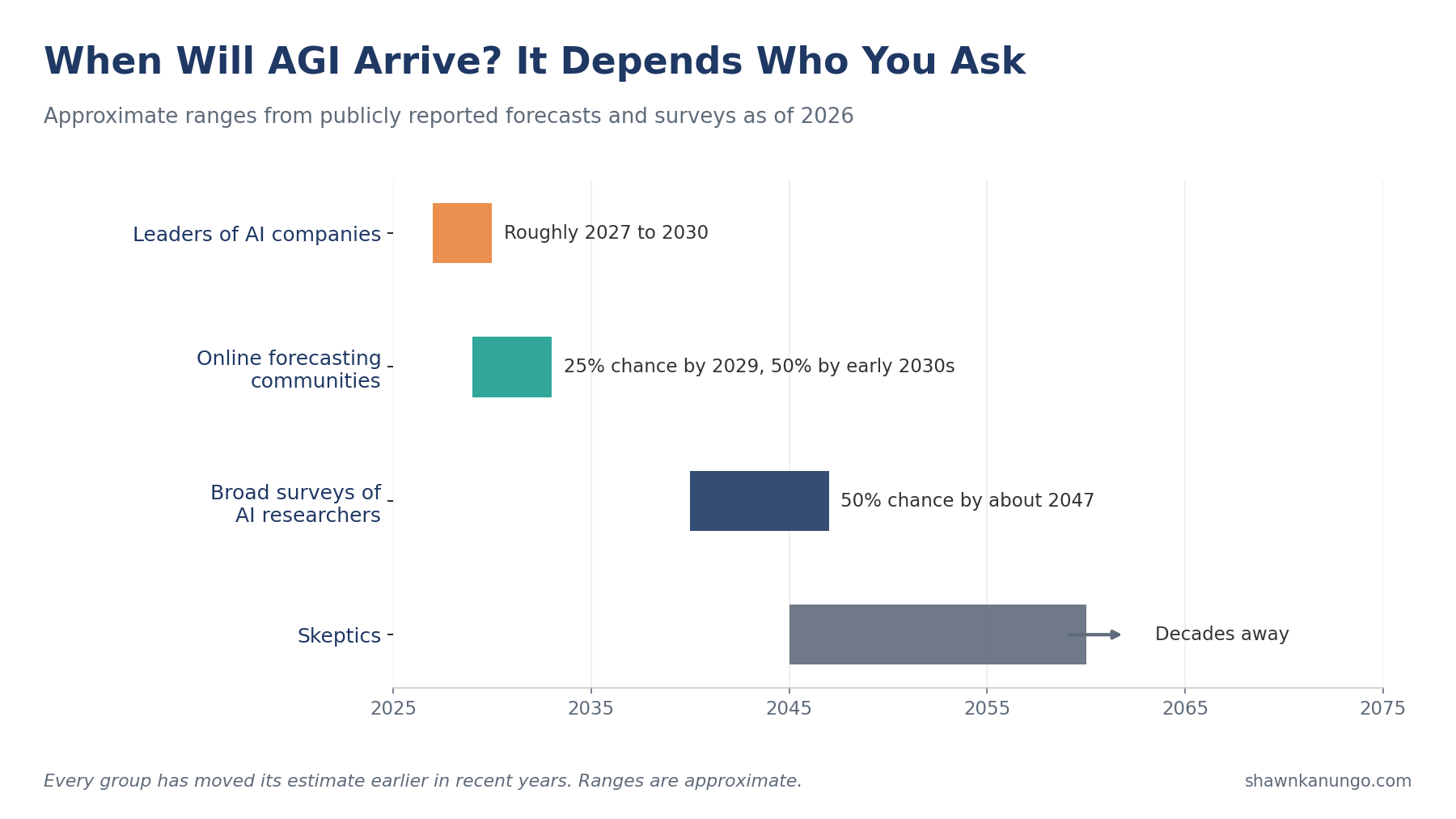
AGI timeline predictions by group: AI company leaders, forecasting communities, AI researcher surveys and skeptics
Leaders of AI companies
Typical AGI estimate: Roughly 2027 to 2030
Why they lean this way: Closest to the latest systems and progress
What to watch out for: Strong commercial incentives to sound optimistic
Online forecasting communities
Typical AGI estimate: About 25% chance by 2029, 50% by the early 2030s
Why they lean this way: Track records and constant updating as news breaks
What to watch out for: Can swing with hype and headlines
Broad surveys of AI researchers
Typical AGI estimate: 50% chance of human-level machine intelligence by around 2047 (large 2023 survey of about 2,800 researchers)
Why they lean this way: Wide range of academic experts, not just builders
What to watch out for: Older data, and many respondents work far from the frontier
Skeptics
Typical AGI estimate: Decades away, or not possible with current methods
Why they lean this way: Focus on reliability, reasoning and learning gaps
What to watch out for: Have repeatedly underestimated recent progress
Two things jump out from this table.
First, the gap is huge. Depending on who you ask, AGI could be a few years away or a few decades away.
Second, every group has moved its estimate earlier. Not long ago, many forecasts placed AGI around the middle of the century or later. Over the last several years, as AI systems improved faster than expected, those estimates have pulled in sharply. That direction of travel tells you more than any single number.
The Case for AGI Arriving Soon
The optimists point to a few things:
Fast, steady progress. AI systems have improved quickly in writing, coding, analysis and reasoning in just a few years.
The rise of AI agents. AI that can plan and carry out multi-step tasks is a big step toward more general capability. I explain why in From AI Agents to AGI.
Massive investment. The world’s largest technology companies are pouring unprecedented money, talent and computing power into the race.
AI helping build AI. As AI gets better at coding and research, it may speed up its own development.
The Case for AGI Taking Much Longer
The skeptics point to different evidence:
Reliability is still a problem. AI still makes confident mistakes that people would catch.
AI doesn’t learn like we do. Most systems don’t truly learn from experience after deployment.
New problems are still hard. Tests built around unfamiliar reasoning puzzles still show a clear gap between AI and people.
Real-world limits. Energy, chips, data and regulation could all slow progress.
History. AI has gone through cycles of big promises followed by long slowdowns, often called “AI winters.”
My view? Both sides are making real points. That’s exactly why I don’t bet on a single date.
Why the Date Matters Less Than You Think
Here’s what I tell leadership teams. Whether AGI arrives in 2029 or 2045, the smart moves for your organization today are almost identical.
Think about it this way. You don’t need to know the exact day of a storm to fix your roof. You need to know a storm is likely, and act before it shows up.
There’s also a bigger point. AGI will probably not arrive on a single day. Researchers at Google DeepMind have proposed thinking about AGI as a series of levels rather than one finish line. That matches what I see in business. Capabilities will keep building, one at a time. Your industry will feel the impact gradually, then suddenly, long before experts agree that “AGI is here.”
I’ve seen this pattern with every major shift. Early on, the new thing looks small or even silly. That’s why disruption always starts as a joke. By the time it stops being funny, the organizations that waited are already behind.
How to Plan When Nobody Knows the Date
Instead of guessing, plan across scenarios. Here’s a simple way to do it:
Plan for a near scenario (3 to 5 years). Ask: if AI could do most of the routine thinking work in our industry by then, what would we need to change? Which roles, products and processes are most exposed?
Plan for a middle scenario (5 to 10 years). Ask: if AI agents handle large parts of our operations, what does our organization look like? What do our people focus on?
Plan for a slow scenario (10+ years). Ask: even if AGI is far away, how much value are we leaving on the table with today’s AI?
Find the moves that win in all three. These are your no-regret actions. In my experience, they almost always include building AI skills, setting clear governance, and getting real results from AI agents today.
Revisit every six months. AI moves fast. Your assumptions should too.
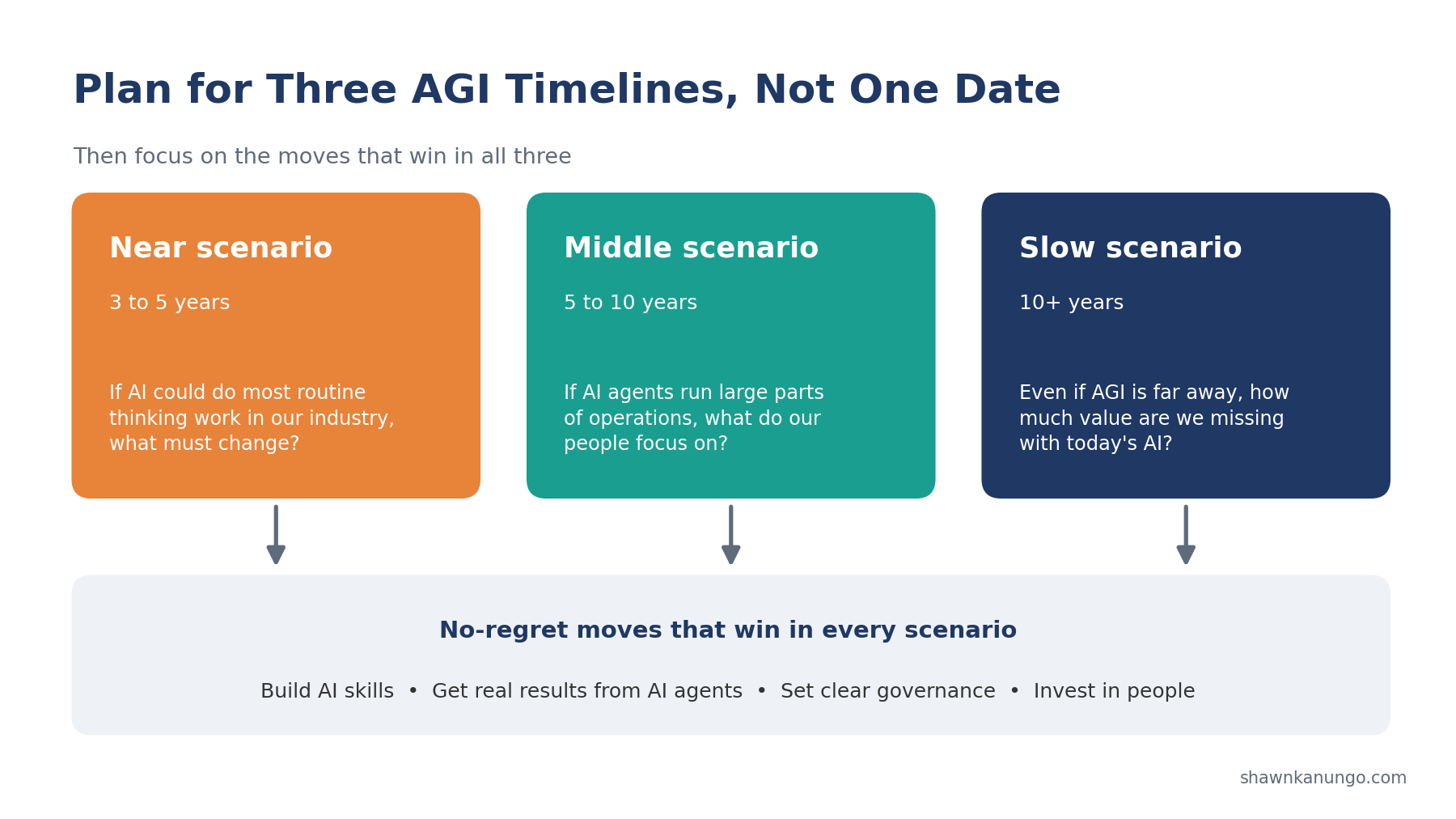
AGI scenario planning: near, middle and slow timelines, plus no-regret moves that win in all three
If you’re a CEO, I go deeper on this in How Should CEOs Respond to AI Disruption. And before you commit a budget, read What Questions Should Executives Ask Before Committing to AI Implementation.
No-Regret Moves to Make Before AGI Arrives
Whatever the timeline, these moves pay off:
Get good at AI agents now. I built an AI agent that handles customer inquiries in my own business. It changed how we work. Agents are the best training ground for what comes next. Measure them properly with this guide to agentic AI ROI.
Decide which decisions stay human. Clear accountability will matter more as AI takes on more judgment. That’s what AI governance is for.
Build deep generalists. People who connect ideas across fields become more valuable as AI covers specialist work. Here’s the deep generalist advantage.
Upskill, don’t just replace. Organizations that bring their people along will adapt faster. See how to close the AI skills gap.
Lead with curiosity, not fear. Fear makes people freeze. Curiosity makes them experiment.
Conclusion: Stop Waiting for the Date. Start Building Readiness.
When will AGI arrive? The honest answer is that no one knows, and anyone who sounds completely certain is selling something.
What we do know is this. The expected timeline keeps getting shorter. The capabilities keep stacking up. And the change will likely feel gradual right up until it doesn’t.
So don’t build your strategy around a prediction. Build it around readiness. The organizations that are learning, experimenting and governing AI well today will be ready whether AGI shows up in five years or twenty-five. The ones waiting for a clear date will find that the date never came, but the disruption did.
If you want your team or audience to leave with a practical, optimistic plan for an uncertain AI future, explore my Innovation Keynote and AI Keynote, or book a conversation.
Frequently Asked Questions About When AGI Will Arrive
When will AGI arrive?
Nobody knows for sure. Leaders of AI companies often predict the late 2020s. Forecasting communities put even odds around the early 2030s. Large surveys of AI researchers point to around the 2040s. Estimates have moved earlier in recent years.
Will we have AGI by 2030?
It is possible but far from certain. Some industry leaders expect AGI before 2030, while many researchers expect it later. Most forecasts give AGI by 2030 a meaningful chance, but well below a sure thing.
What is the expert consensus on the AGI timeline?
There is no real consensus. Estimates range from a few years to several decades. The clearest agreement is on direction: expected timelines have shortened as AI progress has outpaced earlier expectations.
Why do AI experts disagree on when AGI will arrive?
They use different definitions of AGI, disagree on whether current AI methods are enough, face different incentives, and struggle, like everyone, to predict fast-compounding change.
How far away is AGI?
It depends on the definition. Under looser definitions, some argue we are only a few years away. Under stricter definitions, such as AI outperforming humans at most valuable work, many experts expect a decade or more.
Will AGI arrive suddenly or gradually?
Most likely gradually. Capabilities are building step by step, and many researchers now describe AGI as a series of levels. Businesses will probably feel the impact well before experts agree AGI has arrived.
How should businesses prepare if no one knows when AGI will arrive?
Plan for several timelines and focus on moves that win in all of them: building AI skills, adopting AI agents with clear goals, setting strong governance, and investing in people.