
The short answer: Yes, agentic AI is a real step toward AGI, but it is not AGI. AI agents can plan and carry out multi-step tasks toward a goal you set, inside a defined area. AGI would be able to learn and handle almost any goal, in almost any area, on its own. Agents give AI the ability to act. AGI would add the ability to think and adapt across everything.
I’ve watched the AI conversation in boardrooms move in clear stages. First it was “What is this chatbot thing?” Then “How do we use generative AI?” Then “What are AI agents, and should we be worried?” Now the question is “Are agents the road to AGI?”
It’s the right question. Because if agents are the road, then the way your organization uses them today is a preview of how ready you’ll be for what comes next.
In this article, I’ll explain what agentic AI actually is, how it differs from AGI, what’s still missing between the two, and why I believe agents are the best training ground leaders have.
What Is Agentic AI?
Agentic AI is AI that takes action toward a goal, not just answers questions.
With generative AI, you ask and it produces. A human decides what happens next. With agentic AI, you give it an outcome, and it figures out the steps and carries them out.
Most AI agents work in a simple loop:
Understand the goal. “Resolve this customer’s billing question.”
Plan the steps. Look up the account, check recent charges, find the policy.
Take action. Use tools, software and data to do each step.
Check the result. Did it work? If not, try a different approach.
Finish or hand off. Complete the task, or escalate to a person when needed.
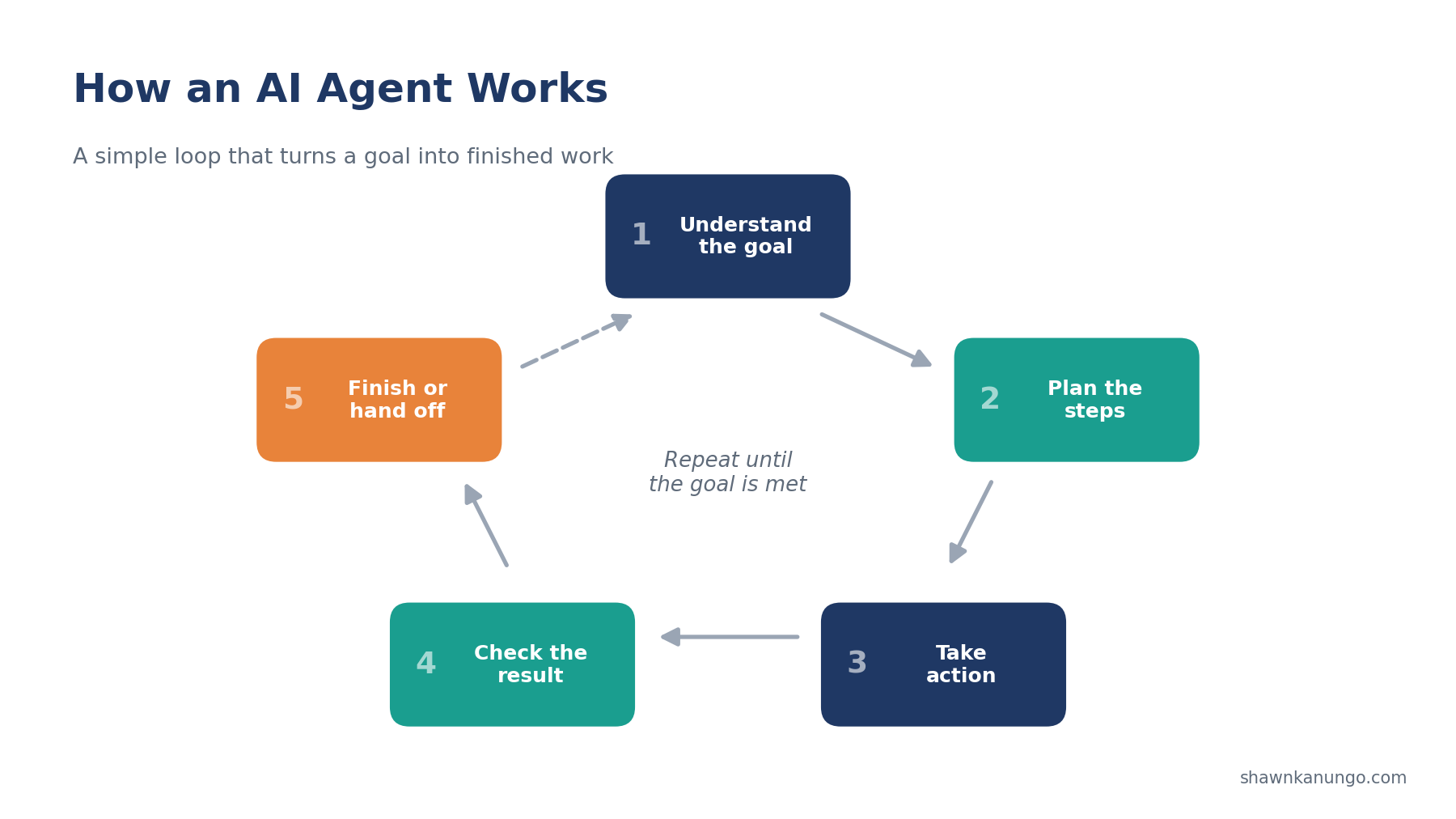
How an AI agent works: understand the goal, plan the steps, take action, check the result, then finish or hand off
That loop is what makes agents feel so different. They don’t just talk. They do.
I explain this in plain language in Agentic AI Explained for Business Leaders.
What Is AGI?
AGI, or artificial general intelligence, is a future form of AI that could learn and reason across almost any intellectual task, the way a capable person can. Google Cloud’s explainer describes it as hypothetical and notes that true AGI does not exist yet.
If you’re new to the topic, start with AGI vs AI: What’s the Difference?
Agentic AI vs AGI: The Key Differences
Agentic AI
What it does: Plans and completes multi-step tasks toward a set goal
Scope: A defined area or workflow
Who sets the goal: Usually a person or organization
Learning: Mostly follows its setup and instructions
Handling the unexpected: Often needs a human when things go off-script
Exists today? Yes, in growing use
Business role: A digital teammate for specific workflows
AGI
What it does: Learns and handles almost any task or goal
Scope: Almost any area
Who sets the goal: Could set and adjust its own sub-goals across areas
Learning: Would learn new skills on its own, from little data
Handling the unexpected: Would adapt like a capable person
Exists today? No, not by most definitions
Business role: A general-purpose colleague across the business
Two Dials: Autonomy and Generality
Here’s the simplest way I’ve found to explain the relationship. Picture two dials.
Dial one is autonomy. How much can the AI do on its own, without a human approving every step?
Dial two is generality. How many different kinds of tasks can it handle, including new ones?
Agentic AI has turned the autonomy dial up sharply. Agents can act, use tools and complete work with less hand-holding.
AGI would turn the generality dial all the way up. It could handle almost anything.
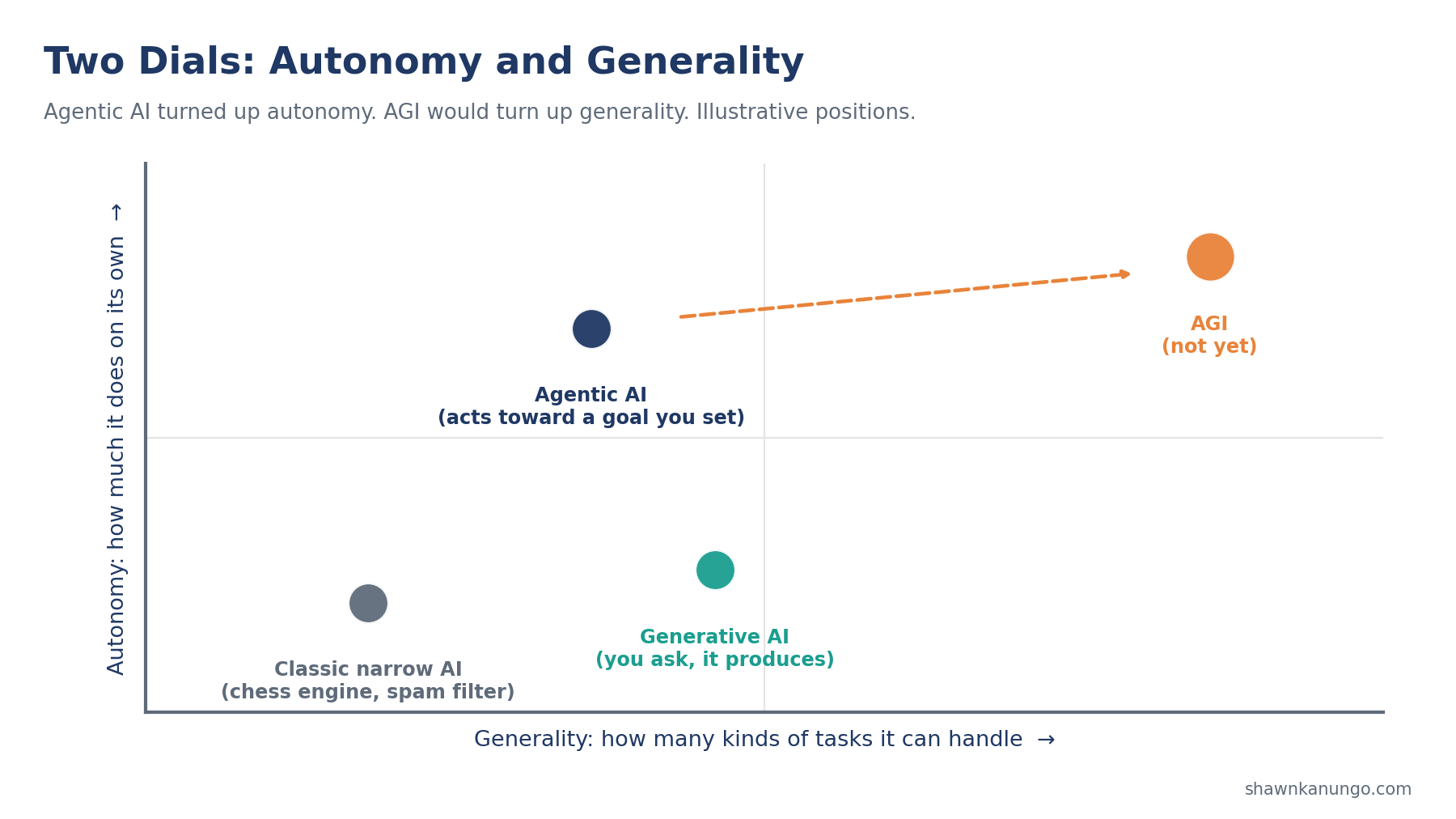
Agentic AI vs AGI on two dials: autonomy and generality
Researchers at Google DeepMind made a similar point in their 2023 framework on levels of AGI. They treated capability and autonomy as separate questions, and noted that reaching AGI doesn’t automatically mean a system acts on its own. That’s an important insight for leaders. How smart an AI is and how much freedom you give it are two different decisions. The second one is yours.
Why Agentic AI Is a Real Step Toward AGI
Agents bring together several abilities that any AGI would need:
Planning. Breaking a big goal into smaller steps.
Tool use. Working with software, data and systems, like a person at a computer.
Memory. Keeping track of context across a task.
Self-correction. Noticing a mistake and trying another way.
Working with others. Coordinating with other agents and with people.
That’s why many researchers describe agents as building blocks of more general intelligence. Each improvement in how agents plan, remember and recover brings AI closer to the flexible, independent work that AGI would require.
I go deeper on where agents are heading in this video: Why AI Agents Are the Future.
What’s Still Missing Between Agents and AGI
Agents are a step, not the destination. Here’s what still separates them from AGI:
Reliability over long tasks. Agents do well on tasks that take minutes or hours. Projects that run for weeks, with changing goals, are still hard.
Real learning on the job. People get better with experience. Most agents don’t truly learn from their own work after deployment.
Handling the truly new. Agents struggle when a situation falls far outside what they were set up for.
Judgment and common sense. Knowing when something feels wrong, even if the rules say it’s fine.
Breadth. A great sales agent is not a great finance agent. AGI would be both, and more.
This is why I’d be careful with anyone who says agents “are basically AGI.” They’re powerful. They’re not general yet. I explain where things stand in Does AGI Exist Yet?
What I Learned Building My Own AI Agent
I don’t just talk about agents. I built one. An AI agent now handles customer inquiries in my own business.
It did more than save time. It changed how we work. It forced us to answer questions we’d never asked clearly before. What exactly should the agent handle? When should it hand off to a person? Who is accountable when it gets something goes wrong? How do we measure whether it’s actually helping?
Those questions are the real lesson. They are the same questions every organization will face, at a much larger scale, as AI becomes more general. Agents let you practice them now, while the stakes are still manageable.
Why Agents Are a Leader’s Best AGI Training Ground
You can’t prepare for AGI by reading forecasts. You prepare by building the organizational muscles AGI will demand. Agents build those muscles today.
Here’s what working with agents teaches you:
Delegation to machines. Deciding which work AI should own, assist with, or stay out of.
Accountability. Setting clear lines on who is responsible when software acts. That’s the heart of AI governance.
Measurement. Proving real value, not just activity. Here’s how to measure the ROI of AI agents.
Redesigning roles. Shifting people toward judgment, relationships and creativity as agents take on routine work.
Trust. Earning trust from customers and employees as more interactions are handled by AI. Agents are already changing conversational marketing and how people search and buy.
The organizations that master these skills with agents won’t need to start from scratch when AI becomes more general. They’ll just turn the dials.
How to Start With AI Agents (Without Getting Burned)
If you’re a leader looking to move from talk to action, here’s a simple path:
Pick one painful, repetitive workflow. Customer inquiries, scheduling, reporting or internal requests are good starting points.
Define success before you build. Time saved, response speed, customer satisfaction or cost per task.
Set the autonomy level on purpose. Start with the agent suggesting and a person approving. Increase freedom as trust grows.
Design the handoff. Make it easy for the agent to pass hard cases to a human.
Review, measure and expand. Learn from the first agent before launching ten more.
And before you invest, ask the right questions. Here are the questions executives should ask before committing to AI implementation.
Conclusion: The Road to AGI Runs Through Your Agents
Is agentic AI a step closer to AGI? Yes. Agents have given AI the ability to act, plan and finish real work. That’s a big move along the path. But they are still specialists working inside boundaries we set. AGI would be something far more general.
Here’s the part that matters for leaders. You don’t need to wait for AGI to start preparing for it. Every agent you deploy is a rehearsal. It teaches your organization how to delegate to machines, hold them accountable, measure their value and redesign work around them.
The leaders who rehearse now will be ready to lead when the real performance begins. The ones who wait will be learning on opening night.
If your organization or audience is ready to get practical about AI agents and what comes next, explore my Agentic AI keynote, watch me on stage, or book a conversation.
Frequently Asked Questions About Agentic AI and AGI
What is the difference between agentic AI and AGI?
Agentic AI plans and carries out multi-step tasks toward a goal you set, inside a defined area. AGI would learn and handle almost any task or goal across any area. Agentic AI exists today. AGI does not.
Are AI agents a step toward AGI?
Yes. Agents combine planning, tool use, memory and self-correction, which are abilities AGI would need. But agents still lack broad reliability, real on-the-job learning and the ability to handle truly new situations.
Is agentic AI the same as AGI?
No. Agentic AI increases how much AI can do on its own. AGI would increase how many different things AI can do, almost without limit. They are related but separate ideas.
What are AI agents in simple terms?
AI agents are software that can take a goal, plan the steps, use tools to complete them, check the results and either finish the task or hand it to a person.
What are examples of AI agents in business?
Common examples include agents that answer customer inquiries, schedule meetings, process routine requests, prepare reports, research leads and handle simple IT or HR tickets.
Will AI agents lead to AGI?
Many researchers see agents as building blocks of more general intelligence, but agents alone may not be enough. Breakthroughs in learning, reliability and reasoning are likely still needed. No one knows exactly when or how AGI will arrive.
How should leaders prepare for the shift from AI agents to AGI?
Start deploying agents in focused workflows, set clear rules on autonomy and accountability, measure real value, and redesign roles around human judgment. These habits will matter even more as AI becomes more general.