
Thank you for being part of my session at TD Synnex’s Endpoint Summit
The After Show
In the latest episode of The After Show, hosts dive into Shawn Kanungo's thought-provoking session at TD Synnex’s Endpoint Summit
Leaders,
Are you ready?
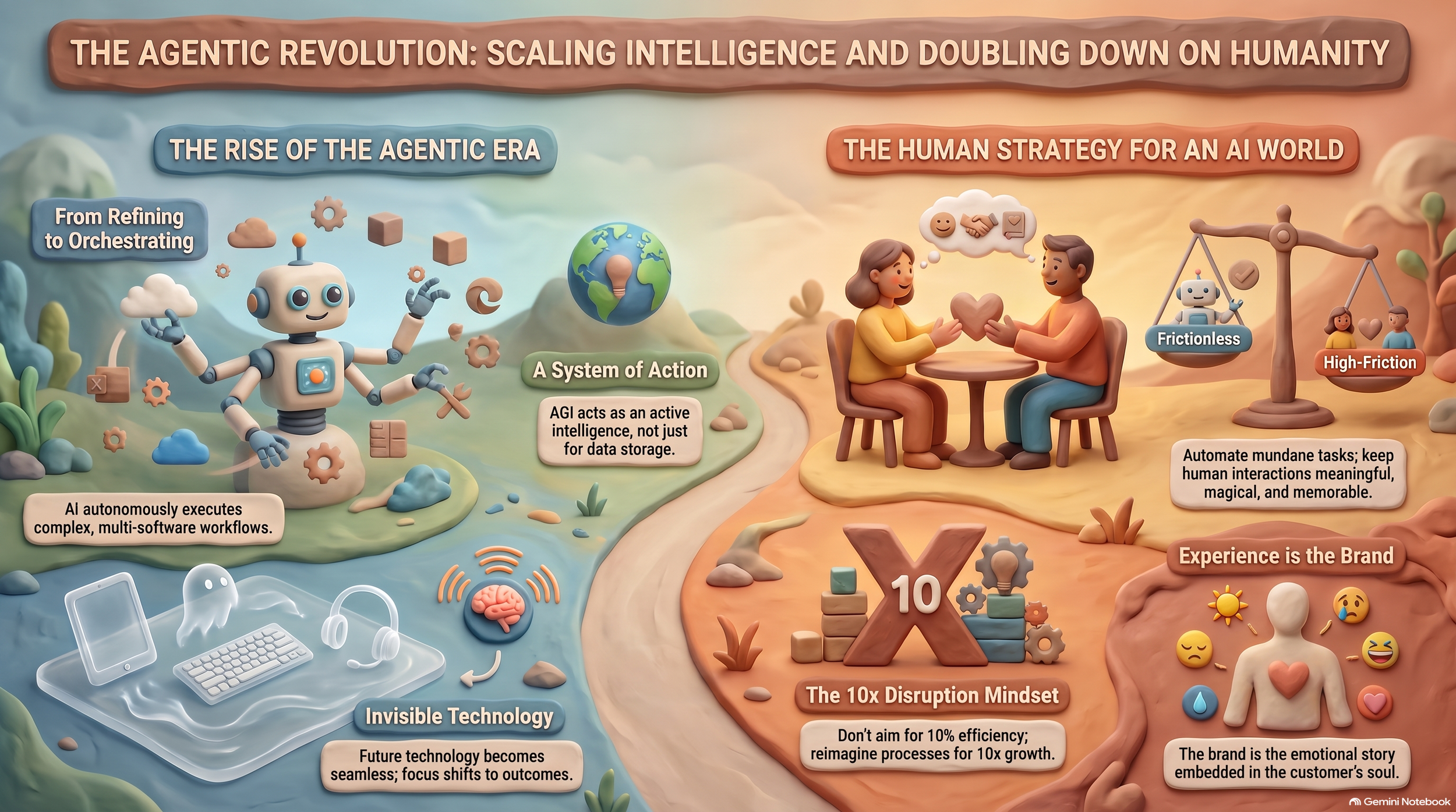
Artificial intelligence is fundamentally transforming modern industries by shifting the focus from simple workplace efficiency to complete organizational reinvention. Rather than merely layering new technology onto existing workflows, professionals must be willing to challenge traditional practices and embrace radical imagination. This technological revolution is not about replacing human labor, but rather empowering individuals to rebuild their processes from scratch by asking unconventional questions. Ultimately, success in this rapidly evolving landscape requires individuals to let go of outdated methods, adopt a mindset of continuous adaptation, and focus on delivering exceptional human-centric experiences.
KEY TAKEAWAYS (an AI-Output with Hallucinations)
MY #1 USED AI TOOL
Wispr Flow - I don’t type anymore, I just voice everything
My favorite AI AGENTS
Dots & GPT-6 Astra by OpenAI - AGI is here
Claude’s Opus 5.5 by Anthropic - The best model right now
Grok Bot by SpaceX AI - A downloadable AI team
Hermes - My personal AI Harness
Perplexity Computer - An AI agent orchestrator that has access to 19 different models
Muse by Meta - great personal AI agent - highly recommend for non-technical users.
Text-to-App
Lovable - Build any app with agentic reasoning (best at front-end)
v0 by Vercel - Text-to-Webpage (really good front-end)
Replit - Idea-to-App (best for full app)
Text-to-IMAGE/VIDEO
Claude Design for motion graphics - claude.ai/design
HeyGen - AI Video Avatar
ChatGPT Image 2.0 - Best Image Generator
Google’s Nano Banana Pro 2- 2nd Best Image Generator
Research & other
NotebookLM - Research and the two AI podcast hosts that you see above :)
Google AI Studio - Real-time AI co-presence
Clay - AI Outbound Sales | Generating lists of emails and sending cold outreach
Executive Briefing: Reimagining Innovation, Work, and Strategy in the Era of Artificial Intelligence
Executive Summary
The rapid acceleration of Artificial Intelligence (AI) represents a fundamental paradigm shift in technology, organizational design, and human labor. Based on insights from industry strategy expertise presented at TD SYNNEX, this briefing document synthesizes key concepts regarding how AI is evolving from a mere tool for productivity into an autonomous System of Action.
The core insights presented in the source context include:
Evolution to Systems of Action: AI has moved beyond simple drafting and text generation toward full execution, computer utilization, and autonomous task completion. Software engineering is transitioning into "decision engineering," where the primary constraint on execution is human imagination.
The Hybrid Compute Future: While background AI agents operating 24/7 offer significant capabilities, their continuous execution risks unsustainable compute costs. Consequently, the operational model of the future is hybrid—anchored by local AI PCs on-device, bursting to cloud models only for extraordinary tasks.
Redefining Human Work (Awakening Human Ingenuity): AI will not simply replace jobs; it will automate tasks humans were never capable of performing at scale. Technology must be designed around human gifts and strengths, moving away from rigid software systems (CRMs, ERPs) that previously forced human labor into repetitive, transactional structures.
The Strategic Dichotomy (Fast-Seamless vs. Deeply Human): As AI elevates baseline customer expectations across all sectors, organizations face a stark choice. Market leaders will either offer ultra-efficient, friction-free transactional experiences or deeply human, high-touch, magical experiences. Middle-ground organizations risk obsolescence.
Overcoming the Courage Deficit: Organizations currently face a courage problem rather than a technology problem. Achieving exponential growth requires moving past incremental cost-cutting (e.g., guaranteed $1M savings) to pursue high-value revenue innovation (e.g., $100M transformational opportunities). Leaders must reframe questions, adopt zero-based process design, and unlearn legacy playbooks.
1. The Evolution of AI: From Systems of Record to Systems of Action
Capability Trajectory (2022–2026)
The adoption and capability of AI have progressed rapidly across distinct phases:
2022–2024 (Early Adoption & Basic Prompting): Usage was primarily categorized into three operational buckets:
Basic communication drafting (e.g., writing emails).
Asset refinement (e.g., polishing cover letters and resumes).
Experimental testing within open API playgrounds.
2025–2026 (Autonomous Task Execution): AI systems have transitioned into software that independently completes end-to-end tasks, interacting directly with user interfaces and operating systems.
[System of Record]             [System of Intelligence]            [System of Action]
Paper / Database Records  -->  Data Aggregation & Analysis  -->  Autonomous 24/7 Task Execution
(Legacy ERPs / CRMs)           (Software Analytics)              (AI Agents & Computer Use)
Decision Engineering vs. Traditional Software Development
Traditional software engineering required building application logic, security layers, and interfaces manually. Today, AI capabilities allow complete, functional applications to be generated rapidly via structured prompts.
Case Study (Custom Enterprise Platform): Using advanced frontier models (e.g., Anthropic's Claude), complete custom platforms—such as an internal employee onboarding portal modeled after consumer streaming interfaces—can be prototyped, debugged, and packed with automated security overlaps instantly. Processes that historically required millions of dollars and dedicated development teams can now be executed seamlessly.
Shift to Decision Engineering: Software engineers are shifting from manual coding toward "decision engineering"—guiding AI agents, evaluating outputs, and determining architectural goals.
The Rise of "Computer Use" and Direct UI Interaction
The shift toward AGI (Artificial General Intelligence) is driven by AI's ability to perform computer use—operating native software applications on a laptop or desktop interface better than a human professional.
Cross-Application Execution: AI can open complex, unfamiliar professional software (e.g., Blender, Unreal Engine) and execute sophisticated commands (such as modeling a male mannequin exploding into thousands of physics-rendered pieces wearing specific attire like a cowboy hat) purely via targeted goals.
Invisible Software: The UI drop-down menus and buttons of traditional software are becoming obsolete. Users can simply voice an idea or state a goal, while autonomous agents execute the necessary actions across underlying applications in the background.
2. Architecture, TCO, and the Hybrid Compute Paradigm
Background AI Agents and Continuous Context
Organizations are deploying persistent, context-aware AI agents that run 24/7 in the background across documents, communications, and enterprise workflows.
Agent / Model
Enterprise Context / Originator
Key Operational Function
Muse
Meta
Contextual background operational support
Dot
Public / Consumer
Personal background assistant
Grokbot
SpaceX / xAI
Background system processing
Operator / Swarm
OpenAI
Task-oriented workflow execution
Zoom AI Agents
Zoom
Organizational meeting and workflow integration
These agents actively monitor workflows to spot discrepancies, such as flagging improper flight bookings or financial errors, saving organizations thousands of dollars and days of manual review.
Total Cost of Ownership (TCO) & Compute Risks
Despite their capabilities, 24/7 autonomous agents introduce substantial financial risks for executive leadership, particularly Chief Financial Officers (CFOs):
The Compute Cost Spike: Because agents run continuously (often operating at 40%+ background background capacity), token usage and compute overhead compound exponentially.
Model Instability & Compute Regret: Industry observations (including public commentary from figures like Elon Musk) note that running massive frontier models continuously produces unsustainable levels of "high compute regret" due to excessive resource consumption.
The Hybrid Model Solution
To balance advanced AI execution with cost management, the future of enterprise technology architecture must be hybrid:
                  +-----------------------------------+
                  |        Cloud AI Models            |
                  |  (High-Compute / Complex Tasks)   |
                  +-----------------------------------+
                                    ^
                                    | (Burst Compute)
                                    v
                  +-----------------------------------+
                  |          Local AI PCs             |
                  |  (On-Device / Daily Execution)    |
                  +-----------------------------------+
Local Compute (On-Device AI PCs): The vast majority of daily organizational workflows occur locally on AI-powered PCs, leveraging on-device processing to reduce latency and eliminate ongoing cloud API costs.
Cloud Compute (Frontier Models): High-powered cloud models are reserved strictly for extraordinary, compute-intensive tasks, optimizing the total cost of ownership while maintaining performance.
3. Redefining Work, Employment, and Human Ingenuity
AI’s Impact on Labor and Job Roles
A primary concern surrounding AI is whether it will eliminate human employment. The source material offers a nuanced perspective:
Automating the Impossible: AI will replace certain traditional job functions, but its primary function is executing work that humans could never manually perform. Humans cannot conduct continuous, 24/7 audits across millions of global financial transactions or scan 80,000 candidates across 911 job roles simultaneously.
The Shift from Knowledge to Execution: Knowledge is no longer an exclusive source of power, as frontier AI models democratize information access. Execution power is similarly becoming automated through computer-use agents. Consequently, value relies on asking the right strategic questions and determining direction.
"Safe" Work Roles: A Microsoft study identified physical, hands-on occupations—such as landscapers and dredge operators—as among the safest from immediate AI automation.
Awakening Human Ingenuity (AHI)
Historically, organizations structured human work around the limitations of their software systems (e.g., creating rigid 9-to-5 roles built around manual data entry into CRMs and ERPs). AI enables a shift toward Awakening Human Ingenuity (AHI)—realigning work around human strengths, creativity, and interpersonal connection.
Legacy Model: Work Designed Around Technology
[System / Software] --> Dictates Structure --> [Human Performs Manual Data Entry]

Future Model: Technology Designed Around Human Strengths
[Human Vision / Core Gifts] <-- Supported By <-- [AI System Handles System Execution]
Role Personalization: Employees can focus on their primary strengths while AI handles secondary administrative tasks:
Sales Professionals: Focus on relationship building while AI manages CRM data logging.
Engineers: Focus on creative architecture while AI generates detailed code implementations.
The "Scary Good" Professional
The most valuable and indispensable assets within any organization are not defined solely by technical domain mastery or AI usage alone. Instead, they are "scary good" professionals—individuals who possess deep mastery of their primary craft and aggressively leverage AI to amplify their execution power.
       Craft Mastery ONLY               AI Fluency ONLY            "Scary Good" Professional
(High Expertise, Low Scale)      (High Scale, Low Depth)     (Deep Craft + AI Amplification)
   --> Moderate Value               --> Moderate Value              --> Maximum Value &
                                                                        Indispensability
4. The Competitive Edge: Fast-Seamless vs. Deeply Human
Elevated Baseline Customer Expectations
Technological innovation permanently raises baseline customer expectations. Once consumers experience instant delivery, one-click services, or automated generative media, their standard for all service interactions shifts upward.
Example: Modern consumers and younger generations expect real-time creation and instant resolution; delay or friction is viewed as an unacceptable system failure.
The Corporate Landscape Dichotomy
As baseline expectations rise, middle-tier organizations risk falling into the "Platypus Zone"—businesses that are neither fast enough to be transactionally efficient nor personal enough to build deep human loyalty. Success requires committing fully to one of two extreme models:
                                 [THE PLATYPUS ZONE]
                             (Mediocre, Undifferentiated)
                                     - AVOID -
                                         |
               +-------------------------+-------------------------+
               v                                                   v
  [MODEL 1: FAST & SEAMLESS]                             [MODEL 2: DEEPLY HUMAN]
  - Fully Transactional                                  - High-Touch & Magical
  - Zero Friction                                        - Extreme Customer Care
  - Autonomous Execution                                 - Relational & Craft-Focused
  (e.g., Uber, McDonald's App)                           (e.g., Luxury Resorts, High-Care)
Model 1: Fast, Seamless, and Transactional
Operational focus: Complete removal of friction, automated self-service, instant delivery.
Examples: Uber, streamlined mobile ordering applications.
Model 2: Deeply Human, Magical, and Care-Centric
Operational focus: Uncompromising customer obsession, deep empathy, memorable real-world human interactions.
Key Metric: High emotional resonance and trust that technology cannot replicate.
Human Empathy as a Strategic Moat
While AI can optimize operations, human care and emotional connection remain non-replicable.
Resort Wake-Up Call Incident: A practical example illustrates this distinction: an automated system or basic prompt can deliver a scheduled phone call. However, a hospitality team member who notices a guest missed a wake-up call, personally visits the room with tea and cookies, checks on their well-being, and takes personal pride in service delivers a memorable experience.
The Loyalty Equation: Consumers build ultimate trust in two things: highly reliable, flawless technology, or genuine human care. Strategic advantage belongs to organizations that cultivate extreme human obsession alongside AI implementation.
5. Strategic Innovation Mindset: Questions, Courage, and Zero-Based Thinking
The Organizational Courage Deficit
Most enterprises do not suffer from a technology deficit; they suffer from a courage deficit. When presented with strategic opportunities, leadership frequently prioritizes minor cost-cutting over growth:
                         STRATEGIC CHOICE MATRIX

      Option A: The "Bread"                  Option B: The "Lottery Ticket"
   ($1M Guaranteed Cost Savings)          ($100M New Revenue Opportunity)
   -----------------------------          ---------------------------------
   - Low Risk                             - High Upside
   - Incremental Optimization              - Requires Structural Risk
   - Corporate Safe Choice                - 5% Risk of Failure / Uncertainty

   ** Majority of Executives Choose Option A Due to Fear of Uncertainty **
To drive true innovation, leadership must move away from defensive cost-cutting and build the risk tolerance required to pursue high-value growth initiatives.
Reframing the Question: The Kobayashi & Chestnut Framework
Disproportionate business results stem from fundamental changes in the questions leadership asks. This dynamic is illustrated by historical competitive eating disruptions:
[Traditional Question]              [Kobayashi Reframing]             [Chestnut Reframing]
"How do I eat more food?"   -->     "How do I make eating    -->     "How do I optimize this
                                    physically easier?"              as an elite athletic
(Yields incremental progress)       (Breaks buns, dips in water;     career?"
                                    doubles previous record)         (Yields 18-year dominance)
The Ridiculous Question Rule: To break out of incremental thinking, leaders must ask absurd or extreme questions. For example, if an enterprise plan is scheduled to take five years, ask: "Why can't this be completed in six months?"
Asking absurd questions forces teams to stop optimizing legacy, friction-heavy processes and forces them to re-architect systems entirely.
Starting from Zero (Zero-Based Process Reimagination)
Bolting AI onto an existing legacy process yields minor efficiencies. True disruption requires Starting from Zero—rebuilding operational processes from scratch under the assumption that modern AI capability already exists.
Legacy Marketing Process (Incremental):
[Strategy] --> [Pre-Production] --> [Production] --> [Post-Production] --> [Launch] (18 Months)

Zero-Based AI Marketing Process (Reimagined):
[Day 1 Prompt & Asset Generation Sprint] --> [Immediate Visual Alignment] --> [Execution] (1 Day)
Unlearning Success and Overcoming Technological Fear
Throughout history, major innovations have sparked societal panic and skepticism before becoming ubiquitous standards:
[1800s: Bicycles]           [1876: Telephones]          [1890s: Player Pianos]        [1960s: Television]
Feared "Bicycle Face"       Feared Loss of              Feared Destruction of         Feared it Would Make
& Social Ruin               Personal Connection         Live Concert Halls            Societies "Dumb"
Disruption Starts as a Joke: Major innovations—from 1950s credit cards replacing cash to modern ride-sharing applications—were initially dismissed or treated as jokes by industry incumbents.
Unlearning Identity: The primary barrier to AI adoption for seasoned professionals (with 10, 20, 30, or 40 years of experience) is identity. Leaders must be willing to let go of the specific methods that made them successful in the past to remain relevant in the future.
6. Comprehensive Summary Matrix
Theme / Domain
Core Principle
Operational Example / Evidence
Strategic Takeaway
System of Action
AI is evolving from simple text generation to autonomous task execution across desktop UIs.
Generating full-production web platforms via Claude; automated security overlap generation.
Transition developer focus from manual coding to "Decision Engineering."
Hybrid Compute Architecture
24/7 background agents carry high TCO; hybrid execution balances cost and performance.
Agent compute costs scaling unsustainably; Musk commentary on background agent compute regret.
Run routine workflows locally on AI PCs; reserve cloud frontier models for complex tasks.
Awakening Human Ingenuity (AHI)
Technology should be designed around human gifts, freeing labor from repetitive tasks.
Eliminating manual copy-paste 9-to-5 workflows; Microsoft study highlighting landscaper/dredge operator roles.
Restructure jobs to focus human effort on connection, strategy, and creative vision.
The "Scary Good" Professional
Deep domain mastery combined with aggressive AI adoption creates maximum organizational value.
Professionals mastering their core craft while utilizing autonomous tools for execution.
Encourage and reward craft experts who integrate AI tools into daily workflows.
Service Dichotomy
AI raises baseline consumer expectations, forcing a choice between total automation or deep care.
Instant visual generation expectations; luxury resort wake-up calls delivered with personalized care.
Avoid the middle "Platypus Zone." Commit to hyper-seamless automation or high-touch human care.
Courage in Innovation
Real transformation requires pursuing growth over guaranteed cost reduction.
Choice between $1M cost savings ("bread") vs. $100M revenue growth ("lottery ticket").
Overcome risk aversion; evaluate high-upside transformative initiatives.
Zero-Based Reimagination
Rebuild workflows from scratch rather than bolting AI onto legacy processes.
Marketing asset timelines reduced from 18 months to 1-day generative prompt sprints.
Ask "ridiculous questions" (e.g., 5 years to 6 months) to force structural rethinking.
Unlearning Legacy Success
Historical fear accompanies innovation; long-term success requires unlearning past methods.
Skepticism surrounding credit cards, bicycles, and TVs; professionals with 20+ years of experience.
Leaders must unlearn legacy practices and cultivate continuous adaptiveness.
7. Actionable Conclusion: Primary Questions for Leadership
To successfully navigate the AI transformation, organizational leaders must challenge their existing frameworks by evaluating two core questions:
The Secondary Question: "Why Not?" Challenge legacy assumptions, evaluate technological potential, and eliminate unnecessary process friction.
The Primary Question: "Why NOT?" Actively disrupt your own business model, challenge past success factors, and boldly reframe organizational ambition to build the future of your industry.
If you scrolled this far.
Here’s more!