
Thank you for attending my session at SWITCH
The After Show
In the latest episode of The After Show, hosts dive into Shawn Kanungo's thought-provoking session at SWITCH
Leaders,
Are you ready?
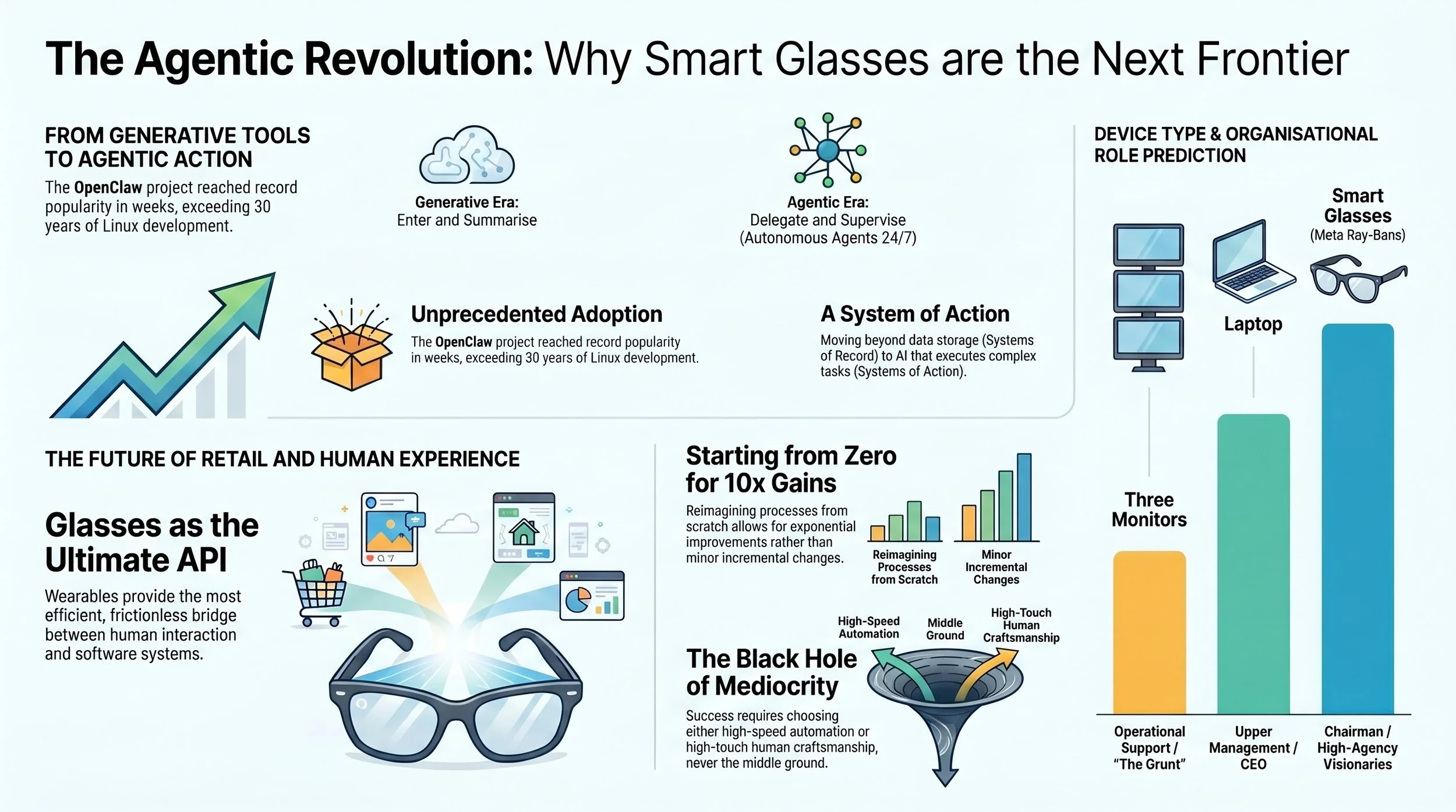
This presentation focuses on the transformative power of artificial intelligence and the necessity of personal disruption within the healthcare and biotechnology sectors. The speaker argues that we are entering an "agentic era" where software shifts from mere content generation to autonomously executing complex tasks. To remain competitive, organizations must embrace synthetic data and "build with the end in mind," using AI to automate routine labor while prioritizing human strengths. However, the talk warns that as technology makes life more efficient, trust becomes the rarest asset, necessitating "crafted friction" to maintain meaningful human connections. Ultimately, leaders are encouraged to overcome their fears by becoming proficient in these tools, ensuring they foster a culture deeply committed to both innovation and care.
The Agentic Revolution and the Future of Smart Wearables
Executive Summary
This document synthesizes key insights regarding the current evolution of Artificial Intelligence and its integration into the eyewear industry. We are transitioning from an era of generative AI—used primarily for text refinement and summarization—to an "Agentic Era" characterized by technology that acts, executes, and makes autonomous decisions. Central to this revolution are AI-integrated glasses, which serve as the "ultimate API," providing a frictionless interface between humans and a vast ecosystem of digital agents. To thrive in this environment, organizations must shift from being "systems of record" to "systems of action," balancing high-speed automation with meaningful human "friction" to avoid the "black hole of mediocrity."
--------------------------------------------------------------------------------
1. The Nature of Disruption
The analysis identifies a recurring pattern in the history of innovation: disruptive technology is almost always initially dismissed or viewed with skepticism.
The "Joke" Phase: Major disruptions (the Internet, Uber, credit cards) began as concepts that consumers found absurd or unsafe before they became ubiquitous.
The Discomfort Requirement: True innovation is inherently provocative. If a new technology or strategy does not cause discomfort among industry leaders, it likely lacks sufficient disruptive potential.
The Takeoff Point: Disruption remains a "joke" only until it fundamentally alters the landscape, at which point the competitive disadvantage falls on those who disregarded it.
--------------------------------------------------------------------------------
2. The Agentic Era: From Chatbots to Action
A critical shift is occurring in how AI is utilized, moving from passive research tools to active agents.
The Shift in AI Utility
Era
Primary Function
Primary Use Cases
Generative (2022–2025)
Summarize & Refine
Email drafting, Tinder bios, meeting summaries.
Agentic (2026 & Beyond)
Delegate & Execute
Acting on behalf of the user, orchestrating tools, 24/7 decision-making.
Key Technological Drivers
Agentic Agency: Defined as the capacity for software to not only think but to "get stuff done" (Agency = the act of executing).
Muse Spark (Meta): A new large language model (LLM) that outperforms competitors (Claude 4.6, GPT-4) in multimodal tasks and reasoning, representing a "rebuilt from scratch" approach to AI.
OpenClaw: An open-source personal AI assistant project that has scaled faster than Linux. It allows users to have a persistent, "always-on" assistant (e.g., "Carlton") that can operate across various LLMs.
--------------------------------------------------------------------------------
3. AI Glasses: The "Ultimate API"
Smart glasses are positioned as the primary hardware interface for the Agentic Revolution.
Frictionless Interface: Glasses remove the barrier of the screen, allowing software to speak to other software (API functionality) through a natural human interface.
Invisible Technology: The goal of future technology is to be "invisible." Users should not need to understand the underlying application (e.g., Excel or a specific LLM); they should only experience the outcome of the task being completed.
System of Action: Unlike traditional software (QuickBooks, Excel) which served as "systems of record" for storing data, AI-paired glasses function as "systems of intelligence" that perform real-time tasks in the field.
--------------------------------------------------------------------------------
4. Strategic Frameworks for Industry Evolution
The source provides specific strategic models for businesses—particularly those in the optical and retail sectors—to navigate the AI transition.
The "Black Hole of Mediocrity"
Organizations must choose one of two paths to remain competitive:
High-Speed/Frictionless: Prioritizing automation, efficiency, and on-demand delivery (e.g., Amazon, Uber).
High-Friction/Meaningful: Prioritizing craftsmanship, human relationships, and magical experiences (e.g., luxury brands, Disney).
The Risk: Attempting to remain in the middle leads to the "black hole of mediocrity," where a brand is neither efficient enough to compete on speed nor personal enough to compete on value.
"Starting from Zero"
To achieve 10x (rather than 10%) improvements, leaders are encouraged to reimagine their processes as if starting from a blank slate:
Automate: What can be handled entirely by AI agents?
Eliminate: What legacy processes are no longer necessary?
Add Friction: Where is the human touch most valuable to the patient/customer?
--------------------------------------------------------------------------------
5. The Future of Work and Identity
The document addresses the impact of AI on labor and the necessary mindset shifts for professionals.
High Agency as the Core Skill: In an era where AI provides the "intelligence," the most valuable human trait is "High Agency"—the ability to be an architect of one's own outcomes and to orchestrate AI agents to "get stuff done."
Job Transformation: AI will not only take over existing tasks but will perform jobs humans were never capable of doing, particularly in complex field environments (construction, manufacturing, etc.).
The "Rookie" Mindset: Professionals must be willing to let go of the "ego" built over decades of success. The revolution threatens identity more than jobs; leaders must "bury" their past successful selves to reach the "next mountain top."
--------------------------------------------------------------------------------
6. Notable Insights and Evidence
The "Screen Correlation": There is a perceived inverse correlation between the number of monitors a person uses and their level of agency. Grunt work requires multiple monitors; high-level leadership (and the future "agentic" user) requires only a single, mobile interface like smart glasses.
Safest Job in AI: According to Microsoft research cited in the source, the "dredge operator" is currently considered the safest job due to its reliance on physical, analog processes (pencil and paper).
The Radical Care Strategy: Technology is only one half of the success equation. The most effective long-term strategy remains "deeply caring" for staff so they, in turn, provide "concierge-level" value to patients that AI cannot replicate.
"Knowledge is no longer power. Power today belongs to people who are bold, people who can innovate, and people who can fight the status quo."
If you scrolled this far.
Here’s more!