
Thank you for being part of UNBOUND 2026
The After Show
In the latest episode of The After Show, hosts dive into Shawn Kanungo's thought-provoking session at UNBOUND 2026

Big Ideas,
Real Impact.
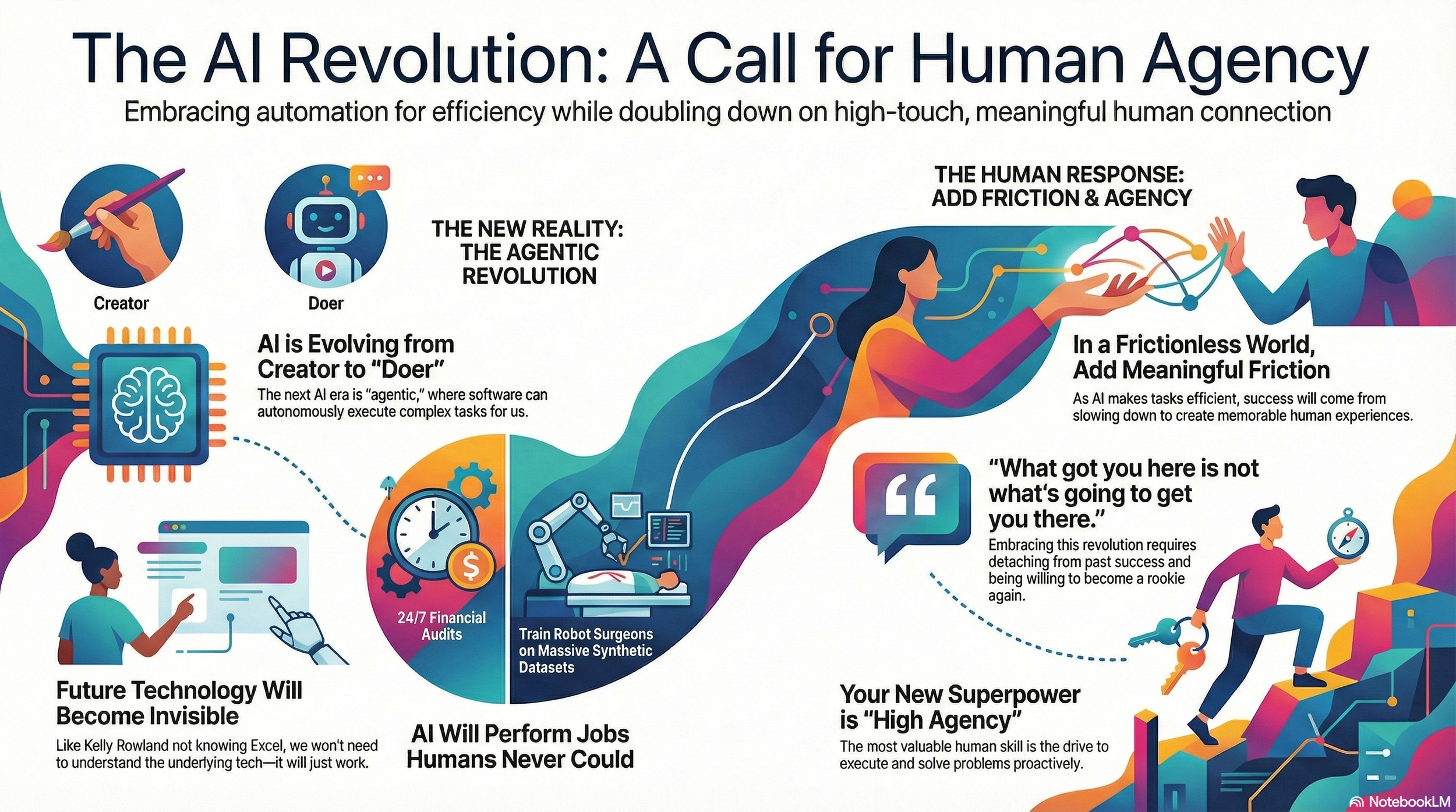
This presentation focuses on the transformative power of artificial intelligence and the necessity of personal disruption within the healthcare and biotechnology sectors. The speaker argues that we are entering an "agentic era" where software shifts from mere content generation to autonomously executing complex tasks. To remain competitive, organizations must embrace synthetic data and "build with the end in mind," using AI to automate routine labor while prioritizing human strengths. However, the talk warns that as technology makes life more efficient, trust becomes the rarest asset, necessitating "crafted friction" to maintain meaningful human connections. Ultimately, leaders are encouraged to overcome their fears by becoming proficient in these tools, ensuring they foster a culture deeply committed to both innovation and care.
KEY TAKEAWAYS (an AI-Output with Hallucinations)
MY #1 USED AI TOOL
Wispr Flow - I don’t type anymore, I just voice everything
AI AGENTS & AGentic workflows
Atlas - AI Browser by OpenAI
n8n - Workflow automation
Cursor - Coding agent
Comet by Perplexity - Best Agentic Browser - browse the internet with AI and get stuff done
Lindy - Build an AI agent - great for AI automation
LLM
Gemini 3 - The Best LLM on the planet right now
OpenAI’s Deep Research - Absolutely the best research tool out there right now
Manus - Most comprehensive AI agent in my opinion
Claude Skills - Claude Skills is the best skills agent - this allows to be more deterministic with your agents.
Grok 4 - Equivalent to o3 from ChatGPT - awesome for X data
Text-to-App
Lovable - Build any app with agentic reasoning (best at front-end)
v0 by Vercel - Text-to-Webpage (really good front-end)
Replit - Idea-to-App (best for full app)
Text-to-IMAGE/VIDEO
Midjourney - Best for pictures and video
HeyGen - AI Video Avatar
Runway - Text to Video
Google’s Nano Banana Pro - Best Image Generator
Research & other
NotebookLM - Research and the two AI podcast hosts that you see above :)
Google AI Studio - Real-time AI co-presence
Clay - AI Outbound Sales | Generating lists of emails and sending cold outreach
Briefing: Innovation, AI, and the Agentic Era
Executive Summary
his document synthesizes the core themes from a presentation by innovation strategist Shan Kung on the transformative impact of Artificial Intelligence. The central argument is that society is entering the "agentic revolution," a new era where AI systems can not only think but also autonomously execute complex tasks. This shift moves beyond simple content creation to unlock extraordinary value, fundamentally reshaping industries, careers, and the nature of work.
Key takeaways include:
• The Agentic Era: AI is evolving from a "system of record" to a "system of intelligence." The emergence of "AI agents"—autonomous, always-on systems that can make decisions and get things done—marks a historical turning point in technology.
• Transformation of Healthcare: Simulation is poised to become the most critical industry in healthcare. As autonomous systems like robotic surgeons develop, simulation provides the essential training ground, testing environment, and source of high-quality procedural data needed to ensure safety and capability.
• The New Power Dynamic: In an AI-driven world, raw knowledge is no longer the ultimate source of power. Instead, power belongs to individuals who are bold, innovative, and driven. The most valuable human skill of the next decade will be "high agency"—the ability to be an architect of one's own outcomes and execute without handholding.
• The Imperative of Self-Disruption: The AI revolution threatens not just jobs, but identity. To thrive, professionals must be willing to detach from past successes, "become a rookie again," and fundamentally reimagine their processes from zero to achieve exponential, rather than incremental, improvement.
• The Dichotomy of Friction: The future will be dominated by two successful models: hyper-efficient, "frictionless" services (e.g., Amazon) and high-touch, meaningful experiences that deliberately introduce "friction" to create memorable, human-centric value. The greatest strategy remains to deeply care for people, as this fosters the trust and high-agency culture necessary for innovation.
Introduction: The Provocateur's Stance
Shan Kung, a globally recognized innovation strategist, partner at Queen and Brook, and bestselling author of The Bold Ones, delivered a presentation framing the current advancements in AI as a fundamental revolution. His stated purpose was not to provide answers but to provoke and challenge the audience with "bold questions" about the future. He urged attendees to disagree with his positions, framing disagreement as essential for a meaningful conversation about disruption.
"The real reason why I'm here today is to ask some really bold questions. In fact, my job today is to provoke you. And at the end of this presentation, I want you to disagree with this presentation because this wouldn't be a conversation around the future and disruption... unless you disagree with me."
The Dawn of the Agentic Revolution
Kung argues that the period since the launch of ChatGPT at the end of 2022 has primarily focused on generative AI for content creation (e.g., refining emails, summarizing conversations). However, beginning in 2026, the world is moving into a new phase: the "agentic era."
• Defining Agency: Agency is defined as "the power to act, the power to get stuff done, the power to execute."
• The Spectrum of Agency:
◦ On one end are Large Language Model (LLM) Workflows, such as a bot summarizing and sending a conversation.
◦ On the other end are True AI Agents, which are described as autonomous, always-on, decision-making systems that can orchestrate entire workflows and "get stuff done."
• The Core Shift: This marks the first time in human history that software can not only think like humans but also act on their behalf, a development poised to unlock extraordinary value.
Practical Applications in Healthcare Simulation
To demonstrate the current capabilities of agentic AI, Kung presented several real-world examples specifically tailored to the healthcare simulation industry.
Example 1: Claude Code as a Digital Team
Kung showcased "Claude Code" by Anthropic as the "best and the truest AI agent" available in 2026. He demonstrated how it functioned like "10 people on my team" by executing the following project:
1. Project Setup: Created a folder on his computer named "healthcare simulation."
2. Task Assignment: Was given a project description with best practices in the field.
3. Content Generation: Created multiple work documents and "incredible" PowerPoint decks for every part of the healthcare simulation workflow.
4. Application Development: Built a functional sim center application that could run various patient scenarios, such as a head trauma case.
Example 2: Reimagining "Harvey" as an AI Agent
Inspired by Dr. Michael Gordon, whom he called the "Michael Jordan of simulation," Kung reimagined the iconic "Harvey" cardiopulmonary patient simulator for the agentic world.
1. Lifelike Visualization: Used Google's Gemini to transform the mannequin's image into a realistic human video.
2. AI Agent Creation: Turned "Harvey" into a 24/7, always-on AI agent that could be interacted with in real-time.
3. Live Demonstration: Engaged in a live conversation with the Harvey agent, asking about its symptoms. The agent responded with a detailed, coherent description of its condition ("I feel short of breath... there's a tightness in my chest"). It also demonstrated multilingual capabilities by restating its condition in Hindi upon request.
Example 3: Leveraging Synthetic Data for Analysis
Kung posits that the safest way to utilize AI in privacy-sensitive fields is to use synthetic data—realistic, but entirely fake, data sets.
1. Data Generation: He tasked an AI with creating a 50,000-line synthetic Excel data file for a hospital unit in San Antonio based on best practices.
2. AI-Powered Analysis: Using a tool called "Claude for Excel," he instructed the AI to perform a "simulation optimization analysis" on the synthetic data, demonstrating how professionals can have a "10x analyst at your fingertips" without using real patient information.
The Future of Work and Technology Redefined
The agentic revolution will fundamentally change humanity's relationship with technology and the very nature of work.
The "Kelly Rowland" Principle
The ultimate future of technology is one where it becomes so seamless that users do not need to understand its underlying mechanics—it "just gets stuff done." This concept is illustrated by singer Kelly Rowland, who was famously seen texting in a Microsoft Excel spreadsheet in a 2002 music video and later admitted she had no idea what Excel was. This level of abstraction is the goal.
From System of Record to System of Intelligence
For decades, software has primarily served as a "system of record"—a more elegant way to store, retrieve, and maintain data (e.g., moving from paper ledgers to Excel to QuickBooks). The current revolution is different because AI has created a "system of intelligence" that can execute tasks humans could never perform.
"People ask, you know, will AI take jobs? Yes, it will take jobs. AI agents will do jobs that humans could never do. My father was never able to do a 24/7 reconciliation of receipts and invoices."
Simulation: The Future of Healthcare
Kung argues that simulation is not just relevant but will become the most important industry in an AI-driven healthcare future. Citing (and expressing skepticism about the timeline of) Elon Musk's prediction that Optimus robots will be better surgeons than humans in three years, he makes the following case:
• Simulation as the Testing Ground: Autonomy is impossible without simulation. Robotic surgeons and other AI systems will require simulation to be trained, to prove their capabilities, to test supervision models, and to understand edge cases.
• Data as the Competitive Advantage: The high-quality procedural data generated through simulation will become the new competitive advantage, as it is essential for training effective and safe AI.
Human Skills in the Age of AI
As technology becomes more capable, uniquely human attributes become more valuable.
Concept
Description
Key Quote
Boldness Over Knowledge
For centuries, knowledge was power. In an age where AI provides instant access to information, the defining trait is no longer what you know, but your willingness to act, innovate, and challenge the status quo.
"Knowledge is important, but boldness is power."
Overcoming Fear
Fear of AI stems not from the technology itself, but from a lack of immersion and practice. The solution is to actively engage with AI tools until proficiency is built.
"The reason why you are scared is because you haven't put in the work yet... Work scared until you become scary."
High Agency
The most important skill of the next decade is "high agency." This is the human equivalent of an AI agent: someone who is an architect of their own outcomes, acts autonomously, and gets things done without needing permission or handholding.
"The irony of this AI revolution is that we are building AI agents... And the most important skill for human in the next 10 years is actually getting stuff done."
The Societal Challenge: Trust and Friction
The rise of agentic AI presents profound societal challenges, primarily centered on the erosion of trust and the over-optimization of human experience.
The End of Trust
The deepest implication of AI is that it "marks the end of trust." When it becomes impossible to distinguish between what is real and what is AI-generated, the foundation of social cohesion is threatened. This will lead to an "age of infinite hell" with hypersophisticated blackmail, exponential scams, and deep fakes. The necessary counterbalance is to develop and rely on critical thinking skills.
The F-Word: Reintroducing Friction
Society is systematically turning every interaction into its most efficient, frictionless form, from food delivery to media consumption. This relentless optimization "sucks out the meat, the context, and ultimately, the trust." Kung argues for bringing back the "F-word": Friction.
• The Two Winning Models: In the future, only two types of organizations will thrive:
1. Frictionless: Hyper-efficient, transactional businesses (Amazon, McDonald's).
2. Friction-Filled: Businesses that deliberately slow things down to create meaningful, magical, and memorable human experiences (Four Seasons, Genius Bar).
• The Experience is the Brand: An organization's brand is not its logo or mission statement, but the story embedded in the hearts and minds of its customers and stakeholders.
The Call to Action: Disrupt Yourself
To navigate this revolution, individuals and organizations must embrace radical self-disruption.
The Strategy of Deeply Caring
Kung recounts a story of a hotel in Dubai where an employee was so proud of his workplace—because leadership cared for the staff and their families—that it created a tangible sense of trust and excellence. The ultimate strategy for building a high-agency, innovative culture is to deeply care about people.
Becoming a Rookie Again
The greatest challenge of the AI era is that it threatens our identity, which is built on years of experience, titles, and credentials. The path forward requires a difficult but necessary act of letting go.
• Start from Zero: Instead of making incremental improvements, take an existing process and ask, "If I started this from zero today... how would I reinvent it?" This mindset shift leads to 10x, not 10%, improvements.
• Detach from Success: The most critical step is to detach from what made you successful in the past. Thank your past self for its accomplishments, and then "bury it."
"What got you here is not what's going to get you there."
Ultimately, Kung concludes that the most powerful actor in this new world is not the most knowledgeable or experienced, but the one who can act in the face of fear.
"The most dangerous person in the room is the person who is most afraid yet bold enough to move forward."
If you scrolled this far.
Here’s more!