
Thank you for being part of Results’ BEx Summit 2026
The After Show
In the latest episode of The After Show, hosts dive into Shawn Kanungo's thought-provoking session at Results’ BEx Summit 2026

Leaders,
Are you ready?
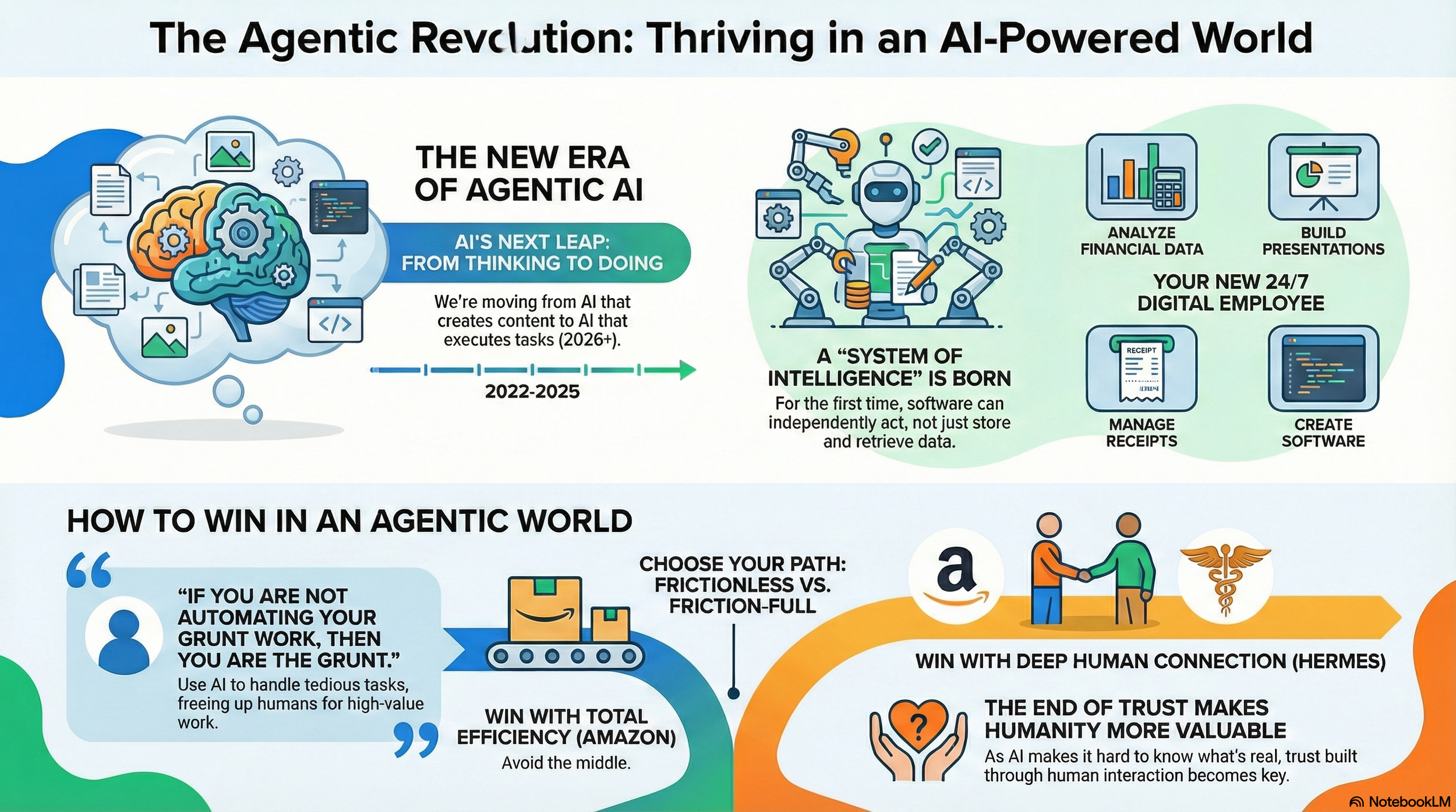
This presentation focuses on the transformative power of artificial intelligence and the necessity of personal disruption within the healthcare and biotechnology sectors. The speaker argues that we are entering an "agentic era" where software shifts from mere content generation to autonomously executing complex tasks. To remain competitive, organizations must embrace synthetic data and "build with the end in mind," using AI to automate routine labor while prioritizing human strengths. However, the talk warns that as technology makes life more efficient, trust becomes the rarest asset, necessitating "crafted friction" to maintain meaningful human connections. Ultimately, leaders are encouraged to overcome their fears by becoming proficient in these tools, ensuring they foster a culture deeply committed to both innovation and care.
KEY TAKEAWAYS (an AI-Output with Hallucinations)
MY #1 USED AI TOOL
Wispr Flow - I don’t type anymore, I just voice everything
AI AGENTS & AGentic workflows
Perplexity Computer - An AI Agent on Demand
Claude Code / Claude Cowork - The best AI General Agent today
OpenClaw - The first PROACTIVE AI Agent
Atlas - AI Browser by OpenAI
OpenAI’s Deep Research - Absolutely the best research tool out there right now
Claude Skills - this allows to be more deterministic with your agents
Text-to-App
Lovable - Build any app with agentic reasoning (best at front-end)
v0 by Vercel - Text-to-Webpage (really good front-end)
Replit - Idea-to-App (best for full app)
Text-to-IMAGE/VIDEO
Midjourney - Best for pictures and video
HeyGen - AI Video Avatar
Runway - Text to Video
Google’s Nano Banana Pro 2 - Best Image Generator
Research & other
NotebookLM - Research and the two AI podcast hosts that you see above :)
Google AI Studio - Real-time AI co-presence
Clay - AI Outbound Sales | Generating lists of emails and sending cold outreach
Briefing: Innovation, AI, and the Agentic Era
Executive Summary
The global business landscape is entering a fundamentally new era defined by the transition from generative AI as a tool for summarization to autonomous AI agents capable of execution. This "Agentic Revolution" shifts technology from a "system of record"—which merely stores and retrieves data—to a "system of intelligence" that performs actions 24/7.
To remain competitive, organizations must navigate a bifurcated economy. Success will be found either in becoming fast and frictionless (prioritizing extreme efficiency) or by doubling down on human friction (creating meaningful, memorable, and high-touch experiences). The middle ground is defined as a "black hole of mediocrity." Leaders must cultivate "high agency" within their teams—hiring individuals who act as architects of their own outcomes—and be willing to adopt a "rookie mindset" by disrupting their own legacy processes to leverage the greatest technological shift in human history.
--------------------------------------------------------------------------------
1. The Transition to the Agentic Era
The current technological landscape is moving beyond the initial phase of Artificial Intelligence (2022–2025), where use cases were limited to refining emails, summarizing meetings, or generating images.
From LLM Workflows to Autonomous Agents
Large Language Model (LLM) Workflows: These are predefined recipes where a bot might summarize a conversation and send it off.
True Autonomous Agents: This represents the 2026 and beyond era. These are proactive, 24/7 software entities capable of making decisions and executing complex tasks without constant human intervention.
The Shift in Utility: We are moving from a chat-based era (answering and researching) to a delegation era (supervising and getting stuff done).
Real-World Applications of AI Agency
The source context identifies several tools and examples of this transition:
Digital Employees (Claude/Anthropic): Creating "all-competency" digital employees for specific firms (e.g., Kerr Interior Systems) that can research an organization, find RFPs on procurement sites, and generate detailed proposals, estimates, and visual presentations autonomously.
Vibe Coding (Lovable): The ability to turn text descriptions into fully functional applications, such as a "Netflix-style" onboarding platform for new employees, including security and authentication features.
Lead Generation and Personalization (Perplexity Computer): Automating the research of hundreds of event attendees to find their contact information and LinkedIn profiles, then drafting hundreds of personalized emails tailored to their specific business needs.
Proactive Chief of Staff (Open Claw): A 24/7 agent that works proactively while the user sleeps, identifying and executing tasks without being prompted.
--------------------------------------------------------------------------------
2. Systems of Intelligence vs. Systems of Record
A critical distinction in this revolution is the evolution of software's core purpose.
System of Record: For four decades, software (Excel, QuickBooks, OCR machines) has focused on more elegant ways of retrieving, maintaining, and storing data.
System of Intelligence: AI represents a system of action. It can perform tasks that were previously humanly impossible, such as 24/7 audits of every single transaction or constant reconciliation of receipts and invoices.
The Impact on Labor: While AI will displace some roles, it primarily takes over "jobs that humans could actually never do" due to the scale and consistency required.
--------------------------------------------------------------------------------
3. The Organizational Impact: The "Agentic Enterprise"
The rise of AI agents necessitates a fundamental redesign of the modern corporation, moving away from the 20th-century assembly-line model.
Flatter Hierarchies
Traditional organizations created layers of management (assistant managers, directors, VPs) to oversee work.
As AI begins to plan, execute, and check its own work, the need for middle management diminishes. Organizations will become flatter, turning former managers into "builders" who execute rather than just supervise.
Designing Around Human Strengths
Historically, organizations were designed around "process technologies" (e.g., "you are the ERP person").
The Agentic Enterprise designs around unique human gifts. AI agents handle the tasks that individuals dislike or lack proficiency in (e.g., a salesperson who hates backend data entry or an engineer who cannot visualize ideas), allowing humans to focus on their core strengths.
The Rise of "High Agency"
The most critical skill in this new era is "High Agency."
A high-agency person is an "architect of their own outcomes" who does not ask for permission but instead finds ways to make things happen.
--------------------------------------------------------------------------------
4. The "Friction" Framework: Two Paths to Success
In a frictionless economy where everything is on-demand and seamless, "friction" becomes a strategic choice rather than a nuisance.
The Winning Quadrants
Organizations must choose to be in one of two categories to avoid mediocrity:
Fast and Frictionless: Prioritizing speed, self-service, and consistency. Examples include Amazon, Temu, and McDonald's.
High-Friction Experiences: Doubling down on humanity to create moments that are meaningful, magical, and memorable. Examples include the Four Seasons, Hermes craftsmanship, or the Apple Genius Bar.
The "Black Hole of Mediocrity"
Companies that sit in the middle—neither fast enough to be frictionless nor human enough to be an experience—will fail. Strategy now requires looking at every process and deciding whether to make it incredibly seamless or deeply human.
--------------------------------------------------------------------------------
5. Strategic Imperatives for Leadership
The speed of change is accelerating, with the average S&P 500 company lifespan expected to drop to 12 years by 2030.
Strategy as Energy: Strategy is defined as an "imaginary theory that has to set people on fire." Without energy and momentum, strategy is merely a "PowerPoint."
Eliminating Speed Limits: The traditional "speed limit" of business was the number of humans on a team and the hours in a day. AI agents remove these limits, allowing for 10x improvements rather than marginal gains.
The Rookie Mindset: Successful leaders must be willing to let go of their ego and past successes. To innovate, one must be willing to "start from zero," automating the mundane and doubling down on humanity where it matters most.
"Work scared until you become scary." The advice for those overwhelmed by AI technology is to immerse themselves in it until they build the muscle to become "dangerous" and empowered by the tools.
--------------------------------------------------------------------------------
6. Critical Insights and Quotes
Theme
Key Takeaway
Power
Knowledge is no longer power; "people that are hungry, people that are bold, people that can innovate" hold the power today.
The F-Word
"We need more friction... we need to make things that are meaningful and magical and memorable."
Brand Identity
"The experience is the brand. Your brand is not your logo... it’s the story embedded in the hearts and minds of your customers."
Leadership
"Strategy without energy is just called a PowerPoint."
Adaptability
"What got you here will not get you there."
--------------------------------------------------------------------------------
Conclusion
The most important year of a professional's career is the current one. Whether starting out or nearing retirement, the imperative is to build a skillset around agentic technology. The goal is not merely to use AI for efficiency but to leverage it to amplify human strengths, creating organizations that are either hyper-efficient or deeply human, but never mediocre.
If you scrolled this far.
Here’s more!