
Thank you for being part of my session at RBC Insurance
The After Show
In the latest episode of The After Show, hosts dive into Shawn Kanungo's thought-provoking session at RBC Insurance
Leaders,
Are you ready?
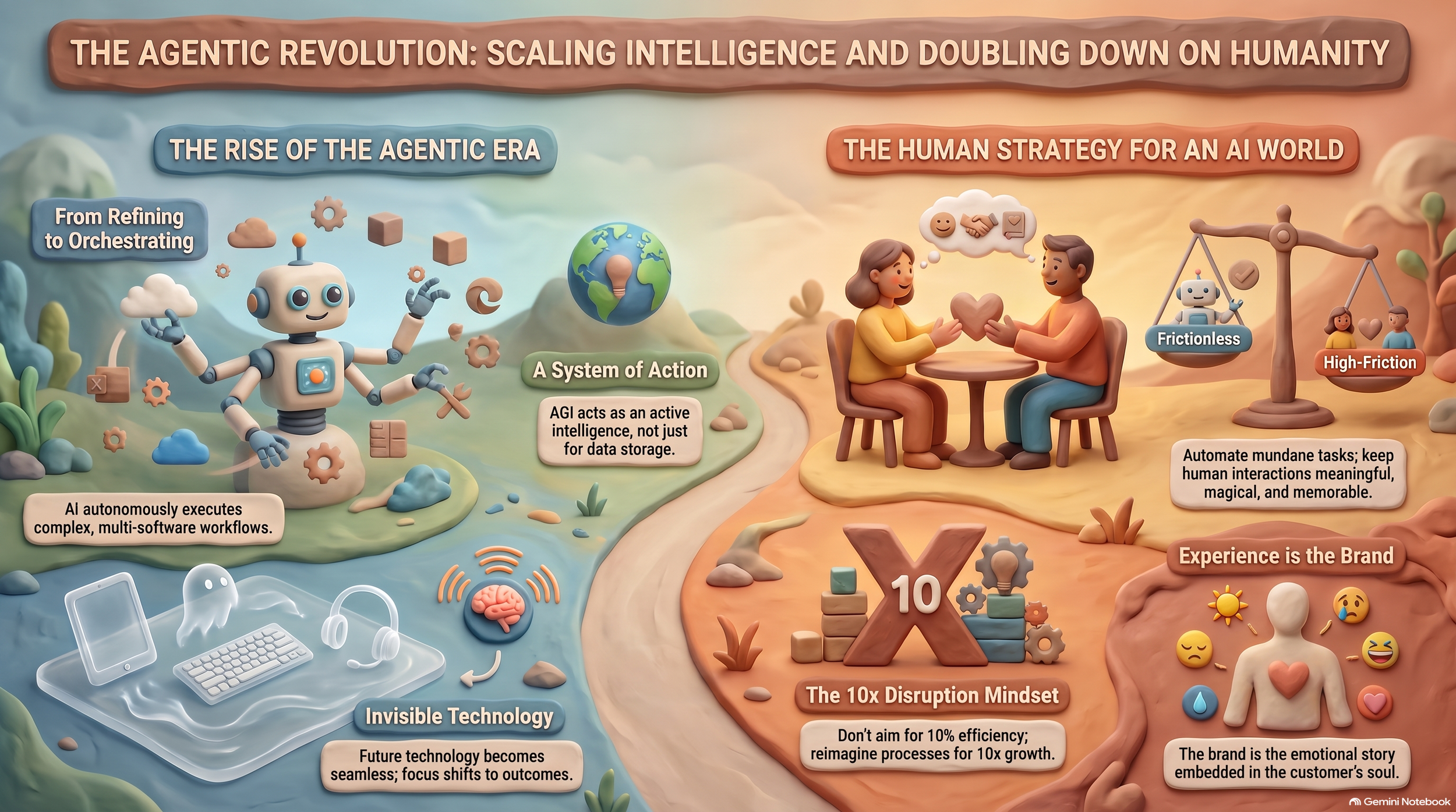
Artificial intelligence is fundamentally transforming modern industries by shifting the focus from simple workplace efficiency to complete organizational reinvention. Rather than merely layering new technology onto existing workflows, professionals must be willing to challenge traditional practices and embrace radical imagination. This technological revolution is not about replacing human labor, but rather empowering individuals to rebuild their processes from scratch by asking unconventional questions. Ultimately, success in this rapidly evolving landscape requires individuals to let go of outdated methods, adopt a mindset of continuous adaptation, and focus on delivering exceptional human-centric experiences.
KEY TAKEAWAYS (an AI-Output with Hallucinations)
MY #1 USED AI TOOL
Wispr Flow - I don’t type anymore, I just voice everything
My favorite AI AGENTS
Dots & GPT-6 Astra by OpenAI - AGI is here
Claude’s Fable 5.2 by Anthropic - The best model right now
Grok Bot by SpaceX AI - A downloadable AI team
Hermes - My personal AI Harness
Perplexity Computer - An AI agent orchestrator that has access to 19 different models
Muse by Meta - great personal AI agent - highly recommend for non-technical users.
Text-to-App
Lovable - Build any app with agentic reasoning (best at front-end)
v0 by Vercel - Text-to-Webpage (really good front-end)
Replit - Idea-to-App (best for full app)
Text-to-IMAGE/VIDEO
Claude Design for motion graphics - claude.ai/design
HeyGen - AI Video Avatar
ChatGPT Image 2.0 - Best Image Generator
Google’s Nano Banana Pro 2- 2nd Best Image Generator
Research & other
NotebookLM - Research and the two AI podcast hosts that you see above :)
Google AI Studio - Real-time AI co-presence
Clay - AI Outbound Sales | Generating lists of emails and sending cold outreach
Executive Briefing: Navigating the AI Revolution, Agentic Systems, and Strategic Friction
Executive Summary
The rapid advancement of Artificial Intelligence (AI) has shifted the global business landscape from basic digital assistance to an era defined by Agentic AI and Artificial General Intelligence (AGI). Based on insights shared by innovation strategist Sean "Shuga" Dungo at the Fairmont in Ottawa, organizations face an urgent strategic imperative: the gap between entities that comprehend this technological shift and those that do not will compound exponentially over the coming year.
The central thesis of this briefing is that AI represents the ultimate engine of conventional wisdom, derived from historical data. Consequently, competitive advantage no longer stems from knowledge or technical execution—which are rapidly becoming commoditized—but from human judgment, asking bold questions, and reframing business models.
Key Takeaways:
The Shift to Systems of Action: For decades, software provided "systems of record" (storing and retrieving data). AI introduces "systems of action"—autonomous capabilities that execute complex, 24/7 continuous operations beyond human capacity.
Redefining Power: Power has evolved from Knowledge to Execution, and now decisively to Judgment. As execution becomes automated, the value of choosing what to solve increases dramatically.
The Dual Winning Models ("AI vs. Al"): Market dominance will belong exclusively to organizations that choose one of two extremes: Fast & Frictionless (automated, single-button execution) or Deeply Experiential & Friction-Rich (high-touch, human-centric craftsmanship). The middle ground represents a "black hole of mediocrity."
Self-Disruption Framework: True innovation requires abandoning the incremental 10% optimization mindset and forcing a zero-based operational rebuild—asking how to execute a five-year strategy within six months to achieve 10x outcomes.
AGI as "Awakening the Greatness Inside": Rather than replacing human workforce value, AI eliminates repetitive "robot work" (assembly-line tasks, data copy-pasting), enabling professionals to focus on specialized human strengths, trust-building, and high-value consultative engagements.
1. The Evolution of AI: From Text Polishers to Systems of Action
The Historical Trajectory (2022–2026)
The adoption and capability of AI tools have undergone a compressed multi-phase evolution:
[Late 2022 - 2025: Basic Utility]
  └─ Drafting emails, social media content, novelty image generation
        │
        ▼
[Late 2025: Agentic Era]
  └─ Emergence of autonomous AI agents executing multi-step tasks
        │
        ▼
[2026 & Beyond: AGI & Computer Use]
  └─ Autonomous multimodal agents operating computers natively; continuous self-healing code
2022–2025 (Initial Adoption): Widespread usage was largely restricted to low-level text adjustments (e.g., polishing emails) or novelty output (e.g., generating stylized viral images).
Late 2025 (The Agentic Era): AI transitioned from static chat interfaces to active workflow agents.
Current Horizon (AGI & Computer Use): Advanced models—such as Anthropic’s Claude (Fable 5.2, Opus) and OpenAI’s Astra 6—have mastered computer operation. AI can now interact with complex software suites natively, executing tasks across applications better than human operators.
Precision Engineering via Recursive Loops
The paradigm of software creation has shifted from manual programming or primitive "vibe coding" to precision engineering. Modern frontier models operate in continuous recursive feedback loops:
Software applications can be prompted into existence, self-correcting code, and patching security vulnerabilities every minute.
Anthropic reports that approximately 90% of their internal development work utilizes their own Fable model systems.
Custom, complex enterprise software (such as specialized onboarding platforms) that previously cost millions of dollars and years of labor can now be generated, iterated, and deployed into full production almost instantaneously.
The Wright Brothers Paradox: Conventional Wisdom vs. Innovation
AI models are trained on all existing historical data, making them the ultimate engines of conventional wisdom.
The Analogy: Had the Wright brothers consulted an advanced AI model prior to their first flight, the system—analyzing all historical scientific consensus up to that point—would have concluded that powered human flight was impossible.
Strategic Implication: Relying solely on AI yields standard, conventional answers. Market leadership requires asking unconventional questions (e.g., "Why not?") to push past historical precedent.
2. AI as a Teammate: Operationalizing Agentic & Ambient AI
Organizations are transitioning from direct manual "prompting" to deploying Ambient AI—autonomous agents running persistently in the background, observing operations, identifying discrepancies, and executing high-level directives.
Case Studies & Capabilities
Deployment Type
Example / Tool
Operational Execution & Output
Recruitment & Workflow Automation
Plexi
Scanned 50 independent Canadian insurance brokerages/MGAs distributing RBC Insurance, analyzed open roles, vetted candidate pools, ranked 1,000 viable candidates (e.g., identifying passive candidates at banking institutions), and generated 1,000 personalized outreach emails autonomously.
Autonomous Software Development
Claude Fable 5.2
Tasked with building a 9-team CFL video game from scratch. Operating long-running agentic loops, the system orchestrated complex, unfamiliar software (Blender, Unreal Engine, Adobe Creative Suite) to deliver a functional 3D game within 24 hours.
Virtual Executive Support
Custom Avatar Agent ("Carlton")
Participates in daily operational standup meetings via audio/avatar interfaces. Capable of converting raw conference documents into multi-format deliverables (audio podcasts, concise briefing notes, and 10-page pitch decks) asynchronously.
Ambient Financial Oversight
Enterprise Monitoring Agents
Runs continuously in the background to spot travel and billing discrepancies across international operations without manual prompting, saving thousands of dollars and administrative overhead.
System of Record vs. System of Action
For five decades, enterprise software (from paper ledger books to Excel and QuickBooks) merely provided a system of record—a digitized method to store, retrieve, and maintain data.
AI represents the first true system of action. It performs continuous operational work that human labor could never sustain, such as 24/7 real-time reconciliation of every invoice, receipt, and transaction across an enterprise.
3. Labor, Identity, and the Shift to Human Judgment
The SAFEST vs. Most Vulnerable Roles
A common enterprise concern is the displacement of human labor. Historical perspective and current studies indicate a fundamental shift in role security:
High-Vulnerability Roles: Pure execution-based roles (e.g., standard software coders) face rapid automation as AI models handle end-to-end syntax, backend development, and security deployment.
High-Security Roles: Roles requiring physical presence, mechanical adaptability, and non-digitized feedback loops remain highly secure. A landmark Microsoft study identified a dredge operator (e.g., field equipment operators utilizing physical paper/pencil logs) as one of the safest roles in the AI era.
EVOLUTION OF COMPETITIVE POWER:
[Knowledge is Power]  ──►  [Execution is Power]  ──►  [JUDGMENT IS POWER]
 (Obsolete: Democratized    (Obsolete: Automated      (Current Paradigm: Determining
  by LLMs & search)          by AI computer use)       which problems to solve)
Addressing Workplace Fear: "Work Scared Until You Become Scary"
Fear of AI stem from a lack of direct engagement with the technology.
Employees who do not engage with AI fear job replacement.
Employees who actively build a muscle around AI realize it amplifies their capabilities, allowing them to build systems and become "scary good" (indispensable specialists).
Core Rule: AI itself will not replace professionals; however, professionals who master AI to execute higher-level strategy will replace those who do not.
AGI as "Awakening the Greatness Inside"
Historically, corporate environments forced human workers to adapt to industrial assembly lines and static software platforms (CRM data entry, redundant copy-pasting, unproductive status meetings). AI automates this "robot work," freeing human capital to focus on uniquely human traits: complex problem-solving, emotional connection, and high-trust advisory roles.
4. Strategic Differentiation: Friction vs. Convenience
As technology digitizes standard processes, baseline client expectations rise continuously. When every service is accessible via a single screen button, convenience becomes table stakes, forcing businesses to re-evaluate how they differentiate.
THE STRATEGIC MATRIX: AVOID THE MIDDLE

  [ FAST & FRICTIONLESS ]            [ BLACK HOLE OF MEDIOCRITY ]          [ DEEP EXPERIENCE & FRICTION ]
   - Single-button execution          - Moderate speed                      - High-touch consultative care
   - Complete automation              - Standard client portals             - Deep human relationships
   - High volume, low margin          - Undifferentiated service            - Premium positioning, high trust
   (e.g., Amazon, McDonald's)         (HIGH RISK OF FAILURE)                (e.g., Four Seasons, Hermès, Genius Bar)
The Return of the "F-Word" (Friction)
Counter-intuitively, sustainable competitive advantage requires strategically reintroducing friction—slowing down interactions to create meaningful, memorable, and high-trust human experiences. Organizations must choose between two winning models:
Fast & Frictionless: Ultra-automated, programmatic, instant execution (e.g., Amazon, Temu, McDonald's).
Deep Experience & Friction: Craftsman-level, highly personal, consultative engagements that build deep trust (e.g., Four Seasons, Hermès, Apple Genius Bar).
Warning: Operating in the middle zone results in entering the "black hole of mediocrity"—providing neither ultimate convenience nor real human value.
The "AI and Al" Dichotomy
To succeed, an enterprise must balance two foundational operational pillars:
AI (Incredibly Reliable Technology): Automating back-office operations, compliance, routine administrative pipelines, and transactional tasks seamlessly.
Al (Concierge-Level Human Care): High-touch, deeply caring human representatives (symbolized by exemplary service encounters like hotel concierge staff who provide personalized, proactive follow-through).
The ultimate operational strategy leverages AI in the backend to give human personnel (Al) the time and capacity to deeply care for clients.
5. Frameworks for Self-Disruption and Innovation
Reframing the Question: The Chestnut-Kobayashi Paradigm
Disruption does not require building complex technical infrastructure; it begins by altering the fundamental question being asked.
The Baseline Approach: In competitive hot-dog eating prior to 2001, competitors asked, "How do I eat more hot dogs?" (Yielding an industry record of 25).
First Disruption (Takeru Kobayashi): Asked, "How do I eat a hot dog more easily?" By breaking the bun, dipping it in water, and adjusting mechanics, he doubled the record to 50.
Second Disruption (Joey Chestnut): Asked, "How do I train like an elite athlete?" By introducing targeted jaw, stomach, and athletic training regimens, he went on to dominate the Nathan's competition for 18 years.
The 5-Year Plan in 6 Months Challenge
To break out of incremental thinking, leadership teams must take their current 5-year strategic plan and ask: "How do we achieve this in 6 months?"
Why this works: Achieving a 5-year target in 6 months cannot be accomplished by making minor 10% efficiency tweaks to existing processes. It forces the organization to throw out legacy assumptions, dismantle friction-heavy bureaucracy, and rebuild from zero to achieve 10x improvements.
INCREMENTAL IMPROVEMENT VS. ZERO-BASED REBUILD

Traditional Approach:
[Existing Process] ──► +10% Optimization ──► Marginal Gains

Zero-Based Rebuild:
[Zero Baseline] ──► Prompt/Automate Output + Inject Human Friction ──► 10x Transformation
Historical Context: Disruption Always Looks Like a Joke
Every major technological leap initially faces skepticism, public ridicule, or fear-mongering:
The 1800s (Bicycles): Opponents claimed unchaperoned movement would cause a medical condition dubbed "bike face" (wrinkles and dark under-eye circles from high speeds).
1876 (Telephones): Pundits and publications claimed telephones would render public concert halls obsolete.
1960s (Television): Feared as a medium that would systematically degrade public intelligence.
1990s (Credit Cards at Fast Food): Skeptics openly mocked using credit cards for micro-transactions ($3.10 at Burger King), fearing it would destroy point-of-sale speed.
Strategic Lesson: Dismissing disruptive ideas because they initially appear impractical or absurd leaves an enterprise vulnerable when the market shifts.
6. Actionable Implementation Roadmap & Tactical Guidance
For organizations seeking to implement AI integration without exposing themselves to operational risk, leadership should follow a clear three-step execution framework:
Step 1: Document Legacy Processes
  └─ Map all internal workflows, data transfers, and administrative touchpoints.

Step 2: Identify Core Operational Bottlenecks
  └─ Pinpoint areas consumed by repetitive "robot work" vs. high-value client touchpoints.

Step 3: Consult Frontier LLMs for Automation Architecture
  └─ Input documented processes into frontier AI tools (Claude Fable 5.2, OpenAI Astra 6)
     and query: "Where should we automate, eliminate, or reintroduce human friction?"
Key Technical & Operational Guidelines (Q&A Insights)
1. Data Privacy and Sovereignty
Enterprise Security: Organizations handling sensitive personal data (e.g., dates of birth, salaries, claims histories, medical records) must deploy enterprise-tier AI environments.
Sovereignty Compliance: Utilize cloud architectures (e.g., AWS Bedrock, Claude Enterprise) configured with strict Canadian data sovereignty guarantees to ensure corporate information is never used to train public foundational models.
Governance: Engage dedicated privacy and legal counsel to evaluate evolving terms of service and establish clear internal guidelines before rolling out client-facing tools.
2. Managing Authenticity vs. Digital Clones
Internal Workflows First: Prioritize AI integration within back-office efficiency, data synthesis, and workflow automation before introducing client-facing AI interfaces.
Transparency & Channels: Using synthetic clones (voice/video avatars) for information dissemination can serve as an effective supplementary channel, provided full disclosure is maintained.
The Human Premium: Digital tools must never replace direct, face-to-face interactions, physical handshakes, and authentic relationship management.
3. Moving to Ambient Operations
Context Priming: AI models cannot operate autonomously without deep organizational context. Enterprises must feed their strategy, vision, process maps, and historical challenges into system environments to achieve accurate, tailored outputs.
If you scrolled this far.
Here’s more!