
Thank you for being part of my session at the Leadership Invitational
The After Show
In the latest episode of The After Show, hosts dive into Shawn Kanungo's thought-provoking session at The Leadership Invitational
Leaders,
Are you ready?
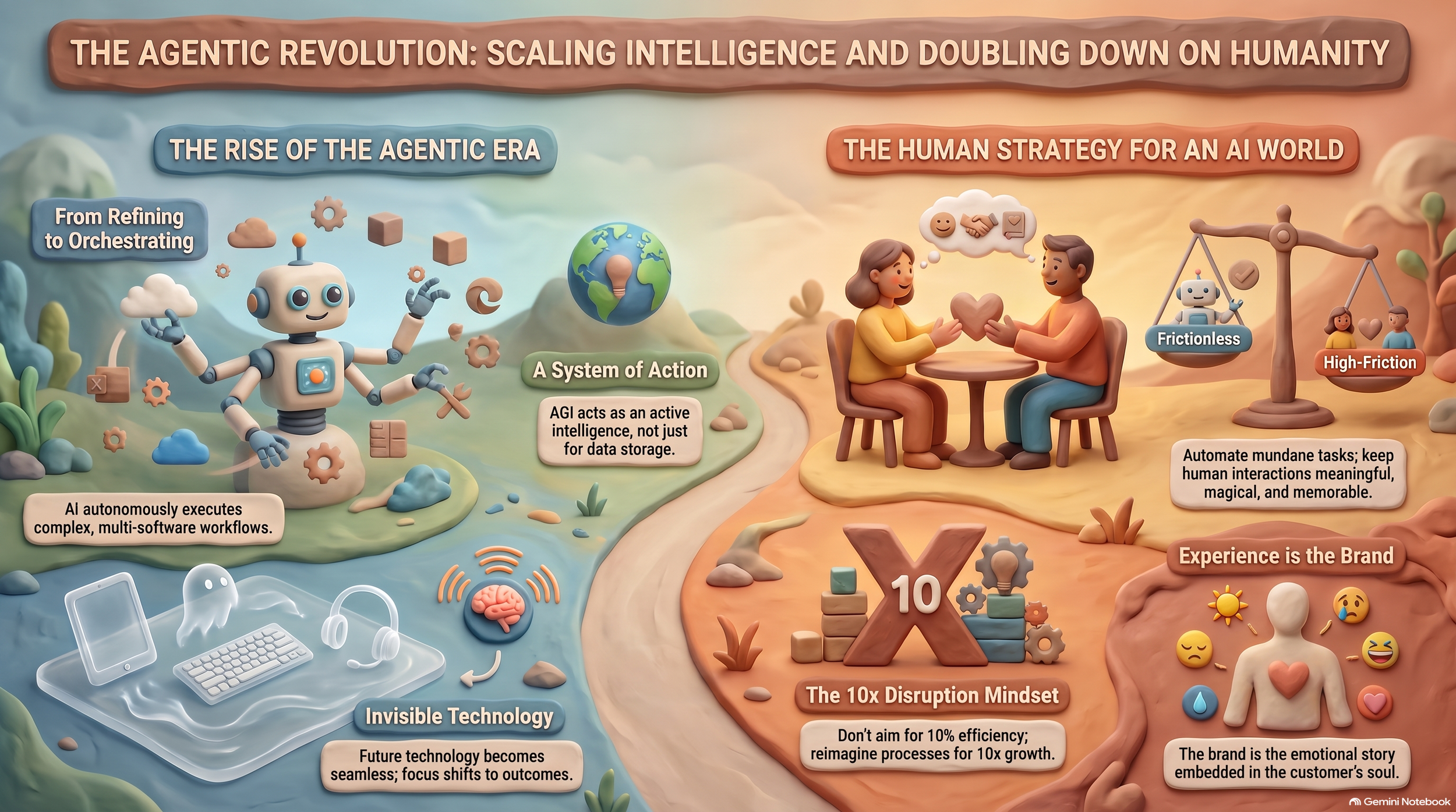
Artificial intelligence is rapidly transforming the modern workplace by shifting technology from a simple record-keeping system into an autonomous tool capable of executing complex tasks. During a keynote address at a conference, speaker Shawn Kanungo argued that while artificial intelligence often relies on conventional wisdom, it empowers professionals to transcend traditional boundaries and completely reimagine their organisations. Rather than replacing human labour entirely, these advanced agents can handle routine procedures across various software platforms, allowing people to focus on higher-level problem-solving and judgment. However, embracing this digital evolution requires leaders to overcome the fear of the unknown by developing a personal proficiency in new tools. Ultimately, true competitive advantage in an automated landscape stems from asking bold questions and cultivating a deep, human-centric commitment to customers.
KEY TAKEAWAYS (an AI-Output with Hallucinations)
MY #1 USED AI TOOL
Wispr Flow - I don’t type anymore, I just voice everything
My favorite AI AGENTS
Dots & GPT-6 Astra by OpenAI - Great models
Claude’s Fable 5.2 & Opus 5.5 by Anthropic - The best model right now
Grok Bot by SpaceX AI - A downloadable AI team
Hermes - My personal AI Harness
Perplexity Computer - An AI agent orchestrator that has access to 19 different models
Muse by Meta - great personal AI agent - highly recommend for non-technical users.
Text-to-App
Lovable - Build any app with agentic reasoning (best at front-end)
v0 by Vercel - Text-to-Webpage (really good front-end)
Replit - Idea-to-App (best for full app)
Text-to-IMAGE/VIDEO
Claude Design for motion graphics - claude.ai/design
HeyGen - AI Video Avatar
ChatGPT Image 2.0 - Best Image Generator
Google’s Nano Banana Pro 2- 2nd Best Image Generator
Research & other
NotebookLM - Research and the two AI podcast hosts that you see above :)
Google AI Studio - Real-time AI co-presence
Clay - AI Outbound Sales | Generating lists of emails and sending cold outreach
Executive Briefing: Strategy in a World of Disruption, Generative AI, and Leadership
Executive Summary
This briefing document synthesizes the strategic insights, technological analyses, and leadership frameworks presented by innovation strategist Shan Kungo at the Leadership Invitational (hosted by PCL). The keynote address, titled "Strategy in a World of Disruption," explores the rapid evolution of Artificial General Intelligence (AGI), the transition from digital systems to physical AI, and the urgent imperative for leaders to disrupt their own organizational paradigms.
Critical Takeaways
The Arrival of AGI and Agentic Systems: Technology has transitioned from basic generative prompt-matching (2022–2025) to the agentic era and current Artificial General Intelligence (AGI) capabilities. Frontier AI models can now independently operate desktop applications, write and patch their own code in recursive loops, and execute complex multi-step workflows.
The Power Shift to Judgment: Knowledge and execution have been commoditized by AI models capable of superior data retrieval and software execution. Power now resides in judgment—the ability to select the right problems to solve and ask unconventional questions.
Systems of Record vs. Systems of Action: Previous generations of software merely refined data storage, retrieval, and maintenance (Systems of Record). AI introduces the first historical Systems of Action and Intelligence, capable of continuous, autonomous execution.
Strategic Positioning: Eliminating the Middle: Future organizational dominance belongs exclusively to two extremes: frictionless models operating at ultimate efficiency (e.g., Amazon, McDonald's) and friction-rich experiences rooted in human connection, craftsmanship, and trust (e.g., Four Seasons, Hermès). The middle space represents a "black hole of mediocrity."
Leadership and Organizational Culture: Embracing true innovation requires funding high-upside uncertainty rather than guaranteed cost savings. Leaders must foster psychological safety, embrace failure, reward high-value AI "token offenders," and ask the core disruptive question: "Why not in six months?"
1. Leadership Foundations: Addressing Blind Spots
Effective leadership requires actively identifying and eliminating organizational blind spots.
The Leadership Blind Spot: Perspective changes based on positioning. Just as sound converges differently upon a conductor standing at the podium compared to an audience member seated in the back of a hall, leaders experience organizational reality differently from their teams.
Mitigation Strategy: Leaders must maintain continuous dialogue to understand how their leadership is being received and actively solicit the perspectives of those throughout the organization.
2. The AI Revolution: Evolution, AGI, and Precision Engineering
[2022–2025: Basic Tasks] ──► [2025: Agentic Era] ──► [Current: AGI & Computer Use]
 (Email polishing, bios)     (Autonomous agents)      (Cross-app desktop execution)
The Technological Evolution Timeline
2022–2025 (Initial Generative Phase): Widespread AI usage was limited to trivial tasks such as polishing emails, updating bios, or generating novel images.
2025 (The Agentic Era): AI models advanced to perform autonomous agentic workflows, handling multi-step logic.
Current Era (Artificial General Intelligence / AGI): AI models can execute cognitive tasks on par with humans. Frontier models (e.g., OpenAI’s Astra, Anthropic’s Claude Opus and Fable) can autonomously control a computer, utilizing any desktop application proficiently.
From "Vibe Coding" to Precision Engineering
Recursive Self-Correction: Two years ago, AI-generated software was considered basic "vibe coding." Today, AI models operate in recursive loops, fixing their own code and patching security vulnerabilities.
Self-Building Models: Companies like Anthropic utilize AI to build up to 90% of their latest models.
Headless Software & Model Context Protocol (MCP): Software is moving toward headless execution, where AI models directly interact with underlying software infrastructure and desktop interfaces without requiring manual human step-by-step input.
Paradigm Shift: System of Record to System of Action
For decades, business software (ledger books, spreadsheets, ERPs) merely created more elegant Systems of Record to store and retrieve data. Modern AI represents the first System of Action and Intelligence, enabling 24/7 autonomous operations (such as continuous receipt reconciliation and real-time transaction auditing) that were physically impossible for human labor.
+-----------------------------------------------------------------------+
|                       HISTORICAL SOFTWARE EVOLUTION                   |
+-----------------------------------------------------------------------+
|  Ledger Books  ──►  Spreadsheets (Excel)  ──►  Enterprise ERPs        |
|  (Manual Paper)     (Digital Storage)         (System of Record)      |
+-----------------------------------------------------------------------+
                                   │
                                   ▼
+-----------------------------------------------------------------------+
|                          CURRENT AI PARADIGM                          |
+-----------------------------------------------------------------------+
|                    SYSTEM OF ACTION & INTELLIGENCE                     |
|           (Continuous 24/7 Auditing, Autonomous Execution)            |
+-----------------------------------------------------------------------+
The Next Frontier: Physical AI (Bits to Atoms)
While the past several decades focused strictly on digital "bits," the upcoming decade will focus on Physical AI ("atoms"), applying intelligent automation directly to physical industries such as construction, heavy equipment, and manufacturing.
3. Real-World Case Demonstrations
During the keynote, several live demonstrations illustrated the capability of current AI tools across diverse domains:
Domain
Objective
AI Tool / Environment
Workflow & Result
Enterprise HR
Netflix-style onboarding platform for PCL
Anthropic's Claude (Fable Model)
Prompted to generate a fully functioning application interface aligned with corporate operations, complete with back-end security patching.
Talent Acquisition
Global candidate sourcing and ranking
Perplexity
Tracked 55 attendee companies, analyzed global candidate pools across open roles (e.g., QA role at Architects Hawaii), ranked 7,000 candidates, and automatically drafted personalized outreach emails.
Niche Software
Canadian Football League (CFL) video game
Anthropic Claude, Unreal Engine, Blender, Adobe Suite
Autonomous, long-running agents analyzed software manuals, controlled local software applications, and compiled a fully playable sports game.
Construction
Architectural rendering from blueprint
AutoCAD, Autodesk Fusion, Blender, Unreal Engine
Processed blueprints for the Fendi Residences in Scottsdale, AZ (including penthouse layouts) to generate high-precision 3D renderings without visual "AI slop."
Media & Creative
Video reverse-engineering (REA)
Video Generation Models
Extracted the structural essence and editing style of a TikTok video (John Morant/song asset) and synthesized it with online media assets and audio speeches.
4. Reimagining Labor, Human Strengths, and Organizational Identity
Ending Century-Old "Robot Work"
Since the invention of the assembly line, organizations designed human work around system processes and standardized optimization—forcing humans to perform repetitive "robot work" (data transfer between systems, redundant meetings, administrative drudgery).
AI liberates human labor by handling administrative and process tasks. Work can finally be designed around unique human strengths:
Visualizing Complex Engineering: An engineer who struggles to articulate design concepts can use an AI agent to instantly visualize ideas.
Client Engagement: Sales professionals can delegate back-end CRM upkeep to AI agents, freeing them to focus entirely on human relationships.
Positioning: Holding an anti-AI stance is fundamentally anti-human, as it insists on keeping humans trapped in mechanical, robotic tasks.
Shift in Core Power Metrics
+-------------------+       +-------------------+       +-------------------+
| KNOWLEDGE WAS     |  ──►  | EXECUTION WAS     |  ──►  | JUDGMENT IS       |
| POWER             |       | POWER             |       | POWER             |
| (Commoditized by  |       | (Commoditized by  |       | (Determines what  |
|  AI Search/LLMs)  |       |  Computer Use)    |       |  problems to solve|
+-------------------+       +-------------------+       +-------------------+
Threat to Identity vs. Job Displacement
AI does not merely threaten jobs; it threatens human identity. Professionals accumulate decades of experience, designations, and certifications. Adapting to AI requires releasing past playbooks and unlearning outdated habits.
Overcoming Fear: "Work Scared Until You Become Scary Good"
Fear of AI typically stems from a lack of hands-on interaction. True indispensability requires becoming "scary good"—combining deep domain specialization with mastery of AI tools.
[Domain Specialist] + [AI Mastery] = [Scary Good / Indispensable]
Historical Context of Fear Surrounding Technology
Technological advancement historically triggers unwarranted societal panic:
1800s (Bicycles): Panic over unchaperoned travel led to the invention of a fake medical condition called "bike face" to discourage women from riding.
Late 1800s (Telephones): The New York Times (1876) warned that telephones would destroy physical concert halls.
1960s (Television): Fears that television would permanently degrade public intelligence.
5. Strategic Differentiation: The Friction Edge
Rising Baseline Expectations
As technology abstracts processes into instant digital buttons (food delivery, e-commerce), baseline stakeholder expectations continuously escalate. Efficiency is no longer a competitive differentiator; it is an entry requirement.
                     THE STRATEGIC MARKET LANDSCAPE

  Frictionless Scale         Black Hole of          Friction & Experience
    (Button-Driven)           Mediocrity              (Craftsmanship/Human)
 ┌───────────────────┐    ┌─────────────────┐    ┌─────────────────────────┐
 │ Amazon            │    │                 │    │ Four Seasons            │
 │ Temu              │ ──►│  THE MIDDLE     │◄── │ Hermès                  │
 │ McDonald's        │    │  (Unfocused Orgs│    │ Apple Genius Bar        │
 └───────────────────┘    └─────────────────┘    └─────────────────────────┘
The Strategic Dichotomy
To avoid falling into the black hole of mediocrity, organizations must deliberately choose between two operational extremes:
Incredibly Frictionless: Fully automated, button-driven, agentic execution designed for absolute speed and convenience (e.g., Amazon, Temu, McDonald's).
Intentional Friction (Experience & Craftsmanship): Slowing processes down to create meaningful, magical, and memorable human experiences built on trust and obsession (e.g., Four Seasons, Hermès, Apple Genius Bar).
Organizational Trust Factors
Trust relies on two distinct elements:
Incredibly Reliable Technology: Systems that execute flawlessly (e.g., smartphone multi-alarm systems).
Deeply Cared-For People: Staff members who are valued and empowered by leadership, who then pass that care on to clients (e.g., hotel staff executing personalized, multi-layered wake-up services).
6. Frameworks for Organizational Disruption
1. Funding Innovation vs. Funding Certainty
Most organizations claim to desire breakthrough innovation, but their capital allocation proves they only fund certainty.
                               THE RECRUITER'S DILEMMA

      CHOICE A: "BREAD"                         CHOICE B: "LOTTERY TICKET"
 ┌───────────────────────────┐             ┌─────────────────────────────────┐
 │ $1 Million Cost Savings   │             │ $100 Million Net New Revenue    │
 │ • Guaranteed Outcome      │             │ • 5% Chance of Success          │
 │ • Standard Optimization   │             │ • High Personal Risk on Failure │
 └───────────────────────────┘             └─────────────────────────────────┘
               │                                            │
               ▼                                            ▼
   [Funded by Most Orgs]                        [Required for Disruption]
To lead in a disruptive world, executive teams and boards must actively support and capitalize high-upside "lottery ticket" initiatives rather than defaulting to safe, incremental cost-saving measures.
2. Rewarding "Token Offenders"
In AI implementation, organizations must distinguish between types of high-volume tool usage:
Bad Token Usage: Burning computing power on trivial queries (e.g., checking weather via frontier models) without learning.
Token Offenders (Innovators): Employees aggressively utilizing AI tokens to create fundamentally new organizational value. These individuals should be studied and rewarded, not reprimanded.
3. Reframing the Question: The Kobayashi/Chestnut Effect
Innovation does not require inventing new industries; it requires asking different questions.
  Traditional Framing                  Kobayashi Reframing                Joey Chestnut Reframing
┌──────────────────────┐             ┌──────────────────────┐           ┌────────────────────────┐
│ "How do I eat more   │    ──────►  │ "How do I eat a      │  ──────►  │ "How do I train like   │
│  hot dogs?"          │             │  hot dog easier?"    │           │  an athlete?"          │
└──────────────────────┘             └──────────────────────┘           └────────────────────────┘
Conventional Question: "How do I eat more hot dogs?" (Yielded historical maximums of 25 hot dogs).
Kobayashi's Disruptive Question: "How do I eat a hot dog easier?" (Separated bun and meat, dipped bun in water; doubled the record to 50).
Chestnut's Strategic Evolution: "How do I train like an athlete?" (Conditioned jaw and stomach capacity to dominate the sport long-term).
4. The Dangerous Question: "Why Not in Six Months?"
Organizations must take their standard five-year strategic plan and ask: "Why not in six months?"
Answering this question forces teams to reject incremental improvements (10% gains) and embrace complete process reinvention from zero to achieve 10x improvements.
Disruption initially appears ridiculous to legacy competitors. Historical media coverage from the introduction of credit cards shows widespread public skepticism over paying electronically for low-cost items ($3.10 fast-food meals). Disruption always looks like a joke until the market shifts.
+-----------------------------------------------------------------------+
|                        THE ZERO-BASED RESET                           |
+-----------------------------------------------------------------------+
| Examine Legacy Processes  ──►  Determine What to Automate/Eliminate   |
|                                ──►  Inject Intentionally High-Touch   |
|                                     Human Friction Where it Matters   |
|                                ──►  Achieve 10x Performance Gains     |
+-----------------------------------------------------------------------+
5. Transitioning from 100 to Zero
Scaling from 0 to 100 is focused on growth, but true leadership in an era of disruption requires going from 100 to 0: letting go of legacy successes, healthy egos, and outdated playbooks.
Core Question #2: Why not?
Core Question #1 (The Ultimate Leadership Question): Why not me?
7. Implementation & Q&A Insights
During the post-keynote Q&A session, specific tactical recommendations were provided regarding AI implementation, organizational context, and talent management:
Software & Model Selection Strategy
Avoid Model Obsession: 99% of organizational tasks do not require the latest, most expensive frontier models. Older models or open-weight models are sufficient for the vast majority of workflows.
Focus on Organizational Muscle: Prioritize building internal agility and integration capabilities rather than trying to standardize on a single software vendor, as AI tools evolve continuously.
Leverage Computer Use Capabilities: Focus on AI systems capable of operating existing software suites directly via desktop automation and Model Context Protocol (MCP) integrations.
The Context-First Implementation Framework
Before spending capital on AI software, organizations must build a structured context layer:
Define Outcomes & Vision: Document explicit strategic objectives and organizational goals.
Identify Core Challenges: Detail key bottlenecks and operational friction points.
Map Processes & Time Allocation: Thoroughly document existing workflows and daily staff calendars.
Deploy Context to LLMs: Feed this detailed operational context into frontier models and ask the AI to identify low-hanging automation targets and recommended toolsets.
Creating "Unicorn" Talent
Instead of attempting to recruit rare, expensive external talent ("unicorns") based on resumes or academic pedigree, leaders must create unicorns internally by establishing two non-negotiable cultural pillars:
Deep Commitment to People: Providing high psychological safety and genuine care.
Tolerance for Failure: Granting explicit permission to experiment, take bold operational shots, and learn from unsuccessful attempts.
Practical Example: A heavy-duty mechanic in Texas with zero formal software development background utilized AI tools to independently build an enterprise ERP integration for his executive team, increasing operational productivity by 30% to 75% and doubling his personal compensation.
If you scrolled this far.
Here’s more!