
Thank you for being part of my session at IDEA
The After Show
In the latest episode of The After Show, hosts dive into Shawn Kanungo's thought-provoking session at IDEA

Leaders,
Are you ready?
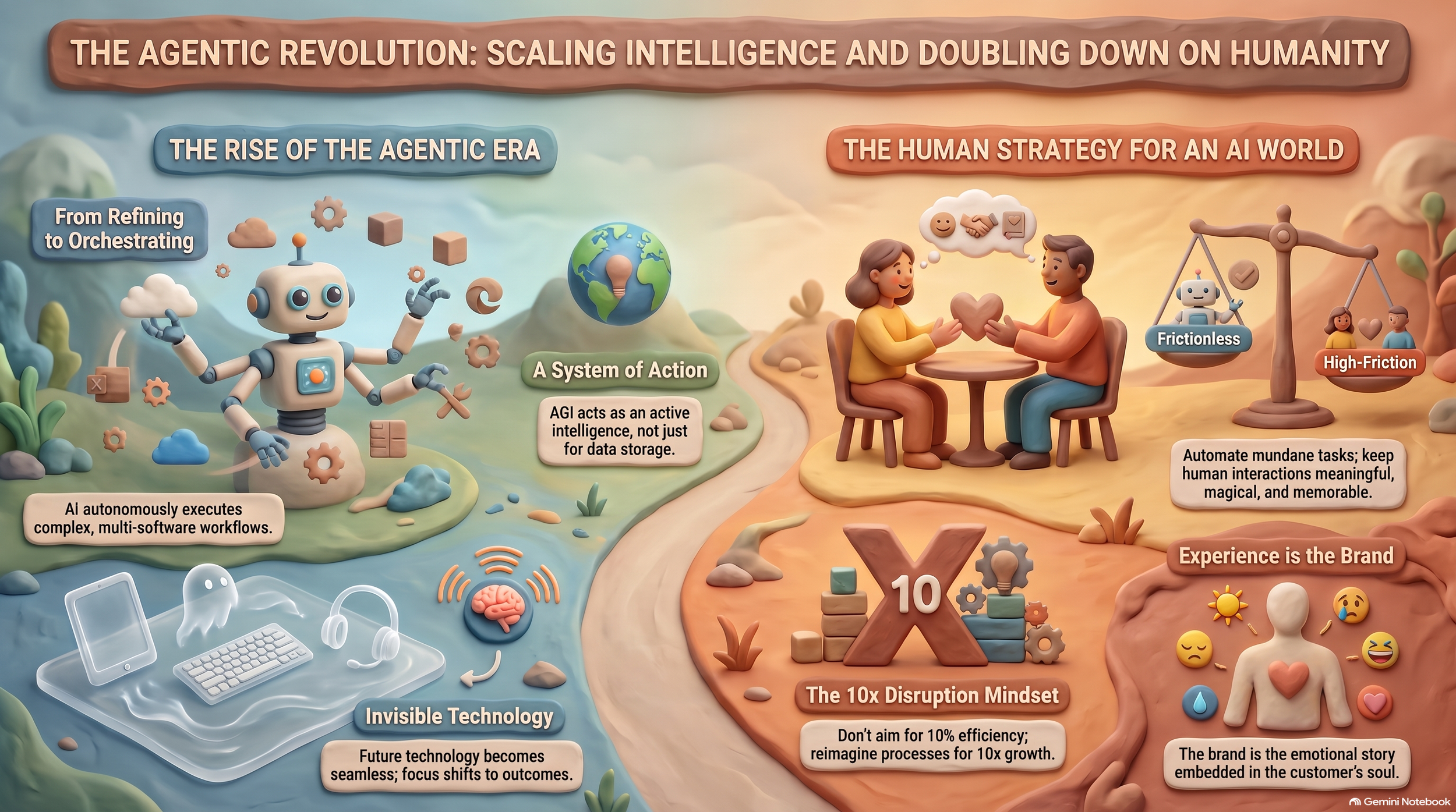
Artificial intelligence is rapidly transforming the modern workplace by shifting technology from a simple record-keeping system into an autonomous tool capable of executing complex tasks. During a keynote address at a conference, speaker Sean Kunga argued that while artificial intelligence often relies on conventional wisdom, it empowers professionals to transcend traditional boundaries and completely reimagine their organisations. Rather than replacing human labour entirely, these advanced agents can handle routine procedures across various software platforms, allowing people to focus on higher-level problem-solving and judgment. However, embracing this digital evolution requires leaders to overcome the fear of the unknown by developing a personal proficiency in new tools. Ultimately, true competitive advantage in an automated landscape stems from asking bold questions and cultivating a deep, human-centric commitment to customers.
KEY TAKEAWAYS (an AI-Output with Hallucinations)
MY #1 USED AI TOOL
Wispr Flow - I don’t type anymore, I just voice everything
My favorite AI AGENTS
Dots & GPT-6 Astra by OpenAI - AGI is here
Claude’s Opus 5.5 by Anthropic - The best model right now
Grok Bot by SpaceX AI - A downloadable AI team
Hermes - My personal AI Harness
Perplexity Computer - An AI agent orchestrator that has access to 19 different models
Muse by Meta - great personal AI agent - highly recommend for non-technical users.
Text-to-App
Lovable - Build any app with agentic reasoning (best at front-end)
v0 by Vercel - Text-to-Webpage (really good front-end)
Replit - Idea-to-App (best for full app)
Text-to-IMAGE/VIDEO
Claude Design for motion graphics - claude.ai/design
HeyGen - AI Video Avatar
ChatGPT Image 2.0 - Best Image Generator
Google’s Nano Banana Pro 2- 2nd Best Image Generator
Research & other
NotebookLM - Research and the two AI podcast hosts that you see above :)
Google AI Studio - Real-time AI co-presence
Clay - AI Outbound Sales | Generating lists of emails and sending cold outreach
Briefing: Innovation, AI, and the Agentic Era
Executive Summary
The rapid evolution of artificial intelligence has moved beyond simple productivity tools into the era of Artificial General Intelligence (AGI) and autonomous agents. This transition marks a fundamental shift from AI as a "system of record" to a "system of action." The primary challenge for modern organizations is not merely "bolting on" AI to existing processes, but reimagining the entire enterprise—a concept termed the "V2 Organization." Success in this new landscape requires moving beyond conventional wisdom and "best practices" toward a focus on human judgment, deep care, and the strategic use of "friction" to create meaningful experiences. The current era demands a "rookie mindset," where leaders must be willing to let go of the identities and methods that made them successful in the past to become "scary good" at harnessing new technological capabilities.
The Evolutionary Timeline of the AI Revolution
The progression of AI technology is categorized into three distinct eras, transitioning from simple task assistance to autonomous execution and supervision.
Era
Timeframe
Characteristics
The Polish Era
Late 2022 – 2025
Users primarily utilize AI for minor tasks: polishing emails, updating social bios, and creating simple creative imagery (e.g., "the Pope in Balenciaga").
The Agentic Era
Late 2025
Models develop reasoning capabilities. Software begins to think like humans and starts "getting stuff done" autonomously.
The AGI Era
2026 onwards
Technology functions as a digital employee. The human role shifts to managing, delegating, and supervising while the AI executes complex, multi-step tasks.
The Rise of Personal AI Agents
The current industry focus is shifting toward "Personal AI Agents"—24/7 digital entities that work continuously in the background. Unlike chatbots, these agents:
Maintain full context of a user's memory, emails, and business operations.
Proactively identify vulnerabilities, such as security gaps or travel discrepancies.
Can build entire platforms or plugins (e.g., creating a "LinkedIn for dots") overnight.
Function as an "invisible" layer of technology, allowing humans to focus on their craft rather than the underlying software.
The "V2" Organization: Reimagining the Enterprise
A critical error in current business strategy is attempting to layer AI on top of legacy processes. The "V2" concept advocates for rebuilding the organization from the ground up using AGI.
AI as a System of Action
Historically, software (ledgers, Excel, CRM, ERP) served as a "system of record"—a more elegant way of storing and retrieving data. AI transforms this into a "system of intelligence and action":
100% Software Utilization: While humans typically use only 20% of a software's capabilities, AI can utilize 100%, leveraging complex tools (like 3D modeling software or Unreal Engine) without the user needing to be an expert in the interface.
Superhuman Execution: AI can perform tasks humans physically cannot, such as 24/7 reconciliation of every invoice or a continuous audit of every transaction.
Invisible Technology: Drawing on the "Kelly Rowland/Microsoft Excel" anecdote, the future of tech is one where the user does not need to understand the application in the background; they simply focus on their world-class talent while the system handles the execution.
The Shift from Execution to Judgment
As AI masters the ability to execute any task, the source of professional and organizational power is shifting.
The End of Knowledge as Power: Since AI has aggregated all existing information, simply "knowing" things is no longer a competitive advantage.
The End of Execution as Power: When AI can use any software on a laptop better than a human, the ability to "do" the work is no longer the primary differentiator.
The Rise of Judgment: Power now resides in the ability to choose what to do. The easier it becomes to do anything, the more it matters what is chosen.
Beyond Best Practices: AI is the ultimate engine of conventional wisdom. True innovation requires asking "dangerous" or "dumb" questions that go against the consensus, as disruptive ideas (like credit cards or Uber) initially appear foolish to the status quo.
The "F-Word" in Business: The Strategic Use of Friction
In an increasingly automated world, technology is driving baseline customer expectations higher. To compete, organizations must choose between two extremes:
Incredible Frictionless Efficiency: Being "agentic," transactional, and seamless (e.g., Amazon, McDonald’s).
High-Friction Humanity: Purposely slowing down to create "meaningful, magical, and memorable" moments (e.g., The Four Seasons, Hermes).
Organizations trapped in the middle—the "black hole of mediocrity"—will fail. The goal is to be either "AI" (incredibly reliable technology) or "Al" (concierge-level, human value-add).
The "Deep Care" Strategy
Innovation is not just about technology; it is built on two human ingredients:
Deep Commitment to People: Caring for employees so they, in turn, care for customers (illustrated by the hotel that invited employees' parents to stay).
Willingness to Embrace Failure: Creating an environment where "trailblazers" feel empowered to experiment.
Overcoming the Crisis of Identity
The AI revolution is often perceived as a threat to jobs, but it is more accurately a threat to identity. Professionals with 20–50 years of experience have built their "egos" and "badges of experience" on skills that AI is now automating.
The Rookie Mindset
To survive the transition, leaders must:
Let Go of Past Success: What made a professional successful in the past will not get them to the next "mountain top."
Work Scared until You Become Scary: Immersion in the technology is the only cure for fear. The most "dangerous" people in an organization are specialists who have also mastered AI tools.
The "Why Not Me?" Question: While "Why not?" is the second most powerful question in innovation, the most important is "Why not me?"—challenging the individual to lead the disruption rather than follow it.
Critical Risks and Considerations
While the outlook is optimistic, several challenges remain:
Security and Governance: CISO and CIO roles are increasingly difficult as they must manage "data sovereignty" and new risk categories in an environment where AI uses sub-processors.
The Expertise Gap: There is a risk of employees using AI to perform tasks they do not fundamentally understand, leading to an inability to troubleshoot or verify accuracy. Deep domain specialty remains essential.
Misinformation: The threat of "deep fakes" and AI-driven misinformation requires a new level of education and skepticism, particularly for generations not natively trained to spot AI-generated content.
If you scrolled this far.
Here’s more!