
Thank you for being part of my session at HighLevel
The After Show
In the latest episode of The After Show, hosts dive into Shawn Kanungo's thought-provoking session at HighLevel
Leaders,
Are you ready?
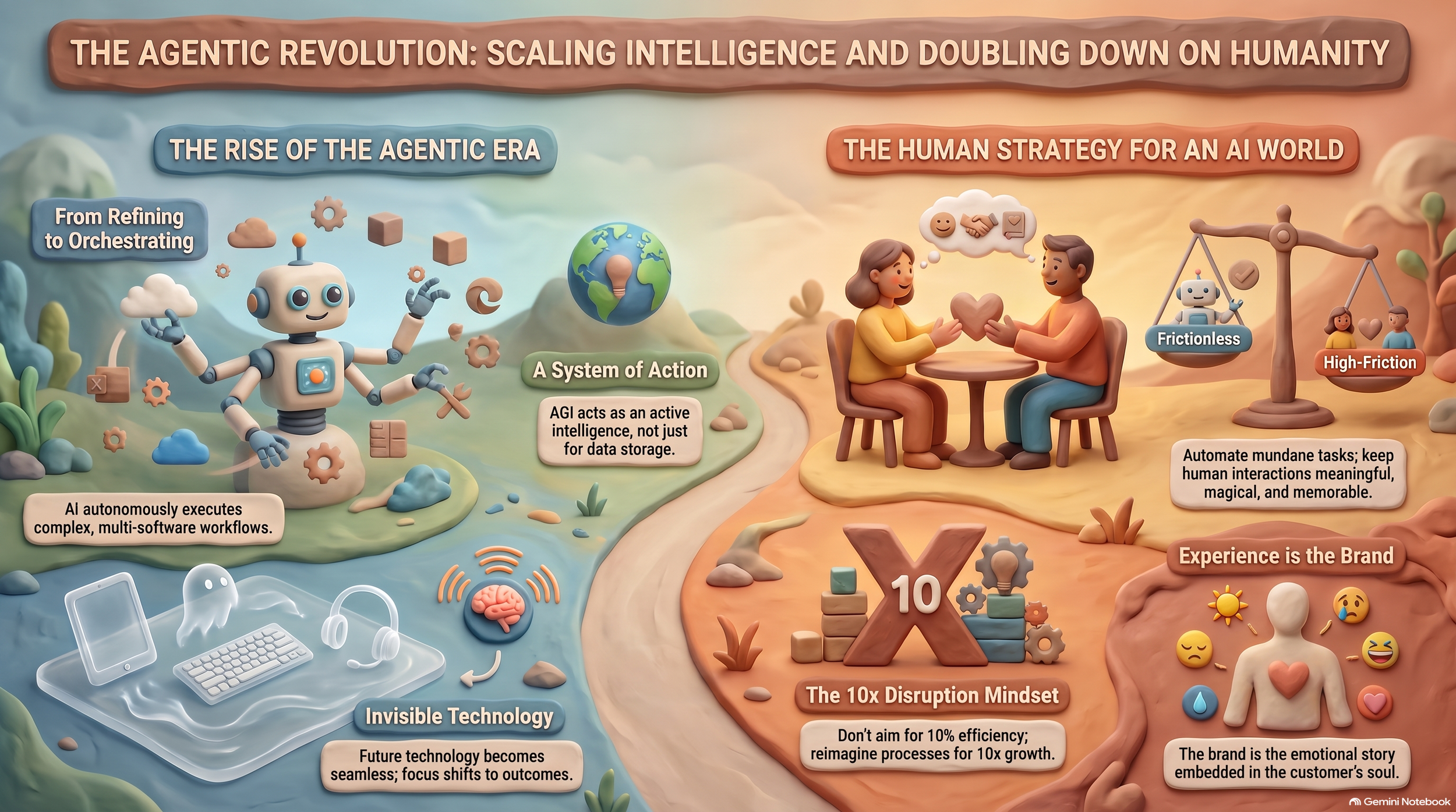
Artificial intelligence is fundamentally transforming the professional landscape by shifting the focus from manual execution to strategic judgment and measurable outcomes. Traditional software models are being replaced by autonomous, always-on AI agents that can independently navigate applications and handle complex workflows. Rather than fearing automation, professionals must reimagine their businesses from the ground up by embracing bold ideas and leveraging technology to amplify human strengths. Success in this new era requires organisations to choose between being entirely frictionless and automated or deeply consultative and relationship-driven, avoiding the mediocre middle ground. Ultimately, the most dangerous and successful person is one who is willing to abandon outdated methods, act like a rookie, and bravely pioneer new possibilities.
KEY TAKEAWAYS (an AI-Output with Hallucinations)
MY #1 USED AI TOOL
Wispr Flow - I don’t type anymore, I just voice everything
My favorite AI AGENTS
Dots & GPT-6 Astra by OpenAI - AGI is here
Claude’s Opus 5.5 by Anthropic - The best model right now
Grok Bot by SpaceX AI - A downloadable AI team
Hermes - My personal AI Harness
Perplexity Computer - An AI agent orchestrator that has access to 19 different models
Muse by Meta - great personal AI agent - highly recommend for non-technical users.
Text-to-App
Lovable - Build any app with agentic reasoning (best at front-end)
v0 by Vercel - Text-to-Webpage (really good front-end)
Replit - Idea-to-App (best for full app)
Text-to-IMAGE/VIDEO
Claude Design for motion graphics - claude.ai/design
HeyGen - AI Video Avatar
ChatGPT Image 2.0 - Best Image Generator
Google’s Nano Banana Pro 2- 2nd Best Image Generator
Research & other
NotebookLM - Research and the two AI podcast hosts that you see above :)
Google AI Studio - Real-time AI co-presence
Clay - AI Outbound Sales | Generating lists of emails and sending cold outreach
Executive Briefing: The Agentic Era, Outcome as a Service, and Strategic Reinvention
Executive Summary
The technological landscape has reached a fundamental tipping point, transitioning from the initial wave of artificial intelligence focused on content creation (2022–2025) to the Agentic and AGI (Artificial General Intelligence) Era (2026 and beyond). Modern frontier models—such as OpenAI’s Astra, Claude’s Fable/Opus 5.5, and specialized speech models like Block’s Desa AI—have shifted AI from software that merely generates content to autonomous software capable of performing complex cognitive tasks, executing workflows, and operating desktop applications better than human professionals.
This shift marks the official demise of traditional Software as a Service (SaaS) and the rise of Outcome as a Service (OaaS). Clients no longer desire systems of record or complex user interfaces; they demand direct, autonomous outcomes. Consequently, knowledge and execution have been democratized, elevating human judgment, bold problem framing, and idea generation as the ultimate competitive advantages.
To survive and thrive in this landscape, organizations must avoid the "black hole of mediocrity" by driving toward two distinct operational extremes:
Frictionless/Agentic Automation ("AI"): Invisible, background, ambient technology delivering seamless execution.
High-Friction Human Experience ("Al"): Deeply caring, high-value, concierge-level human touch.
Rather than incrementally bolting AI onto existing processes for 10% gains, businesses must build a "V2" organization—reimagining operations from scratch to achieve 10x improvements.
1. The Timeline of the AI Revolution (2022–2026+)
The trajectory of artificial intelligence over recent years highlights a rapid evolution from novel text/image generation to fully autonomous systems of action:
Era / Timeframe
Core Focus & Technological Capability
Defining Characteristics & User Behavior
Content Creation Era <br>(Late 2022 – 2025)
Refinement of text, media generation, and basic summarization.
- Email refinement and bio updates.<br>- Novelty image generation (e.g., Pope in a Balenciaga outfit).<br>- Human-driven prompting for static tasks.
Agentic Era <br>(2025)
Autonomous task execution and workflow handling.
- Software begins thinking and "getting stuff done."<br>- Integration of agentic task completion behind the scenes.
AGI / Ambient Era <br>(2026 and Beyond)
Artificial General Intelligence; cognitive parity with humans across general tasks.
- Integration of frontier models (OpenAI Astra, Claude Fable/Opus 5.5).<br>- Pure speech-to-speech voice models (Block's Desa AI).<br>- Ambient AI operating continuously in the background without manual prompting.
Key Technological Drivers
Speech-Native Voice Models: Breakthroughs like Block’s (Jack Dorsey) Desa AI move away from text-based training to pure speech training, enabling human-level expressive, conversational, and emotional voice interactions.
Ambient Background Agents: Systems such as OpenAI’s Dots, Meta’s Muse, and SpaceX’s Grockbot operate continuously in the background. They monitor context, travel plans, internal operations, and schedules without requiring step-by-step human prompts, rendering traditional manual "prompting" obsolete.
2. Paradigm Shift: From SaaS to Outcome as a Service (OaaS)
The Death of Traditional SaaS
Traditional software forced users to navigate user interfaces, select dropdowns, and manually manage data. In the current era:
Software is Going Headless: Clients do not want to manage or interact with software platforms. The UI is replaced by conversational or ambient AI agents that accept intent and execute backend actions.
Systems of Record vs. Systems of Action: For decades, software merely served as an elegant database to store, retrieve, and maintain data (e.g., ledger books to spreadsheets to QuickBooks). Modern AI introduces a system of action and intelligence capable of 24/7 autonomous operations—such as continuous transaction audits and receipt reconciliations—tasks no human could perform manually.
[Traditional Software] ---> System of Record ---> Manual UI Data Entry
[Modern AI Era]       ---> System of Action ---> Autonomous Outcome Delivery
The Business Model Transition
Software as a Service (SaaS): Sells access to tools, databases, and functional dashboards.
Outcome as a Service (OaaS): Charges directly for completed business results. Clients willingly pay higher margins for guaranteed outcomes rather than administrative software access.
3. Practical Applications & Software Demonstrations
Demonstrated implementations highlight how integrated AI engine capabilities (e.g., HighLevel's AI Studio, Lovable integration, and workflow builders) transform raw ideas into production-ready operations:
Automated Context Mapping & Matchmaking: Utilizing AI Studio to map conference attendees, discover hidden business connections, identify "unfound money" (e.g., specialized business scorekeepers), and assign dynamic dynamic matchings across network participants.
Instant Platform Generation (Lovable Integration): Prompt-driven software creation allowing complex applications—such as a custom Netflix-style onboarding platform for a business (e.g., Annmarie Waltz’s lash studio in West Springfield, MA)—to be built instantly and hooked directly into CRMs, automations, and marketing engines.
AI-Powered Workflow Automation: Automated generation of complex multi-step workflows (demonstrated for specialized niches like Janie’s Pet Biz CRM) via single-prompt "Build with AI" interfaces.
24/7 Interactive Voice & Avatar Booking: Deployment of lifelike digital avatars connected to voice models and CRM backends (e.g., Visionary Eye Center demo booking an eye exam for Denzel Washington's son, Dion), seamlessly handling customer intake, location selection, and database scheduling.
Autonomous Computer Use & Production: AI operating full desktop application suites (e.g., Final Cut Pro, After Effects) via direct computer usage—automatically scraping, identifying key segments, clipping, styling, captioning, and rendering video content (e.g., processing Release Radar podcast episodes into vertical clips).
4. Key Strategic Frameworks & Leadership Mindsets
1. Idea Generation & Judgment as the New Leverage
Execution & Knowledge are Democratized: Because AI can operate complex tools better and faster than untrained humans, raw execution power and accumulated basic knowledge are no longer primary competitive advantages.
Judgment is Power: Power lies in asking bold questions, selecting which problems to solve, and establishing high-level strategic direction.
The "Rookie Mindset": Leaders must cultivate the willingness to unlearn past successes, let go of healthy egos, and disrupt their own established models.
2. Building a "V2" Company & Starting from Zero
Most organizations make the mistake of taking existing, legacy processes and simply "bolting AI on top."
The V2 Model: Rebuild a second version of the organization entirely around native AI capabilities.
The "Zero-Based" Process Audit: Take an existing workflow, strip it down to zero, and evaluate:
What can be completely eliminated?
What can be autonomously automated?
What requires deep human empathy and creativity?
The 10x Timeline Compression: Question long-term planning by asking: "If you have a 5-year plan to get somewhere, why can’t you achieve it in 6 months?" Answering this forces radical reinvention rather than 10% incremental optimization.
3. AGI as "Awakening the Greatness Inside"
Rather than viewing AI as a force for job elimination, AGI can be framed as Awakening the Greatness Inside:
For over a century, work was structured around rigid assembly lines and software constraint parameters.
AI removes administrative drudgery (copy-pasting, data transfer, basic scheduling), enabling work to be designed around unique human strengths, talents, and strategic relationships.
5. Winning the Market: The Friction vs. Frictionless Edge
As technology elevates overall consumer expectations (where instant fulfillment is standard), operating in the middle of the market leads to the "black hole of mediocrity." Winning organizations will specialize at two extreme ends of the spectrum:
                      [THE MARKET SPECTRUM]

    FRICTIONLESS                               HIGH-EXPERIENCE
     AUTOMATION             BLACK HOLE            FRICTION
       ("AI")             OF MEDIOCRITY            ("Al")
  ------------------     ---------------     ------------------
  • Invisible Tech       • Standard UI       • Deeply Caring
  • Instant Execution    • Average Service   • Human Concierge
  • E.g., Amazon, Temu   • Slow Responses    • E.g., Four Seasons
The Two Winning Profiles
Frictionless & Agentic ("AI"): Fully automated, seamless, invisible systems where tasks complete with zero manual touch (e.g., Amazon, modern automated delivery systems).
Experiential Friction & Care ("Al"): Intentional slowing down of processes to deliver memorable, high-touch, consultative, concierge-level human experiences (e.g., The Four Seasons, Apple Genius Bar, dedicated business concierges).
Cultural Capital & Storytelling
While scaling output volume (e.g., generating high volumes of content) provides reach, the true edge lies in building cultural capital. Trust and affinity are built through narrative mastery—creating remarkable stories and products so compelling that customers and market participants organically amplify them.
Summary of Actionable Directives for Organizations
Overhaul the Value Proposition: Shift customer contracts and offers from tool access (SaaS) to direct outcome delivery (OaaS).
Initiate the V2 Blueprint: Establish an internal initiative to redesign key service workflows from zero, using agentic AI to target 10x gains rather than 10% efficiencies.
Eliminate Software UI Drag: Transition customer interfaces toward headless, voice, and conversational interfaces linked directly to underlying operational software.
Choose an Extreme: Audit customer touchpoints to ensure every interaction is either completely invisible and frictionless ("AI") or deeply personal, memorable, and high-touch ("Al").
Overcome AI Hesitation: Address organizational fear with deep technical immersion; building active competency transforms anxiety into creative enablement ("Work scared until you become scary").
If you scrolled this far.
Here’s more!