
Thank you for being part of my session at NFDA
The After Show
In the latest episode of The After Show, hosts dive into Shawn Kanungo's thought-provoking session at NFDA

Leaders,
Are you ready?
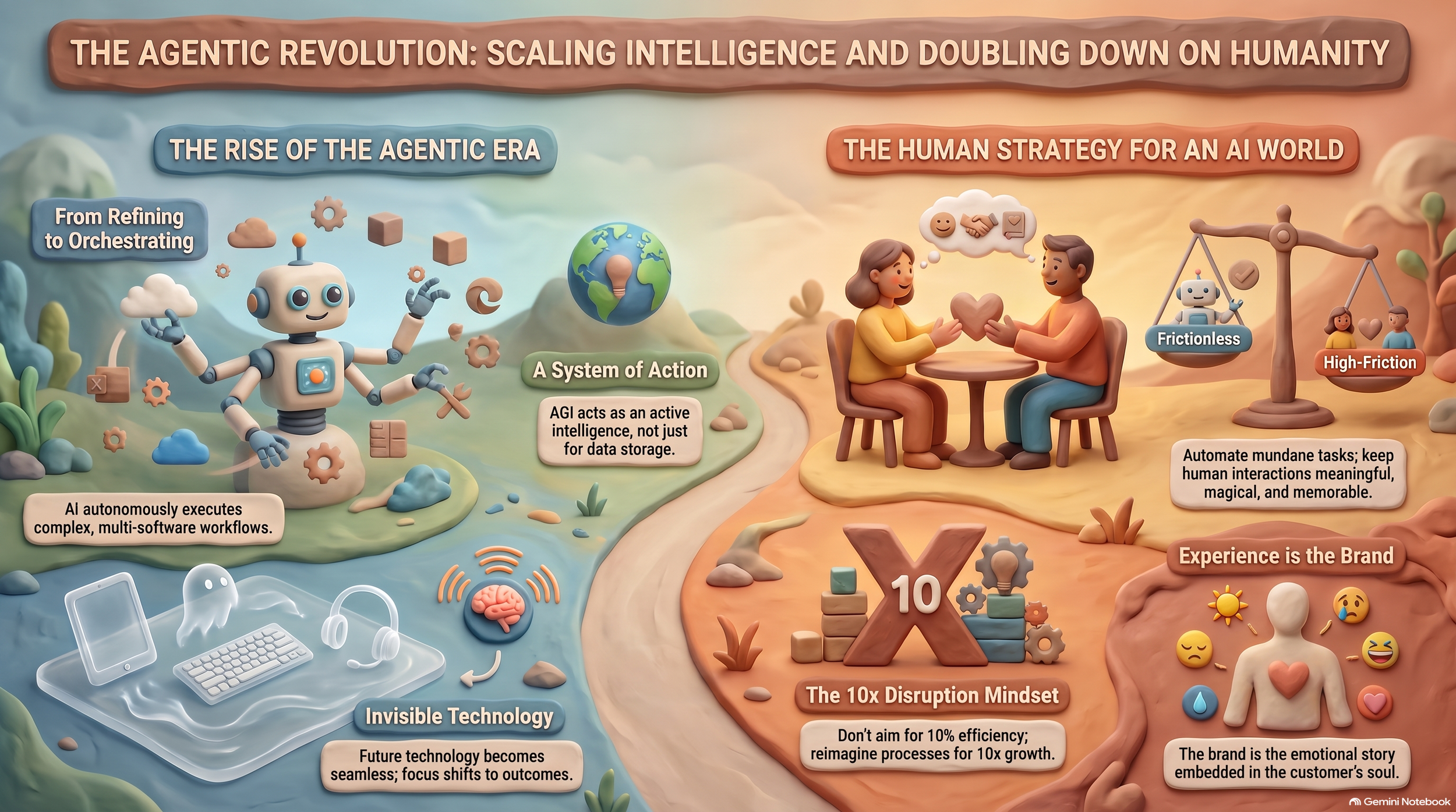
Artificial intelligence is rapidly transforming the modern workplace by shifting technology from a simple record-keeping system into an autonomous tool capable of executing complex tasks. During a keynote address at a conference, speaker Shawn Kanungo argued that while artificial intelligence often relies on conventional wisdom, it empowers professionals to transcend traditional boundaries and completely reimagine their organisations. Rather than replacing human labour entirely, these advanced agents can handle routine procedures across various software platforms, allowing people to focus on higher-level problem-solving and judgment. However, embracing this digital evolution requires leaders to overcome the fear of the unknown by developing a personal proficiency in new tools. Ultimately, true competitive advantage in an automated landscape stems from asking bold questions and cultivating a deep, human-centric commitment to customers.
KEY TAKEAWAYS (an AI-Output with Hallucinations)
MY #1 USED AI TOOL
Wispr Flow - I don’t type anymore, I just voice everything
My favorite AI AGENTS
Dots & GPT-6 Astra by OpenAI - AGI is here
Claude’s Opus 5.5 by Anthropic - The best model right now
Grok Bot by SpaceX AI - A downloadable AI team
Hermes - My personal AI Harness
Perplexity Computer - An AI agent orchestrator that has access to 19 different models
Muse by Meta - great personal AI agent - highly recommend for non-technical users.
Text-to-App
Lovable - Build any app with agentic reasoning (best at front-end)
v0 by Vercel - Text-to-Webpage (really good front-end)
Replit - Idea-to-App (best for full app)
Text-to-IMAGE/VIDEO
Claude Design for motion graphics - claude.ai/design
HeyGen - AI Video Avatar
ChatGPT Image 2.0 - Best Image Generator
Google’s Nano Banana Pro 2- 2nd Best Image Generator
Research & other
NotebookLM - Research and the two AI podcast hosts that you see above :)
Google AI Studio - Real-time AI co-presence
Clay - AI Outbound Sales | Generating lists of emails and sending cold outreach
Executive Briefing: Navigating AI, Innovation, and Strategic Transformation
This briefing document synthesizes key presentations and keynote addresses focusing on organizational innovation, the rapid evolution of Artificial Intelligence (AI), and strategic positioning for the future. Featuring insights from Alan Ram (Senior Vice President and Chief Pre-need Distribution Officer at NGL) and keynote speaker Shawn Kanungo (Innovation Strategist and Bestselling Author of The Bold Ones), this document highlights how organizations can harness emerging AI models, redefine competitive strategy through human-centered "friction," and overcome cultural barriers to achieve exponential growth.
Executive Summary
The business landscape is undergoing a fundamental shift from an era of digitizing data to an era of autonomous action and Artificial General Intelligence (AGI). While conventional AI models optimize past data, strategic market advantage requires asking bold, disruptive questions ("Why not?") that go beyond conventional wisdom.
Key takeaways from the addresses include:
Evolution to Actionable AI: Generative technology has transitioned from basic task automation (2022–2025) to autonomous agents and AGI systems capable of precision engineering, workflow creation, and full execution.
Shift in Value Drivers: In an automated economy, knowledge and execution are commoditized; judgment—knowing what questions to solve and what actions to take—becomes the primary competitive moat.
The Strategic Necessity of Friction: As technology renders transactions frictionless, baseline customer expectations rise. Organizations must differentiate by either offering fast, frictionless convenience or high-friction, deeply caring, experiential touchpoints ("AI + Al").
Overcoming Organizational Inertia: Most organizations fail to innovate because they fund certainty ($100,000 in cost savings) rather than courage ($1,000,000 in potential revenue). True reinvention requires asking radical questions—such as executing a 5-year plan in 6 months—and letting go of legacy achievements.
1. Sponsor Perspective: NGL and Service-Driven Value
Alan Ram introduced the core operating philosophy of National Guardian Life Insurance Company (NGL) within the funeral and pre-need industry.
Core Mission Alignment: Serving families is established as the primary focus ("bread and butter") of funeral home operators, whereas pre-need insurance products and support serve as NGL’s core specialty.
Operational Ecosystem: NGL emphasizes simple death claims processes, dedicated service teams, customized sales training programs, and personal relationship building (e.g., professional support coupled with personal touches like birthday acknowledgments).
Industry Support: Support systems must alleviate backend burdens for service providers so they can maintain focus on high-touch family care.
2. The AI Trajectory: From Optimization to the AGI Era
Shawn Kanungo outlined the rapid acceleration of artificial intelligence, tracing its trajectory from basic text polishers to autonomous cognitive systems.
+-------------------------------------------------------------------+
|                     THE EVOLUTION OF AI                           |
+-------------------------------------------------------------------+
|  2022 - 2025: Basic Optimization Era                              |
|  - Task-specific prompts (email editing, bio updates, images)     |
|  - Focus: Incremental personal productivity                       |
+-------------------------------------------------------------------+
|  Late 2025: Agentic Era                                           |
|  - Autonomous AI agents executing multi-step workflows            |
|  - Shift from answering questions to getting tasks done           |
+-------------------------------------------------------------------+
|  2026+: Artificial General Intelligence (AGI) Era                 |
|  - Cognitive parity with human capability                         |
|  - Continuous recursive self-improvement & precision engineering  |
+-------------------------------------------------------------------+
The Limits of Conventional Models
Optimizing the Past: AI aggregates historical data and scientific research to predict outputs. If historical mechanics like the Wright brothers had relied on generative AI, past data would have suggested human flight was impossible.
The Edge of Disruption: AI excels at conventional wisdom. Competitive edge stems from asking non-obvious, disruptive questions that challenge established frameworks.
The Financial and Market Velocity of AI
The public and financial sector sensitivity to AI messaging is unprecedented:
During a Google developer conference, CEO Sundar Pichai used the term "AI" 34 times, which coincided with a $37 billion increase in Google's market value on that day.
Industry leaders, including Nvidia CEO Jensen Huang, indicate that Artificial General Intelligence (AGI) capabilities have arrived, shifting the narrative from experimental technology to core infrastructure.
3. Practical Demonstrations: Precision Engineering and Rapid Execution
To demonstrate the current capacity of frontier AI tools (such as Anthropic’s Claude, Perplexity, and OpenAI models), Kanungo presented three live organizational prototypes built using prompt-driven design:
Demonstration Target
AI Tool Used
Execution & Operational Deliverable
Strategic Business Value
NGL Onboarding Platform
Claude (Anthropic)
Built a Netflix-style employee onboarding user interface aligned with corporate operations.
Replaces legacy software development. Continuous recursive loops allow AI to patch security and fix backend code ("precision engineering").
FIAT-IFDA Global Recruitment
Perplexity
Scanned 80–90 member countries, identified 1,000 live job postings across 34 countries, ranked 22,000 potential candidates, and drafted localized outreach emails.
Replaces manual global headhunting by identifying specific global talent (e.g., candidate Rosenberg Sepulveda in Colombia) instantly.
Batesville Branded Caskets ("Afterlife")
Astra / ChatGPT
Reverse-engineered Canada Goose’s luxury e-commerce layout; designed artist-branded caskets (Drake, Billie Eilish, The Weeknd); ran 100 targeted digital ads.
Tested a net-new business line that generated 11 pre-orders with minimal ad spend (top seller: Drake "Money in the Grave" casket).
The "V2" Organizational Concept
Every business is advised to build a V2—a parallel, second version of the organization natively designed around AI processes rather than attempting to retrofit AI on top of outdated legacy workflows.
4. Systems of Action, Judgment, and Human Potential
The transition to AGI fundamentally alters the historical relationship between software, labor, and value creation.
+-------------------------------------------------------------------+
|                  EVOLUTION OF DATA SYSTEMS                        |
+-------------------------------------------------------------------+
|  SYSTEMS OF RECORD (Past 40-50 Years)                             |
|  Ledger Books -> Spreadsheets (Excel) -> Cloud Systems (QuickBooks)|
|  Function: Elegant storage, retrieval, and maintenance of data.   |
+-------------------------------------------------------------------+
|                                 │                                 |
|                                 ▼                                 |
+-------------------------------------------------------------------+
|  SYSTEMS OF ACTION / INTELLIGENCE (Present & Future)              |
|  Autonomous AI Agents & AGI Frameworks                            |
|  Function: 24/7 continuous audits, transactions, and execution.   |
+-------------------------------------------------------------------+
The Redefinition of Power
Historical frameworks defined organizational value through knowledge or execution. Today, those capabilities are democratized:
Knowledge is Power (Obsolete): Broad access to real-time AI co-pilots negates information asymmetry.
Execution is Power (Obsolete): Autonomous agents execute digital tasks faster and more accurately than humans.
Judgment is Power (Current Moat): As execution becomes effortless, strategic value rests entirely on human judgment—choosing which problems are worth solving.
Reimagining Knowledge Work and "AGI"
Redesigning the Assembly Line: Work over the last century was built around technology constraints (e.g., CRM maintenance, data entry). AI enables work to be structured around unique human strengths.
AGI as "Awakening the Greatness Inside": AI agents absorb backend administrative burdens (drudgery), freeing professionals to focus on relationship-driven and strategic responsibilities.
Labor Displacement Dynamics: AI agents will displace work that humans were previously unable to perform (e.g., continuous 24/7 transaction auditing).
The Safest Jobs: A Microsoft study highlighted manual, tactile roles—such as a dredge operator (e.g., operator Donnie McCoy using pencil and paper)—as the most insulated from immediate AI automation.
Professional Mindset: AI itself will not take jobs; rather, individuals who master AI will replace those who do not. Professionals must "work scared until they become scary [dangerous/indispensable]."
5. Strategic Differentiating: Bringing Back "Friction" and High Care
When digital platforms make everyday transactions frictionless, consumer baseline expectations continually rise. Organizations must strategically choose their market position to avoid commoditization.
                  THE STRATEGIC MARKET POSITIONING MATRIX

         High Experience / High Human Touch
                       ▲
                       │     HERMÈS / FOUR SEASONS
                       │     APPLE GENIUS BAR
                       │     HIGH-CARE FUNERAL SERVICES ("Al")
                       │
                       │   [ THE BLACK HOLE OF MEDIOCRITY ]
                       │   (Avoid middle-ground operations)
                       │
                       │     AMAZON / TEMU / MCDONALD'S
                       │     (Pure Digital Automation)
                       ────────────► Low Friction / Pure Speed
The Two Winning Operating Models
Fast and Frictionless: Highly automated, instant, transaction-focused organizations (e.g., Amazon, Temu, McDonald's).
Slow, Experiential, and High Friction: Organizations centered on craftsmanship, human connection, and memorable moments (e.g., Hermès, Four Seasons, Apple Genius Bar).
Warning: Operating in the middle creates a "black hole of mediocrity." Service-oriented industries, particularly death care, reside fundamentally in the high-friction, human-centered domain.
The Dual Paradigm: "AI" and "Al"
Long-term organizational trust relies on two elements:
AI (Reliable Technology): Invisible software working in the background to handle scheduling, data validation, and forms.
Al (High-Touch Concierge): Empathetic, dedicated human guidance (exemplified by Gaylord Resorts' "Celebrity Services" or personalized hotel interactions like the Dubai wake-up call service provided by personnel like Muhammad).
Deep Care as Strategy
A sustainable culture of innovation requires two operational pillars:
A profound, demonstrable commitment to people (deep care for employees and customers).
An organizational willingness to embrace failure.
6. Overcoming Organizational Ego and Exercising Courage
The central impediment to innovation in established businesses is rarely technological capability; it is a lack of institutional courage.
The Innovation Dilemma: "Bread" vs. "Revenue"
When presented with a choice between two innovation paths, standard executive teams default to risk aversion:
Option A ("Bread"): A guaranteed $100,000 in cost savings unlocked by AI.
Option B ("The Lottery Ticket"): A $1,000,000 net-new revenue opportunity with a 5% probability of success, where failure is publicly visible.
Most corporate cultures choose the "bread" because corporate funding mechanisms prioritize certainty over disruptive growth.
Dangerous Questions and Unlearning Experience
To escape incremental improvement (10%) and achieve exponential results (10x), leaders must employ radical frameworks:
+-------------------------------------------------------------------+
|                   THE "STARTING FROM ZERO" METHOD                 |
+-------------------------------------------------------------------+
|  1. Radical Horizon Question:                                     |
|     "Why can't we execute our 5-year plan in 6 months?"           |
|     (Forces immediate structural redesign over minor optimization)|
+-------------------------------------------------------------------+
|  2. Process-Level Audit: Select a core workflow and apply:        |
|     - What do we AUTOMATE?                                        |
|     - What do we ELIMINATE?                                       |
|     - Where do we add HUMAN FRICTION/CARE?                        |
+-------------------------------------------------------------------+
|  3. Ego Shedding & Gratitude:                                     |
|     - Honor past operating paradigms that yielded success.        |
|     - Formally "bury" legacy habits to build the new model.       |
+-------------------------------------------------------------------+
The Pattern of Disruptive Ideas
Historically disruptive ideas—such as credit cards at fast-food restaurants in the 1990s, online banking, ride-sharing (Uber), or peer-to-peer marketplaces (Facebook Marketplace)—initially look foolish to industry incumbents. Dangerous ideas consistently look dumb until the non-adapters look obsolete.
Conclusion
Navigating the next era of disruption requires balancing technological capabilities with empathetic human service. Organizations must leverage AI tools to eliminate operational friction in the backend, while intentionally injecting human care, judgment, and connection into customer experiences. Success demands abandoning legacy achievements, funding bold experiments, and acting with courage in the face of uncertainty.
If you scrolled this far.
Here’s more!