
Thank you for being part of my session at EY
The After Show
In the latest episode of The After Show, hosts dive into Shawn Kanungo's thought-provoking session at EY

Leaders,
Are you ready?
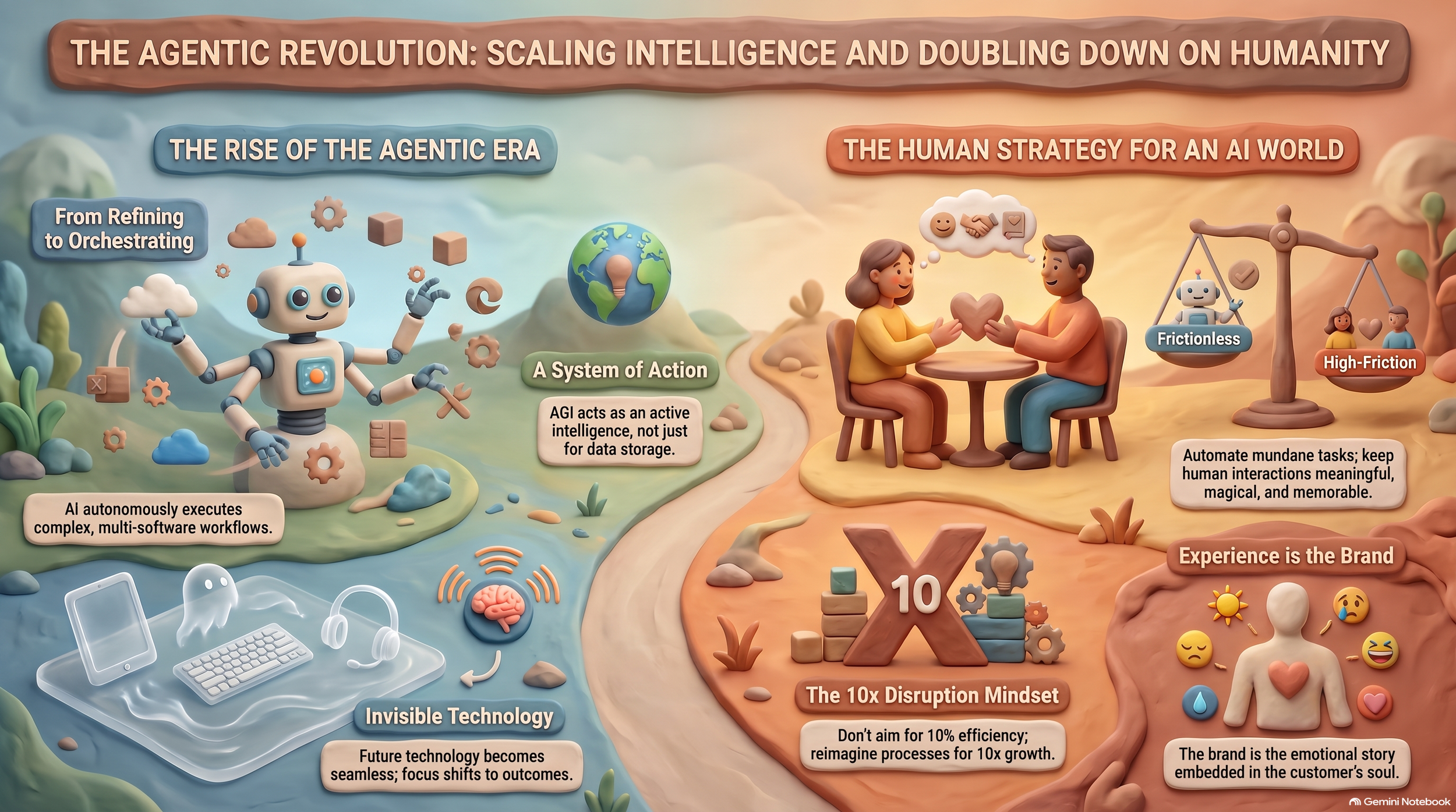
Artificial intelligence is rapidly transforming the modern workplace by shifting technology from a simple record-keeping system into an autonomous tool capable of executing complex tasks. During a keynote address at a conference, speaker Shawn Kanungo argued that while artificial intelligence often relies on conventional wisdom, it empowers professionals to transcend traditional boundaries and completely reimagine their organisations. Rather than replacing human labour entirely, these advanced agents can handle routine procedures across various software platforms, allowing people to focus on higher-level problem-solving and judgment. However, embracing this digital evolution requires leaders to overcome the fear of the unknown by developing a personal proficiency in new tools. Ultimately, true competitive advantage in an automated landscape stems from asking bold questions and cultivating a deep, human-centric commitment to customers.
KEY TAKEAWAYS (an AI-Output with Hallucinations)
MY #1 USED AI TOOL
Wispr Flow - I don’t type anymore, I just voice everything
My favorite AI AGENTS
Dots & GPT-6 Astra by OpenAI - AGI is here
Claude’s Opus 5.5 by Anthropic - The best model right now
Grok Bot by SpaceX AI - A downloadable AI team
Hermes - My personal AI Harness
Perplexity Computer - An AI agent orchestrator that has access to 19 different models
Muse by Meta - great personal AI agent - highly recommend for non-technical users.
Text-to-App
Lovable - Build any app with agentic reasoning (best at front-end)
v0 by Vercel - Text-to-Webpage (really good front-end)
Replit - Idea-to-App (best for full app)
Text-to-IMAGE/VIDEO
Claude Design for motion graphics - claude.ai/design
HeyGen - AI Video Avatar
ChatGPT Image 2.0 - Best Image Generator
Google’s Nano Banana Pro 2- 2nd Best Image Generator
Research & other
NotebookLM - Research and the two AI podcast hosts that you see above :)
Google AI Studio - Real-time AI co-presence
Clay - AI Outbound Sales | Generating lists of emails and sending cold outreach
Executive Briefing: Navigating the Agentic Era, Human Value, and Enterprise Disruption
Executive Summary
The rapid evolution of Artificial Intelligence (AI) has shifted the technological baseline from basic generative prompt-response tasks to an agentic era defined by Artificial General Intelligence (AGI) capabilities, autonomous workflows, and continuous execution systems. Based on key insights presented by technology innovator Shano, the modern enterprise is undergoing a fundamental transition: software is evolving from a mere system of record (storing and maintaining data) to an active system of action (autonomous execution, intelligent decision-making, and continuous optimization).
To maintain competitive advantage over the next 12 months—described as the most critical period of modern professional careers—organizations and individuals must reframe their approach to AI. Success will not stem from leveraging AI merely for incremental efficiency gains, but from asking bolder strategic questions, embracing intentional operational friction to deliver authentic human experiences, and fundamentally disrupting established playbooks.
Critical Takeaways
Strategic Theme
Historical Standard
AGI / Agentic Era Reality
Actionable Imperative
Software Capability
System of Record (Excel, QuickBooks, static data management)
System of Action (Autonomous 24/7 audits, continuous execution)
Shift workflows from manual data handling to ambient, goal-oriented AI execution.
Core Value Driver
Knowledge & Technical Execution ("Knowledge is Power")
Strategic Judgment & Ambition ("Judgment is Power")
Focus human effort on asking the right questions and choosing high-impact problems.
Talent Strategy
Task standardization, specialization within rigid software systems
"Scary Good" Talent (Craft Mastery + AI Tooling Fluency)
Cultivate psychological safety, encourage risk-taking, and redesign work around human strengths.
Market Differentiation
Total Frictionlessness (Button-tap automation, standardized delivery)
Dual-Model Success (Frictionless Efficiency vs. High-Friction Human Experiences)
Automate routine processes while intentionally adding meaningful human touchpoints ("friction").
Innovation Approach
Funding Certainty ("Bread" / Incremental cost savings)
Funding Ambition ($100M upside / Bold 10x reinvention)
Compress 5-year strategic plans into 6-month timelines by reinventing core models from zero.
1. The Technological Paradigm Shift: 2022 to the Agentic Era
Evolution of AI Utilization
Between the emergence of public generative AI models at the end of 2022 and 2025, user engagement primarily fell into three basic transactional categories:
Refining and polishing written text (e.g., emails).
Generating creative personal copy (e.g., dating profiles).
Producing novel image generation (e.g., stylized pop culture imagery).
By late 2025 and 2026, advancing frontier models—such as Anthropic’s Claude Opus 5.5, OpenAI’s Astra, Meta’s Muse, Claude's Duet, and OpenAI's Dots—catalyzed the transition into AGI and personal ambient agents. These models have achieved human-equivalent cognitive performance and advanced computer-use capabilities, allowing AI to manipulate third-party desktop applications, design assets, and write/fix software recursively.
[2022–2025: Prompt Era] ───> Basic Outputs (Text Editing, Bio Polishing, Image Generation)
                                    │
                                    ▼
[2025–2026+: Agentic AGI Era] ──> Autonomous Systems of Action (Recursive Code Repair, Enterprise Operations, Ambient Background AI)
Key Technical Characteristics of Ambient AGI
Recursive Self-Improvement: AI systems now operate in recursive loops, fixing their own application code, patching security vulnerabilities, and refining UI/UX designs autonomously.
Shift from "Vibe Coding" to Precision Engineering: Software creation has shifted from basic code-sketching to precision application building, where software engineers build models predominantly through natural language prompting.
Transition to Computer-Use Proficiency: Frontier models can operate desktop software—such as Final Cut Pro or specialized design tools—at speeds 10x to 1,000x faster than human professionals, performing tasks without requiring native user proficiency from the human operator.
Explosive Token Usage: As AI agents run continuously 24/7 in the background identifying operational discrepancies and security risks, token consumption will grow exponentially, requiring enterprises to implement sophisticated token allocation models.
Demonstrated Capabilities in Enterprise Workflows
Demonstrated enterprise-level applications highlight the scope of current agentic capabilities:
Enterprise Onboarding Applications: Generating full-stack, tailored employee onboarding platforms with custom UI/UX, back-end code, and dynamic security alignment directly from natural language prompts.
Global Talent Acquisition & Ranking Platforms: Utilizing deep search agents (e.g., Perplexity) to search global job listings (~9,000 to 10,000 positions), evaluate hundreds of thousands of candidate profiles (e.g., 175,000 candidates), map regional requirements (such as banking automation testers in Toronto), build comparative candidate ranking platforms, and automatically draft thousands of personalized outbound emails.
Multi-Modal Content Pipeline Automation: Deploying autonomous agents (e.g., "Carlton") featuring custom avatars and voice interfaces to consume multi-document repositories, producing derived deliverables including audio podcasts, executive briefing notes, and 10-page presentation decks on demand.
Autonomous Marketing Execution: Ingesting raw media (such as specialized corporate podcasts like Geostrategy in Action), analyzing full episodes to isolate optimal highlights, applying custom visual motifs via design agents, and manipulating local video editing software to auto-generate marketing collateral.
2. Redefining Labor, Judgment, and the "Scary Good" Workforce
From Systems of Record to Systems of Action
For decades, workplace technology evolved merely as higher-efficiency storage and retrieval systems:
1970s–1980s: Paper ledgers and physical accounting books.
1990s: Digital spreadsheets (Microsoft Excel).
2000s–2010s: Enterprise Resource Planning (ERP), Customer Relationship Management (CRM) tools, and specialized software (e.g., QuickBooks, OCR machines).
These tools remained systems of record. The current paradigm shift delivers a system of action—an intelligent framework capable of executing complex human workflows autonomously (e.g., performing continuous, 24/7 audits of every corporate transaction or real-time reconciliation of receipts and invoices).
   System of Record (Past 50 Years)            System of Action (Agentic Era)
┌─────────────────────────────────────┐     ┌─────────────────────────────────────┐
│ • Manual Data Entry                 │     │ • 24/7 Autonomous Audit & Recs     │
│ • Static Spreadsheets & ERPs        │ ──> │ • Automated Workflow Execution      │
│ • Passive Information Storage       │     │ • Proactive Intelligence & Action   │
└─────────────────────────────────────┘     └─────────────────────────────────────┘
The Shift in Value: Knowledge vs. Execution vs. Judgment
Historical assumptions regarding individual career value have been invalidated by AI capabilities:
Knowledge is Power (Invalidated): When every individual possesses an AI co-pilot trained on all historic scientific and human data, raw knowledge retrieval is democratized.
Execution is Power (Invalidated): When AI uses desktop software and builds infrastructure faster and more proficiently than human experts, raw technical execution ceases to be the primary edge.
Judgment is Power (Current Reality): Power now resides in human judgment, taste, and problem selection. As doing anything becomes frictionless, success depends on what a professional chooses to do and the questions they pose.
"Awakening the Greatness Inside" (AGI) & Redesigning Work
The traditional industrial model—pioneered by Henry Ford’s assembly line—standardized human effort, forcing individuals into rigid, system-centric roles (e.g., "the ERP manager" or "the CRM data clerk") spent performing repetitive "robot work."
Modern AGI enables a transition from "robot work" to true "human work":
Work Redesign: Designing roles around individual human gifts, creative vision, and relationship-building while assigning back-end, administrative, and visual execution tasks to dedicated AI agents.
Labor Protection Reality: Microsoft studies indicate that manual, physical, offline roles (e.g., dredge operators like Donnie McCoy using paper and pencil, plumbers, nurses, electricians) remain protected from direct automation, while digital professional roles are fundamentally reshaped.
The "Scary Good" Professional: The elite workforce of the agentic era consists of individuals who maintain deep craft mastery while effectively harnessing AI capabilities.
                                  [Modern Talent Matrix]

                                     Craft Mastery
                                          ▲
                                          │
                  Legacy Specialist       │      "Scary Good" Elite
               (High Craft, Low Tech)     │   (High Craft, High Tech)
                                          │
       ───────────────────────────────────┼───────────────────────────────────►
                                          │                                     AI Tooling
                                          │                                     Fluency
                 At-Risk / Obsolete       │      Automated Generalist
                (Low Craft, Low Tech)     │    (Low Craft, High Tech)
                                          │
                                          │
3. Strategic Differentiation: The Value of Intentional Friction
The Baseline Expectation Trap
Every major technological advancement elevates baseline consumer and client expectations. Where consumers previously endured long download times or complex multi-step processes, modern users demand instant execution (e.g., one-click food delivery, instant retail fulfillment, automated strategy generation).
However, reliance on pure automated execution leads to a degradation of authentic connection. Unfiltered AI outputs (e.g., generic AI-generated presentation decks or marketing "slop") are easily recognized and ignored.
Dual Winning Models: Speed vs. Friction
Organizations will fall into two successful categories, avoiding the middle "black hole of mediocrity":
 ┌────────────────────────────────┐                 ┌────────────────────────────────┐
 │     Frictionless & Fast        │                 │     Intentional Friction       │
 ├────────────────────────────────┤                 ├────────────────────────────────┤
 │ • Instant, button-tap scale    │   THE BLACK     │ • High-touch, human experiences│
 │ • Fully automated execution    │    HOLE OF      │ • Deep trust & relationship    │
 │ • Low-margin / high-volume     │  MEDIOCRITY     │ • Bespoke problem-solving      │
 │ • E.g., Amazon, Temu, McDonald's│  (Avoid This)   │ • E.g., Four Seasons, Apple    │
 └────────────────────────────────┘                 └────────────────────────────────┘
Frictionless and Fast: Organizations that completely automate delivery via instant, seamless, agentic execution (e.g., Amazon, Temu, McDonald's).
High-Friction and High-Touch: Organizations that deliberately slow processes down to build trust, offer human guidance, create memorable experiences, and solve complex, tailored problems (e.g., luxury hospitality like Four Seasons, Apple's Genius Bar).
The "AI + Al" Service Framework
In professional services, long-term brand equity is defined by the experience delivered rather than marketing collateral. Trust requires a dual-foundation model:
$$\text{Enterprise Value} = \mathbf{\text{AI}} \text{ (Reliable, Continuous Technology)} + \mathbf{\text{Al}} \text{ (Concierge-Level Human Value-Add)}$$
Reliable Technology ($\mathbf{\text{AI}}$): Automated, hyper-efficient, flawless background execution (analogy: an un-failing smartphone alarm array).
Deeply Cared-For People ($\mathbf{\text{Al}}$): Empathetic, highly attentive human practitioners who offer bespoke support and proactively care for client outcomes (analogy: high-end hotel concierge services delivering personal door-knocks and employee-family hospitality initiatives).
4. Organizational Culture and Self-Disruption
Core Ingredients of an Innovative Culture
Establishing an enterprise culture capable of leveraging AI requires two structural components:
Deep Commitment to People: Establishing psychological safety so team members feel supported when attempting unconventional strategies.
Willingness to Embrace Failure: Institutional tolerance for calculated risks to create empowered, innovative talent.
The Innovation Paradox: Bread vs. Courage
When faced with organizational strategic choices, standard enterprise structures routinely default to funding certainty over transformative innovation:
                                [The Enterprise Risk Dilemma]

    Option A: "The Bread"                                 Option B: "The Opportunity"
┌───────────────────────────────┐                     ┌───────────────────────────────┐
│ • $1M Guaranteed Cost Savings │                     │ • $100M New Revenue Upside    │
│ • Incremental / Safe          │                     │ • 5% Success Probability      │
│ • Highly Funded by Default    │                     │ • High Personal Risk / Fame   │
└───────────────────────────────┘                     └───────────────────────────────┘
The "Bread" Choice: Guaranteed incremental cost reduction ($1 Million in efficiency savings unlocked by AI).
The "Opportunity" Choice: Transformative growth ($100 Million in new market revenue with a 5% success probability and high personal visibility upon failure).
Enterprise friction is rarely a technology problem; it is a courage problem. Organizations frequently speak of innovation while exclusively funding "the bread."
Case Study: Re-framing Questions (Kobayashi vs. Chestnut)
Major industry disruptions occur not by optimizing existing parameters, but by changing the underlying question:
Takeru Kobayashi (2001): Transformed competitive eating by increasing the world record from 25 to 50 hot dogs in a single event. Rather than asking "How do I eat more hot dogs?", he asked, "How do I eat a hot dog more easily?" (introducing methods such as breaking the sausage, soaking buns in water, and physical body wiggling).
Joey Chestnut: Maintained dominance by changing the training question to, "How do I train like an elite athlete?" (incorporating targeted jaw/stomach conditioning analogous to professional sports training).
The 6-Month Framework for Self-Disruption
Disruptive technological innovations initially appear impractical or absurd—similar to early public reactions to using credit cards at fast-food establishments in the late 20th century or entering rideshare vehicles with strangers.
To prevent obsolescence and bypass incremental thinking, leaders must apply the 6-Month Constraint Filter:
$$\text{Strategic Challenge: } \text{Execute your 5-Year Plan in } \mathbf{6 \text{ Months}}.$$
Operational Impact: Answering this question renders standard 10% optimizations impossible. It forces teams to zero-base their assumptions, eliminate low-value tasks, automate core administration, and build 10x delivery models.
Transitioning from Mastery to "Rookie Status"
Sustained performance in the agentic era requires letting go of historical playbooks, titles, and past achievements. Professional progression requires continuous zero-based evaluation across three operational categories:
Automate: Tasks transferred entirely to autonomous background AI agents.
Eliminate: Redundant legacy processes, reports, and handoffs that no longer add value.
Frictionize: Critical human interactions deliberately slowed down to maximize trust, strategy, and personal care.
5. Comprehensive Summary of Key Insights & Synthesis
                                  [The Path Forward]

  1. ASK BOLDER QUESTIONS    ───>  Replace "How to optimize?" with "Why not in 6 months?"
  2. DEPLOY AI SYSTEMS       ───>  Shift from manual prompts to continuous Systems of Action.
  3. EMBRACE INTENTIONAL FRICTION─> Combine reliable tech (AI) with concierge care (Al).
  4. WORK SCARED TO BE SCARY ───>  Pair craft mastery with technological fluency.
Core Analytical Conclusions
Past Data vs. Future Innovation: AI is trained entirely on historical data. Relying strictly on AI analysis yields conventional wisdom. Competitive edge requires human leaders to ask visionary questions ("Why not?") that transcend historical datasets.
Continuous AI Integration: The gap between professionals who master agentic AI systems and those who do not will compound rapidly over the next 12 months.
The Core Question of Action: The ultimate strategic driver for individual and enterprise transformation is moving beyond passive observation to ask: "Why not me?"
thumb_upGood report thumb_downBad report
If you scrolled this far.
Here’s more!