
Thank you for being part of SLF 2026
The After Show
In the latest episode of The After Show, hosts dive into Shawn Kanungo's thought-provoking session at SLF 2026
Element,
Are you ready?
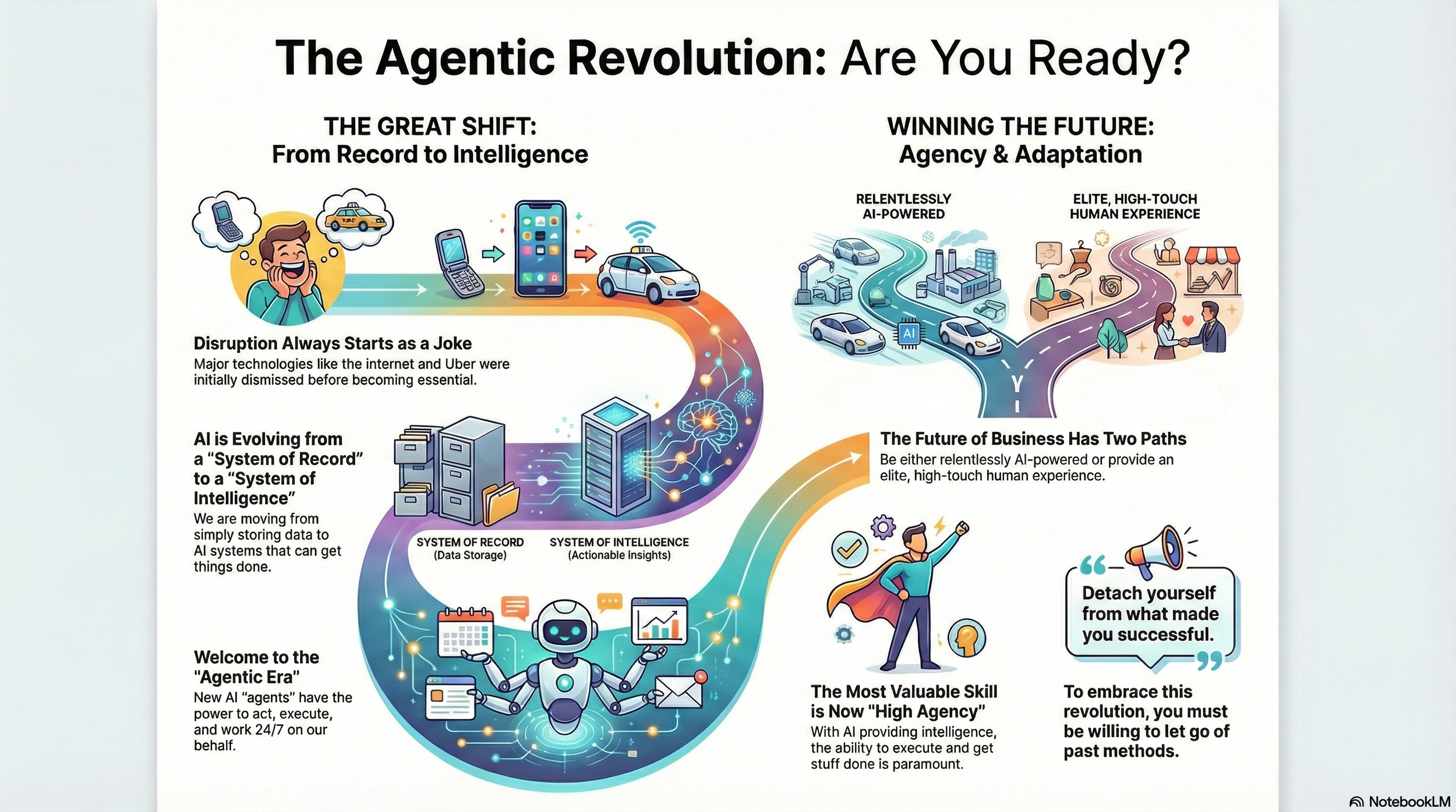
This presentation focuses on the transformative power of artificial intelligence and the necessity of personal disruption within the healthcare and biotechnology sectors. The speaker argues that we are entering an "agentic era" where software shifts from mere content generation to autonomously executing complex tasks. To remain competitive, organizations must embrace synthetic data and "build with the end in mind," using AI to automate routine labor while prioritizing human strengths. However, the talk warns that as technology makes life more efficient, trust becomes the rarest asset, necessitating "crafted friction" to maintain meaningful human connections. Ultimately, leaders are encouraged to overcome their fears by becoming proficient in these tools, ensuring they foster a culture deeply committed to both innovation and care.
KEY TAKEAWAYS (an AI-Output with Hallucinations)
MY #1 USED AI TOOL
Wispr Flow - I don’t type anymore, I just voice everything
AI AGENTS & AGentic workflows
Claude Code / Claude Cowork - The best AI General Agent today
Atlas - AI Browser by OpenAI
n8n - Workflow automation
Cursor - Coding agent
Comet by Perplexity - Best Agentic Browser - browse the internet with AI and get stuff done
Lindy - Build an AI agent - great for AI automation
LLM
Gemini 3 - The Best LLM on the planet right now
OpenAI’s Deep Research - Absolutely the best research tool out there right now
Manus - Most comprehensive AI agent in my opinion
Claude Skills - Claude Skills is the best skills agent - this allows to be more deterministic with your agents.
Grok 4 - Equivalent to o3 from ChatGPT - awesome for X data
Text-to-App
Lovable - Build any app with agentic reasoning (best at front-end)
v0 by Vercel - Text-to-Webpage (really good front-end)
Replit - Idea-to-App (best for full app)
Text-to-IMAGE/VIDEO
Midjourney - Best for pictures and video
HeyGen - AI Video Avatar
Runway - Text to Video
Google’s Nano Banana Pro - Best Image Generator
Research & other
NotebookLM - Research and the two AI podcast hosts that you see above :)
Google AI Studio - Real-time AI co-presence
Clay - AI Outbound Sales | Generating lists of emails and sending cold outreach
Briefing: Innovation, AI, and the Agentic Era
Executive Summary
This briefing synthesizes the core arguments presented by Shawn Kanungo regarding the current technological revolution driven by Artificial Intelligence. The central thesis is that society is entering an "Agentic Era" of AI, a fundamental shift from content creation to automated execution, which necessitates a profound change in organizational structure, leadership, and individual skills.
The most critical takeaways are:
• Disruption Begins as a Joke: All major technological disruptions (the internet, Uber) are initially dismissed or ridiculed. The current skepticism surrounding technologies like autonomous vehicles follows this pattern and risks leaving organizations unprepared when the "joke is on us."
• The Rise of "Agentic AI": The AI revolution is moving beyond chatbots to "agentic" systems with the power to act, execute, and orchestrate complex tasks. Technologies like Anthropic's Claude Co-pilot represent a "chat GPT moment for the enterprise," effectively giving every employee a personal Chief Operating Officer to get work done.
• The Future is AI-Powered or High-Touch: In this new landscape, relevance will be found at two extremes: being a hyper-efficient, "AI driven" organization or providing an invaluable, high-touch, human-centric advisory service. The middle ground will cease to be viable.
• The "Agentic Enterprise" is Human-First: The necessary response to this technological shift is not technological but human. It requires redesigning organizations away from the 20th-century assembly line model built around processes and toward an "Agentic Enterprise" built around amplifying the unique strengths and gifts of its people.
• "High Agency" is the New Core Skill: As AI commoditizes intelligence and information retrieval, the most valuable human skill is no longer knowledge but "high agency"—the ability to execute, innovate, and architect one's own outcomes. The call to action is to detach from past successes and embrace a mindset of proactive execution.
--------------------------------------------------------------------------------
1. The Nature of Disruption: From Joke to Reality
The keynote establishes a foundational principle: disruptive technologies are consistently underestimated at their inception. The pattern shows that technologies which later become ubiquitous are initially perceived as jokes or novelties.
• Core Argument: "Disruption always looks like a joke. until the joke is really on us. Especially when it comes to our customers."
• Historical Precedents:
◦ The Internet: Initial widespread reluctance to put banking information online.
◦ Uber: Initial fear of getting into a stranger's car, which was overcome by mass adoption.
◦ Facebook Marketplace: The inherent risk of transacting with strangers is now a common activity.
• Industry Application: This concept was directly applied to the fleet management industry, citing a customer panel's dismissal of autonomous cars. While viewed as a joke today, the speaker asserts it will not be a joke tomorrow. This historical pattern suggests that dismissing nascent technologies is a significant strategic risk.
2. The Dawn of the Agentic Era
The current AI revolution is defined by a critical evolution from passive content generation to active task execution. This is termed the "agentic era," where AI systems possess agency—the power to act on a user's behalf.
• From Content to Execution: While the post-ChatGPT era has largely focused on content refinement and summarization, the period from 2026 and beyond will be defined by agentic workflows that unlock "extraordinary value."
• Key Technology Example: Anthropic's Claude Co-pilot is presented as the "truest agent" available today and a "chat GPT moment for the enterprise." Its capability was highlighted by a Google engineering leader who stated the tool replicated a year's worth of their work in just one hour.
• Demonstrated Capabilities: An agentic AI can:
◦ Interact with local computer files (creating folders, documents).
◦ Understand and apply internal standards (design and branding elements).
◦ Connect to and operate external software tools (e.g., a PowerPoint maker like Gamma) to orchestrate complex tasks.
• The New Paradigm: This marks a "step change" from a "chat bot experience" to a reality where every employee is equipped with their own virtual "Chief Operating Officer" working 24/7.
3. The Implications of Democratized Execution
The rise of agentic AI dramatically lowers the barrier to sophisticated execution, creating both unprecedented opportunities and new competitive threats.
• Ideation as the Key Skill: When the execution of complex tasks can be automated in minutes, "the most dangerous skill in the world in 2026 is just coming up with an idea." The ability to create a Netflix-style onboarding platform or a professional marketing campaign in minutes, tasks that once took teams a year, exemplifies this shift.
• The Role of Synthetic Data: The safest and most effective way to experiment with powerful AI tools is to use synthetic data—fake but realistic datasets. This allows organizations to leverage any tool on the planet without exposing sensitive, real-world data, enabling rapid analysis and innovation.
• A New Competitive Landscape: The accessibility of these tools means that new competitors, who are not "burdened by legacy infrastructure," can emerge from anywhere. The example of a non-technical shop owner in Malaysia using a WhatsApp-based agentic system to manage her employees illustrates that this technology is no longer the exclusive domain of large tech firms.
4. Human-Centric Principles in a Technological Age
Despite the radical technological changes, the focus must remain on core human needs and the evolution of human expectations.
• The Kelly Rowland Principle: The future of technology is invisibility. Drawing an analogy to singer Kelly Rowland being unaware of Microsoft Excel, the speaker argues that customers do not care about the underlying technology (e.g., "agentic AI"). They care only about solving their problems effectively.
• System of Record vs. System of Intelligence: For decades, business technology has focused on creating better "systems of record" (ledgers, Excel, ERPs) to store and retrieve data. AI marks the advent of a "system of intelligence" that can act on this data, performing jobs humans were never able to do, such as 24/7 financial reconciliation and audits.
• Rising Baseline Expectations: Customer expectations are constantly and rapidly rising. The evolution of in-flight entertainment—from a single shared screen to endless individual choices—shows how quickly a luxury becomes a baseline expectation. For Element Fleet Management, this means customers increasingly demand high-level, CFO-like capabilities and proactive, advisory partnerships.
5. Navigating the Risks and Human Response to AI
The adoption of AI is accompanied by new categories of risk and a profound psychological challenge to professional identity.
• The Human Threat: The primary fear should not be of the technology itself, but of "the people using technology." This will usher in an "age of infinite hell" characterized by hyper-specific deepfakes, exponential scams, and synthetic relationships.
• AI-Specific Vulnerabilities: New technical threats emerge with agentic systems:
◦ Content Injection: Hacking a prompt to make an AI ignore its instructions.
◦ Tool Poisoning: An agent connecting to and being manipulated by a nefarious tool.
◦ Delegation Overreach: An agent taking unintended actions due to insufficient context.
◦ Context Poisoning: Feeding an AI malicious data to corrupt its outputs.
• The End of Digital Trust: As AI makes it impossible to distinguish between real and fake digital content, trust must be placed in verified controls and human relationships, not in what is seen online.
• Threat to Identity, Not Jobs: The deepest resistance to AI stems from its threat to human identity. AI challenges the "badge of experience" and status that professionals have built over decades, making adoption an emotional and psychological hurdle rather than just a technical one.
6. The Strategic Mandate: The Agentic Enterprise
The ultimate response to the AI revolution is a strategic and organizational one, focused on reorienting the enterprise around its people and fostering a culture of execution.
• The Two Poles of Future Relevance: The keynote presents a stark choice for future business models, exemplified by the "celebrity services" employee named Al. Organizations must be either:
1. AI-Powered: Incredibly efficient, automated, and driven by technology.
2. High-Touch like "Al": Providing an indispensable, hand-holding, human-led advisory service. This aligns directly with customer feedback indicating a desire for an "operator expert that can hold their hand" and deliver insights, not just data.
• Redesigning the Organization: For the last century, businesses were designed around the assembly line—structuring roles around processes and technologies (CRM person, ERP person). The "Agentic Enterprise" flips this model, designing the organization around its people to maximize their "unique gifts and strengths."
• High Agency as the Most Valuable Skill: In a world where intelligence is commoditized by AI ("I got 3 genies in my pocket"), the critical differentiator is "high agency." This is defined as the ability to execute, get things done, and act as the "architect of their own outcomes."
• Final Call to Action: To succeed, leaders and employees must consciously "detach" from the mindsets and methods that brought past success. Gratitude for the past must be paired with a willingness to move forward, avoiding the paralysis of nostalgia to truly embrace the opportunities of this new era.
If you scrolled this far.
Here’s more!