
Thank you for being part of my session at Crowe BGK
The After Show
In the latest episode of The After Show, hosts dive into Shawn Kanungo's thought-provoking session at Crowe BGK

Leaders,
Are you ready?
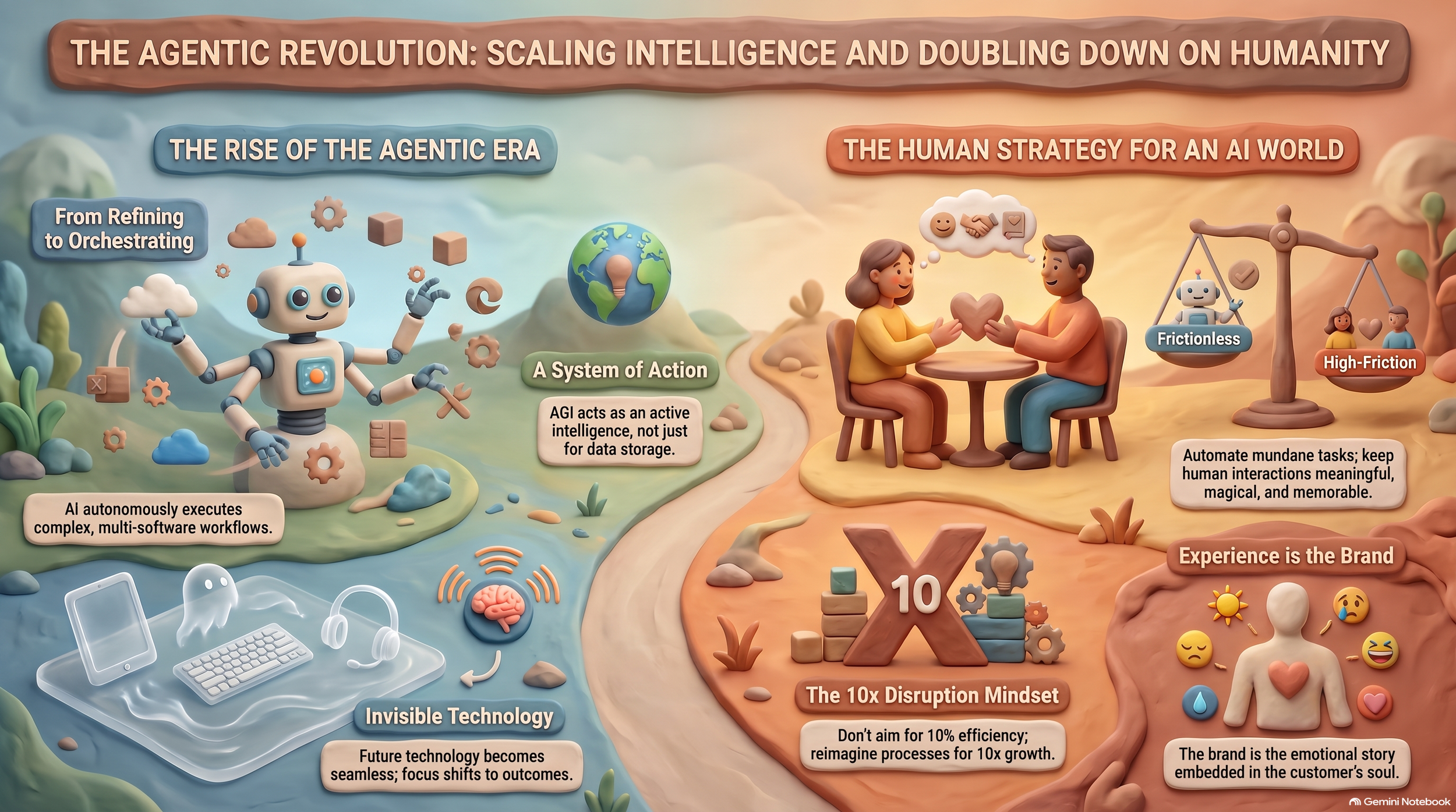
Artificial intelligence is fundamentally transforming modern industries by shifting the focus from simple workplace efficiency to complete organizational reinvention. Rather than merely layering new technology onto existing workflows, professionals must be willing to challenge traditional practices and embrace radical imagination. This technological revolution is not about replacing human labor, but rather empowering individuals to rebuild their processes from scratch by asking unconventional questions. Ultimately, success in this rapidly evolving landscape requires individuals to let go of outdated methods, adopt a mindset of continuous adaptation, and focus on delivering exceptional human-centric experiences.
KEY TAKEAWAYS (an AI-Output with Hallucinations)
MY #1 USED AI TOOL
Wispr Flow - I don’t type anymore, I just voice everything
My favorite AI AGENTS
Dots & GPT-6 Astra by OpenAI - AGI is here
Claude’s Fable 5.2 by Anthropic - The best model right now
Grok Bot by SpaceX AI - A downloadable AI team
Hermes - My personal AI Harness
Perplexity Computer - An AI agent orchestrator that has access to 19 different models
Muse by Meta - great personal AI agent - highly recommend for non-technical users.
Text-to-App
Lovable - Build any app with agentic reasoning (best at front-end)
v0 by Vercel - Text-to-Webpage (really good front-end)
Replit - Idea-to-App (best for full app)
Text-to-IMAGE/VIDEO
Claude Design for motion graphics - claude.ai/design
HeyGen - AI Video Avatar
ChatGPT Image 2.0 - Best Image Generator
Google’s Nano Banana Pro 2- 2nd Best Image Generator
Research & other
NotebookLM - Research and the two AI podcast hosts that you see above :)
Google AI Studio - Real-time AI co-presence
Clay - AI Outbound Sales | Generating lists of emails and sending cold outreach
Briefing Document: Executive Synthesis of Shawn Kanungo on AI, Innovation, and the Future of Professional Services
Executive Summary
The professional services industry faces a pivotal inflection point driven by exponential advancements in Artificial Intelligence (AI). In an era where AI rapidly synthesizes conventional wisdom, competitive advantage no longer derives from knowledge or execution alone, but from judgment, courageous leadership, and unconventional questioning.
Organizations must transition from viewing AI merely as a tool for basic productivity to recognizing it as an ambient, 24/7 autonomous teammate. Crucially, as baseline client expectations rise due to technology, firms must resist middle-tier mediocrity. Success requires a bifurcated strategy: driving radical, agentic speed for routine operations while intentionally reintroducing human "friction"—empathy, trust, and deep client connection—for high-value advisory interactions. Leaders must dismantle legacy mindsets, embrace failure by encouraging bold technological experimentation, and design processes from first principles ("starting from zero").
1. The Paradigm Shift: From Systems of Record to Systems of Action
Evolution of the Technology Trajectory
The role of digital tools in professional services has undergone a fundamental structural shift over recent years:
2022–2025 (The Basic Utilization Phase): Initial AI adoption was confined to minor tasks such as polishing emails, updating social media profiles, or generating novel images.
Late 2025 (The Agentic Era): AI transitioned into executing multi-step autonomous workflows via specialized agents.
Present/Emerging (The AGI & Computer Use Era): Contemporary frontier models (e.g., OpenAI’s Astra, Anthropic’s Claude Opus/Fable 5.2/5.5) have mastered "computer use." AI can now operate software applications, read technical manuals, execute precision engineering, and continuously write or repair its own code autonomously (e.g., 90% of Claude Fable 5.2 was generated by Claude itself).
+-----------------------------------------------------------------------------------+
| ERA                     | CORE FUNCTIONALITY             | OPERATIONAL IMPACT     |
+-------------------------+--------------------------------+------------------------+
| Legacy Software/OCR/ERP | Systems of Record              | Storing, retrieving,   |
|                         |                                | and maintaining data.  |
+-------------------------+--------------------------------+------------------------+
| Ambient/AGI Era         | Systems of Action/Intelligence | 24/7 reconciliation,   |
|                         |                                | continuous auditing,   |
|                         |                                | autonomous execution.  |
+-------------------------+--------------------------------+------------------------+
From Prompting to Ambient Intelligence
Workflows are shifting from manual, point-in-time prompting to ambient, goal-oriented AI agents running continuously in the background (e.g., Meta’s Muse, OpenAI’s DOTS, SpaceX’s Grockbot). While this ambient model causes token consumption to skyrocket as agents continuously prompt themselves, it yields unprecedented oversight—flagging security vulnerabilities, travel discrepancies, and financial mismatches automatically without human intervention.
Redefining the Value of Knowledge Workers
Historically, professional services designed workflows around technological constraints (e.g., assembly lines, ERP entries, manual software inputs). AI automates this routine drudgery, freeing professionals to focus on unique human strengths.
Knowledge is no longer power: Ubiquitous AI provides instant access to digitized human knowledge.
Execution is no longer power: AI agents interact with laptop environments and software applications faster and more proficiently than humans.
Judgment is power: The critical differentiator becomes discerning what questions to solve, finding grey areas, evaluating edge cases, and making high-stakes decisions.
2. Defining the Competitive Edge: "Friction" and the Dual-Model Framework
The Baseline Expectation Inflation
As clients gain access to advanced AI models, their baseline expectations shift dramatically upward. Merely producing standard technical outputs is no longer a differentiator; output quality that was previously considered impressive is now viewed as the minimum standard.
Reintroducing Strategic "Friction"
While conventional wisdom dictates removing all operational friction, long-term brand equity requires intentionally introducing human "friction"—slowing down key client touchpoints to create meaningful, memorable, and trust-building experiences.
                           THE STRATEGIC MARKETPLACE
                                       |
        +------------------------------+------------------------------+
        |                                                             |
        v                                                             v
[ FAST & FRICTIONLESS ]                                      [ SLOW & EXPERIENCE-FOCUSED ]
High-speed, automated, agentic delivery.                     Deep human empathy, craftsmanship, & trust.
(Examples: Amazon, Temu, McDonald's)                         (Examples: Four Seasons, Hermès, Apple)
        |                                                             |
        +------------------------------+------------------------------+
                                       |
                                       v
                     [ THE BLACK HOLE OF MEDIOCRITY ]
                     Firms stuck in the middle will fail.
The "AI vs. Al" Framework for Trust
Organizational trust rests upon two distinct pillars:
AI (Reliable Technology): Flawless, automated execution operating invisibly in the background.
"Al" (Human Empathy): Dedicated hand-holding, high emotional intelligence (EQ), and active problem-navigation.
"The experience is the brand. Your brand is not your logo... It is the soul that is embedded in the hearts and minds and souls of your clients."
3. Cultural Transformation: Courage, Leadership, and Embracing Failure
The Culture of Innovation
A true culture of innovation requires two non-negotiable components:
Deep Commitment to People: Demonstrating authentic care for staff, which directly correlates with how deeply staff care for clients.
Willingness to Embrace Failure: Empowering employees to run experiments without fear of administrative retribution.
Praising "Token Offenders"
Organizations typically penalize employees who take risks that fail. To foster innovation, leadership must change its stance on token usage:
Frivolous Token Usage: Checking routine information (e.g., weather queries) should be discouraged.
Experimental Token Usage: Employees who burn high volumes of tokens testing bold workflows or creating disproportionate client value should be publicly praised, and their experiments should be shared broadly across the firm.
Overcoming the "Bread vs. Lottery Ticket" Dilemma
When presented with innovation choices, organizations face a systemic courage deficit:
+---------------------------------------------------------------------------------+
| OPTION                        | GUARANTEED RETURN     | FAILURE RISK           |
+-------------------------------+-----------------------+------------------------+
| Option 1: "Bread"             | $1M Cost Savings      | 0% Risk (Guaranteed)   |
+-------------------------------+-----------------------+------------------------+
| Option 2: "Lottery Ticket"    | $100M Net New Revenue | 95% Risk of Failure    |
+-------------------------------+-----------------------+------------------------+
Insight: Most organizations claim to seek breakthrough innovation (Option 2), yet consistently allocate capital to incremental cost-savings (Option 1). The obstacle to transformation is not a lack of technology, but a deficit of organizational courage.
4. Operationalizing Radical Transformation
The 6-Month Question vs. First-Principles Thinking
To break away from incremental optimization (e.g., seeking marginal 10% efficiency gains), teams must ask:
"If you have a 5-year plan to get somewhere, why not achieve it in 6 months?"
Answering this question forces teams to abandon existing process bloat and practice first-principles thinking ("Starting from Zero"):
Strip an existing process entirely down to zero.
Rebuild it assuming modern AI agents handle core operations.
Identify what to automate, what to eliminate, and where to insert intentional human touchpoints.
Example: Rather than progressing sequentially through strategy, planning, production, and scheduling, a marketing or assurance team should prompt the final deliverable together in their initial meeting to establish shared clarity instantly, achieving a 10x workflow improvement.
Overcoming Identity Threat and Disruption
The primary barrier to AI adoption in established professions (such as accounting, tax, and assurance) is not technological complexity, but identity threat. Professionals spend decades building expertise, certifications, titles, and established playbooks.
Disruption Mechanics: Early-stage disruptive ideas invariably look ridiculous or unviable (e.g., credit card usage at fast-food restaurants, ride-sharing via Ubers, online banking) until they become the standard.
Unlearning Success: Professionals must let go of past accomplishments. "What got you here is not what's going to get you to the next milestone."
Building Proficiency: Fear of AI stems from a lack of hands-on immersion. Immersion transforms fear into empowerment: "Work scared until you become dangerous."
5. Strategic Directives for Professional Services Leaders
Treat AI as an Autonomous Teammate: Onboard AI models with the same structured delegation, discernment, and review processes applied to human staff.
Eliminate Middle-Tier Services: Audit internal and external workflows to classify them strictly as either ultra-automated/agentic or highly touch-sensitive/human-centric.
Reward High-Risk Experimentation: Reframe failure by celebrating staff who expend computational resources ("tokens") on bold, value-generating tests.
Develop "Unicorn" Professionals: Upskill staff beyond technical accounting or tax standards by training them in AI tool fluidity, rapid prototyping, deep curiosity, and high-EQ client advisory skills.
Execute Zero-Based Process Redesign: Select core operating workflows and redesign them from scratch to achieve exponential (10x) performance shifts rather than linear (10%) efficiency gains.
03:03 / 22:19
1.0x
If you scrolled this far.
Here’s more!