
Thank you for being part of the Corcentric Symposium 2026
The After Show
In the latest episode of The After Show, hosts dive into Shawn Kanungo's thought-provoking session at Corcentric’s Symposium 2026
Leaders,
Are you ready?
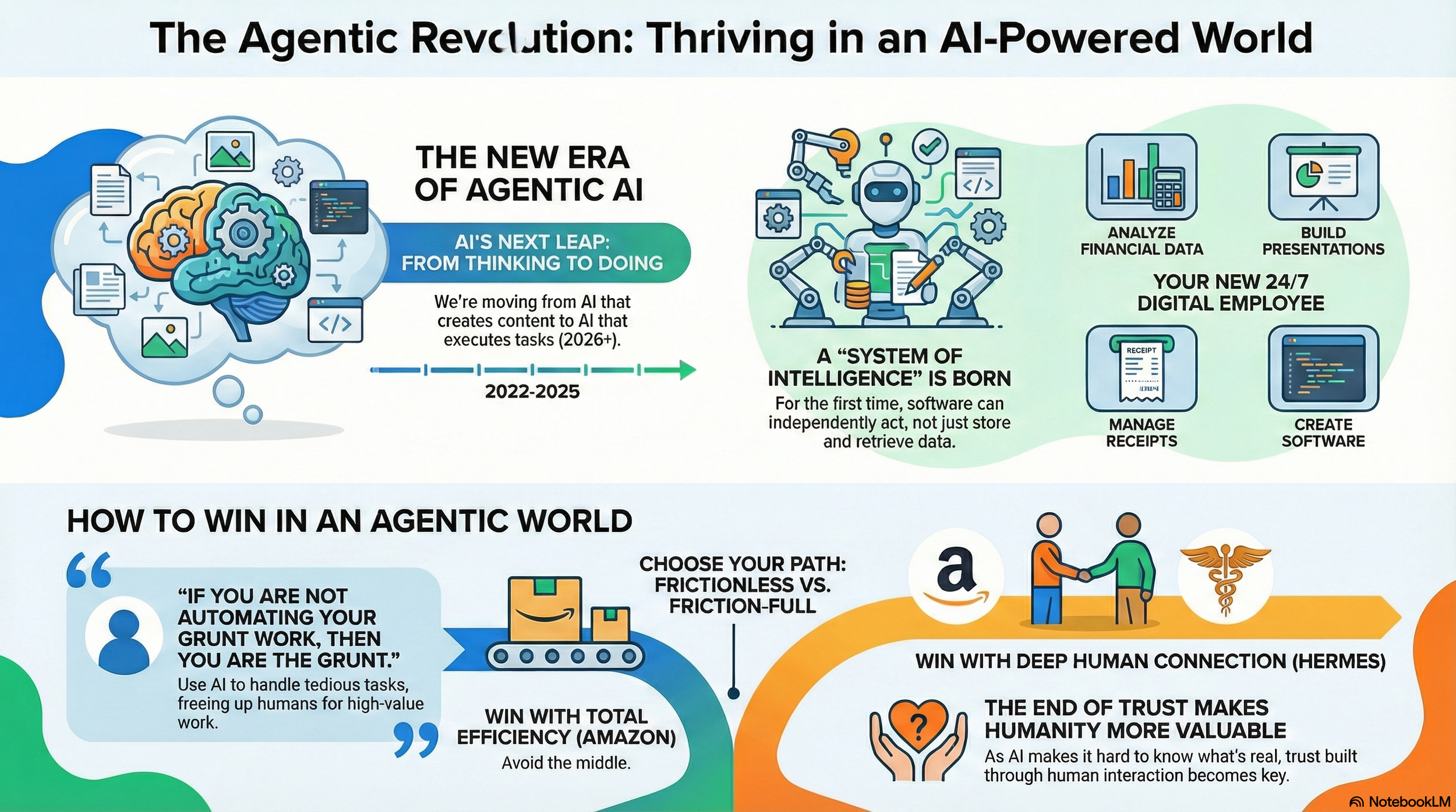
This presentation focuses on the transformative power of artificial intelligence and the necessity of personal disruption within the healthcare and biotechnology sectors. The speaker argues that we are entering an "agentic era" where software shifts from mere content generation to autonomously executing complex tasks. To remain competitive, organizations must embrace synthetic data and "build with the end in mind," using AI to automate routine labor while prioritizing human strengths. However, the talk warns that as technology makes life more efficient, trust becomes the rarest asset, necessitating "crafted friction" to maintain meaningful human connections. Ultimately, leaders are encouraged to overcome their fears by becoming proficient in these tools, ensuring they foster a culture deeply committed to both innovation and care.
KEY TAKEAWAYS (an AI-Output with Hallucinations)
MY #1 USED AI TOOL
Wispr Flow - I don’t type anymore, I just voice everything
AI AGENTS & AGentic workflows
Claude Code / Claude Cowork - The best AI General Agent today (Opus 4.6)
Atlas - AI Browser by OpenAI
n8n - Workflow automation
Cursor - Coding agent
Comet by Perplexity - Best Agentic Browser - browse the internet with AI and get stuff done
Lindy - Build an AI agent - great for AI automation
LLM
Gemini 3 - The Best LLM on the planet right now
OpenAI’s Deep Research - Absolutely the best research tool out there right now
Manus - Most comprehensive AI agent in my opinion
Claude Skills - Claude Skills is the best skills agent - this allows to be more deterministic with your agents.
Grok 4 - Equivalent to o3 from ChatGPT - awesome for X data
Text-to-App
Lovable - Build any app with agentic reasoning (best at front-end)
v0 by Vercel - Text-to-Webpage (really good front-end)
Replit - Idea-to-App (best for full app)
Text-to-IMAGE/VIDEO
Midjourney - Best for pictures and video
HeyGen - AI Video Avatar
Runway - Text to Video
Google’s Nano Banana Pro - Best Image Generator
Research & other
NotebookLM - Research and the two AI podcast hosts that you see above :)
Google AI Studio - Real-time AI co-presence
Clay - AI Outbound Sales | Generating lists of emails and sending cold outreach
Briefing: Innovation, AI, and the Agentic Era
Executive Summary
The Agentic Revolution: Navigating the Future of AI, Innovation, and Human Value
The global business landscape is shifting from a period of AI-assisted content creation to the Agentic Era, where artificial intelligence functions as a "system of action" rather than a mere "system of record." This transition redefines the role of technology from storing and retrieving data to autonomously executing complex tasks and making decisions. To thrive in this environment, leaders must move beyond the "knowledge is power" paradigm—since AI democratizes information—and prioritize high agency, critical thinking, and humanity. The ultimate competitive advantage in an increasingly frictionless, AI-driven world is the ability to provide "friction": meaningful, high-trust human experiences that technology cannot replicate.
--------------------------------------------------------------------------------
I. The Shift to the Agentic Era (2026 and Beyond)
Current utilization of AI has largely centered on content refinement, summarization, and basic research. However, the next phase of the revolution is defined by "Agency"—the ability to act and execute.
From Bots to Agents
The source distinguishes between simple automated tools and true AI agents:
• The Bot/Recipe Spectrum: On one end are predefined recipes, such as a bot summarizing a customer conversation.
• True AI Agents: These are digital employees or AI teammates that are "always on" (24/7), capable of making autonomous decisions and executing end-to-end workflows without constant human prompting.
Systems of Record vs. Systems of Action
Historically, business technology (from ledgers to Excel to QuickBooks) has served as a System of Record—an elegant way to store and retrieve data. AI represents the first System of Action in human history.
• Actionable Intelligence: Unlike a human or a traditional software program, an AI agent can perform 24/7 reconciliations, audits of every transaction, or proactive software creation.
• Value Creation: Value is no longer found in the "elegant storage" of data but in the "autonomous execution" of tasks based on that data.
--------------------------------------------------------------------------------
II. Strategic Innovation: Starting from Zero
To effectively integrate AI, organizations must be willing to "disrupt themselves." This requires a shift from incremental 10% improvements to "10x" reimagining.
The "Start from Zero" Methodology
Instead of optimizing existing processes, leaders should ask: "If we started this process today with current technology, how would we build it?"
• Eliminate and Automate: Identify redundant tasks to be removed or handled by AI.
• Human-Centric Design: Identify where humanity is the most critical element.
• Reverse Workflow: In creative or strategic fields, use AI to generate the final deliverable first to align the vision, then work backward through the creative process.
The Rookie Mindset
Success often creates a "badge of experience" or ego that prevents innovation. True disruption requires:
• Going from 100 to 0: Letting go of the status quo to become a "rookie" again.
• Identity De-coupling: Recognizing that AI threatens traditional job identities, requiring leaders to value high agency over historical status.
--------------------------------------------------------------------------------
III. The Paradox of Friction and Humanity
As AI makes the world increasingly "fast and frictionless," the baseline expectations for convenience rise. This creates a strategic divide in how companies compete.
Two Paths to Success
Strategy
Characteristics
Examples
Fast and Frictionless
Prioritizes efficiency, speed, and one-touch convenience.
Amazon, McDonald's, Temu
Slow and Meaningful
Prioritizes experience, craftsmanship, and human interaction.
Four Seasons, Hermes, Apple Genius Bar
The Value of "Friction"
While AI handles "frictionless" tasks (routing, billing, scheduling), businesses must double down on "friction"—meaningful, magical, and memorable human moments.
• The Experience is the Brand: A brand is not a logo; it is the story embedded in the customer's mind.
• Trust as Currency: In a world of deep fakes and AI-generated content, trust is the rarest and most valuable asset.
--------------------------------------------------------------------------------
IV. The Human Strategy: "Deeply Caring"
The most effective innovation strategy is not technological, but cultural. High-agency employees are created through "Ultimate Empowerment," which requires two ingredients:
1. A Deep Commitment to People: Technology serves as a fail-safe, but people provide the "gentle knock on the door"—the proactive care that creates loyalty.
2. A Willingness to Embrace Failure: Innovation cannot exist without the psychological safety to experiment.
The "Muhammad" Case Study: A hotel guest's trust was secured not by the automated wake-up call, but by the employee (Muhammad) who offered a manual door-knock. This level of service was driven by a culture where the organization "deeply cared" for Muhammad's family, prompting him to care deeply for the guest.
--------------------------------------------------------------------------------
V. Future Skills and Labor Realities
The source argues that AI will not necessarily take jobs that humans currently do, but will take over "jobs humans could never do" (e.g., auditing millions of transactions in real-time).
The New Power Hierarchy
• Knowledge is no longer power: AI provides a baseline of knowledge for everyone.
• High Agency is power: The ability to be an "architect of one's own outcomes" and get stuff done is the most valuable skill for the next decade.
• Critical Thinking: As AI makes more decisions (e.g., Google Maps, Spotify), humans must fight the "convenience trap" to maintain critical thinking and oversight.
--------------------------------------------------------------------------------
VI. Key Practical Insights and Toolsets
The following tools and approaches were highlighted as immediate opportunities for business application:
• Claude (Anthropic): Currently cited as one of the most sophisticated models for research, delegation, and building "skills" (Standard Operating Procedures for AI).
• Claude for Excel: Acts as a "10x financial analyst" within the spreadsheet to perform complex data analysis.
• Lovable: A text-to-application tool that allows users to create functional software or platforms (e.g., a Netflix-style onboarding site) in minutes.
• Deep Research Tools: Utilizing the research capabilities of Gemini or ChatGPT to identify market problems and solutions.
Guidance for Implementation
• Start with Problems, Not Tech: Innovation fails when it begins with a solution looking for a problem.
• Ask the AI: When overwhelmed, use the AI to triage where to begin by providing it with full business context.
• AEO (AI Engine Optimization): Move beyond traditional SEO to ensure business data is discoverable and prioritized by AI search engines.
--------------------------------------------------------------------------------
VII. Critical Takeaways and Quotations
• On Trust: "AI marks the end of trust... when you can't tell what is real and AI, what can you trust?"
• On Strategy: "The greatest strategy in the world is to deeply care."
• On Capability: "The most dangerous skill in the world in 2026 is just coming up with an idea."
• On Growth: "Work scared until you become scary. Work scared until you become dangerous."
If you scrolled this far.
Here’s more!