
Thank you for being part of my session at CHIME26
The After Show
In the latest episode of The After Show, hosts dive into Shawn Kanungo's thought-provoking session at CHIME26

Leaders,
Are you ready?
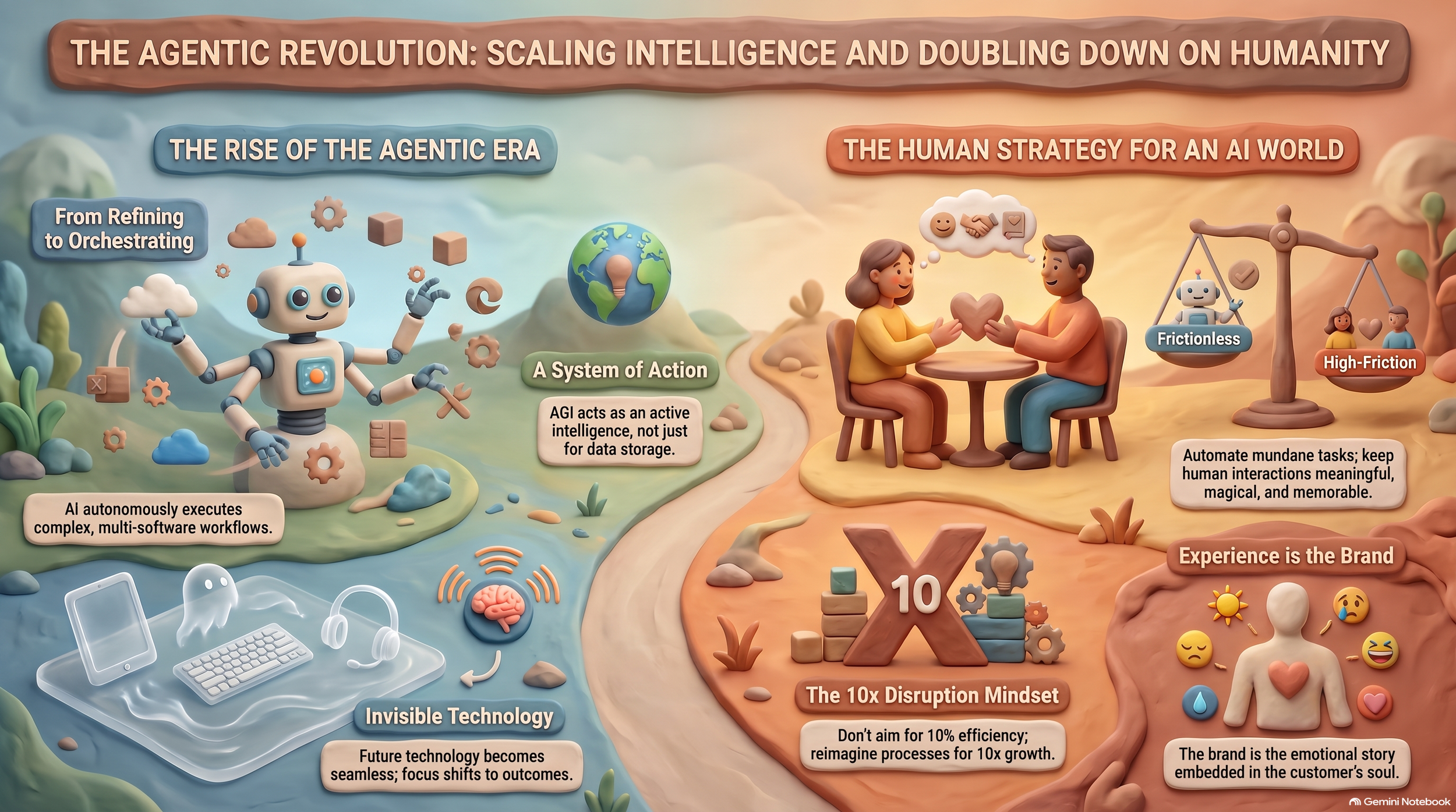
Artificial intelligence is fundamentally transforming modern industries by shifting the focus from simple workplace efficiency to complete organizational reinvention. Rather than merely layering new technology onto existing workflows, professionals must be willing to challenge traditional practices and embrace radical imagination. This technological revolution is not about replacing human labor, but rather empowering individuals to rebuild their processes from scratch by asking unconventional questions. Ultimately, success in this rapidly evolving landscape requires individuals to let go of outdated methods, adopt a mindset of continuous adaptation, and focus on delivering exceptional human-centric experiences.
KEY TAKEAWAYS (an AI-Output with Hallucinations)
MY #1 USED AI TOOL
Wispr Flow - I don’t type anymore, I just voice everything
My favorite AI AGENTS
Dots & GPT-6 Astra by OpenAI - AGI is here
Claude’s Fable 5.2 by Anthropic - The best model right now
Grok Bot by SpaceX AI - A downloadable AI team
Hermes - My personal AI Harness
Perplexity Computer - An AI agent orchestrator that has access to 19 different models
Muse by Meta - great personal AI agent - highly recommend for non-technical users.
Text-to-App
Lovable - Build any app with agentic reasoning (best at front-end)
v0 by Vercel - Text-to-Webpage (really good front-end)
Replit - Idea-to-App (best for full app)
Text-to-IMAGE/VIDEO
Claude Design for motion graphics - claude.ai/design
HeyGen - AI Video Avatar
ChatGPT Image 2.0 - Best Image Generator
Google’s Nano Banana Pro 2- 2nd Best Image Generator
Research & other
NotebookLM - Research and the two AI podcast hosts that you see above :)
Google AI Studio - Real-time AI co-presence
Clay - AI Outbound Sales | Generating lists of emails and sending cold outreach
Executive Briefing: Navigating AI Transformation, Disruption, and Organizational Strategy
Executive Summary
This briefing document synthesizes the strategic insights and core arguments presented by innovation strategist Sha Kango on the nature of disruption, the rapid progression of artificial intelligence (AI), and the imperative for self-disruption.
The central thesis posits that AI has progressed beyond foundational productivity hacks into the era of Artificial General Intelligence (AGI) and autonomous agents. Technology is shifting from explicit interaction ("vibe coding") to invisible execution ("precision engineering"), where AI software agents execute complex workflows faster and more effectively than human operators.
To remain competitive and avoid the "black hole of mediocrity," organizations must abandon legacy playbooks built on past identity and knowledge. Power has shifted from knowledge and execution to judgment. Strategic differentiation in healthcare and enterprise requires a dual approach: making back-end operations entirely agentic and invisible while deliberately introducing human friction, trust, and empathy at critical customer and patient touchpoints.
Key Themes and Strategic Analysis
1. The Historical Nature of Disruption
A foundational rule of technological transformation is that every major disruption initially appears trivial or irrational to established incumbents before becoming the dominant standard.
Initial Skepticism: Historically, disruptive innovations are dismissed as absurd or unsafe.
Internet Banking: Initially rejected due to fears of placing financial data online.
Ridesharing (Uber): Initially viewed as dangerous (entering strangers' vehicles), now a daily global practice.
Credit Cards: Dismissed during early adoption (e.g., at fast-food chains like Burger King) over concerns about transaction delays and impracticality for daily use.
The Disruption Trap: Disruption routinely transitions from a perceived joke to market displacement ("until the joke is really on us"). Leaders are cautioned against dismissing unconventional ideas or disruptive thinkers simply because they challenge existing norms.
Disruption Trajectory:
[ Unconventional Idea ] ──> [ Public Skepticism / Dismissal ] ──> [ Market Integration ] ──> [ Total Displacement ]
2. The AI Evolution: From Vibe Coding to AGI and Invisible Software
The enterprise adoption of artificial intelligence has transitioned rapidly through distinct evolutionary phases:
Era / Phase
Timeline / Context
Core Characteristics & Capabilities
Foundational Phase
Post-ChatGPT (Late 2022 – 2025)
Limited, novelty-driven, or basic administrative use (e.g., recording patient notes, personal profile writing, generating creative images).
Agentic Era
Late 2025
Autonomous AI agents capable of executing multi-step tasks across external environments.
AGI Era
Post-2025 Context
Artificial General Intelligence capabilities where AI performs cognitive tasks on par with or exceeding human capabilities.
Shift from "Vibe Coding" to "Precision Engineering"
Legacy Vibe Coding: Historically, prompting an AI model generated superficial user interfaces (UI) or front-end mockups without underlying enterprise infrastructure.
Precision Engineering: Current models operate in recursive improvement loops, patching their own code and resolving security vulnerabilities automatically (e.g., Anthropic developing up to 90% of its new models using Claude).
Autonomous Software Utilization: AI models now operate standard software suites (e.g., rendering engines, development platforms, databases) up to 1,000 times more effectively than human users. The barrier to solution creation is no longer technical execution, but human imagination and idea generation.
The Concept of "Invisible Technology"
The end state of enterprise technology is complete invisibility. Background software mechanics operate autonomously through AI agents, enabling human workers to focus entirely on value creation, strategy, and patient outcomes.
Cultural Analogy: Popular culture references (such as Kelly Rowland using Microsoft Excel as a messaging app in a 2002 music video without knowing what Excel was) illustrate the ideal end-state: users benefit from output without needing to engage with the underlying technical mechanics.
3. Practical Demonstrations of Agentic AI Workflows
To demonstrate the capabilities of current AI models (such as Anthropic Fable 5.2, Blender, Unreal Engine, and specialized workflow bots), several proof-of-concept workflows illustrate the transition from idea to autonomous execution within 24 to 48 hours:
Healthcare Onboarding Platform (CDW Concept):
Execution: Prompt-driven creation of a customized, Netflix-style onboarding platform tailored for healthcare enterprise software engineers and staff, featuring automated back-end security patching.
Automated Enterprise Talent Acquisition:
Execution: An AI system autonomously scanned thousands of sponsor job listings, identified over 10,000 potential candidates across external databases, built a custom candidate ranking algorithm, and drafted personalized outreach emails for every target candidate.
Complex Simulation & Game Development (CFL Project):
Execution: Utilizing local software suites (Blender, Unreal Engine, Obi Suite, Higgsfield) via AI agents, a fully functional Canadian Football League (CFL) 3D simulation game was generated within 24 hours—a task previously requiring millions of dollars and specialized studio teams.
Medical Anatomy Visualization:
Execution: High-precision interactive male anatomy modeling generated for medical training using rendering engines split into thousands of interactive asset components.
4. The Human Element: Judgment, Identity, and Overcoming Fear
As execution becomes automated, the fundamental nature of work and enterprise value changes.
Historical Power Metrics:
[ Knowledge is Power ] ──> [ Execution is Power ] ──> Modern Imperative: [ Judgment is Power ]
The Shift to Judgment
Obsolescence of Knowledge and Execution: Because AI can access vast datasets and execute operational tasks faster than humans, possession of knowledge and basic task execution no longer provide a competitive advantage.
Judgment as the Core Metric: Enterprise value resides in deciding which problems to solve, framing the right questions, and applying strategic discretion.
Redesigning Human Work
For over a century, workplace design forced humans into "robot work"—adapting human activity to fit assembly lines, ERP systems, and rigid technological workflows. Agentic AI allows work to be redesigned around distinct human strengths (e.g., patient empathy, relationship management, strategic ideation) while delegating administrative back-end tasks to software agents.
Managing Technological Anxiety
Fear of AI stem from a lack of hands-on engagement rather than direct capabilities.
Observation: Individuals who do not engage with AI fear job displacement. Conversely, workers who actively build competency with AI tools consistently request additional automated agents to expand their operational capacity.
Directive: Organizations must encourage employees to "work scared until you become scary [dangerous]"—building technical proficiency through direct immersion.
5. Strategic Differentiation: The Friction Spectrum and "AI + Al"
A critical strategic error in healthcare and enterprise management is seeking a frictionless middle ground. Market dynamics will bifurcate, punishing average experiences while rewarding extreme models.
Strategic Market Positioning:

   [ Fast & Frictionless ] <─────── ( Black Hole of ) ───────> [ High Experience & Trust ]
   - Amazon, McDonald's             (   Mediocrity  )          - Four Seasons, Hermès
   - Fully Agentic AI                                          - High Human Friction
The Two Winning Operational Models
Fast and Frictionless: Highly automated, instant, and completely invisible operations (e.g., Amazon, McDonald's, agentic enterprise back-ends).
High Experience and Friction: Deliberately slowed down to prioritize human craft, relationship building, empathy, and personal connection (e.g., Four Seasons, Hermès, Apple Genius Bar).
Redefining "Patient-Centricity" in Healthcare
True patient-centricity requires an dual focus:
Making back-end systems, administrative intake, and scheduling completely invisible and agentic.
Doubling down on friction, humanity, and trust during direct patient-provider interactions.
The "AI and Al" Model
Future enterprise success relies on combining reliable, invisible technology with high-touch, consultative human engagement:
AI: Rapid, automated, error-free back-end data processing.
"Al" (Concierge Human Touch): Deeply caring, consultative human talent that hand-holds clients or patients through complex, high-stakes experiences.
6. Organizational Self-Disruption and Zero-Based Strategy
Long-standing success often creates structural inertia, making self-disruption the most difficult yet necessary strategic imperative.
The Identity Threat
AI transformation challenges professional identity, designatory credentials, and titles built over decades (10 to 50+ years). To move forward, leaders must detach their identity from historical accomplishments.
Carl Jung Principle: "The first half of your life is dedicated to developing a healthy ego and the last half is letting go."
Strategic Directive: Acknowledge and retire legacy playbooks. What drove success over the past decades will not succeed in an agentic environment.
The Zero-Based Process Strategy
To achieve exponential (10x) improvements rather than incremental (10%) gains, organizations must evaluate internal processes from a baseline of zero:
Zero-Based Evaluation Framework:
[ Re-examine Process from Zero ] ──> 1. What do we AUTOMATE completely?
                                 ──> 2. What do we ELIMINATE entirely?
                                 ──> 3. Where do we ADD FRICTION / Human Connection?
Assume zero legacy infrastructure.
Apply full knowledge of currently available agentic tools.
Identify what must be automated, what must be eliminated, and where human friction/trust must be intentionally inserted.
Key Quotes & Salient Insights
On Disruption: "A disruption always looks like a joke. Every single disruptive technology always looks like a joke... Disruption always looks like a joke until the joke is really on us."
On AI Capabilities: "This is no longer vibe coding. This is now precision engineering... The idea that the AI can use your computer, your laptop, your systems better than any professional has not been possible... until a couple of months ago."
On Strategic Power: "I used to believe that knowledge is power... Then I used to believe that execution is power... To me, what's power today is judgment. And the easier it becomes to do anything, the more it matters what you choose to do."
On Overcoming Fear: "The reason why you are scared is because you haven't put in the work yet... My advice is to work scared until you become scary. Work scared until you become dangerous."
On Market Positioning: "The middle is what I call the black hole of mediocrity... Patient-centric today... is being obsessed with doubling down on friction and humanity and trust and doubling down on making something as agentic and as seamless and as invisible as possible."
On Organizational Change: "Thank your past self and then I want you to bury it because what got you here is not what's going to get you to the next mountaintop."
On Leadership: "The most dangerous person in the room is the person who is most afraid yet bold enough to move forward."
Actionable Takeaways for Leadership
Conduct Zero-Based Process Audits: Select core organizational workflows and redesign them from scratch using autonomous AI capability assumptions. Aim for 10x structural shifts rather than 10% efficiency gains.
Bifurcate Operational Strategy: Eliminate middle-tier operational friction. Automate technical and administrative tasks completely while investing heavily in direct human-to-human trust building.
Shift Mindsets from Execution to Judgment: Reallocate talent development efforts toward critical thinking, problem definition, and strategic decision-making rather than rote software usage or data collection.
Drive Immersion to Eliminate Fear: Require leadership and operational teams to directly experiment with agentic AI tooling to build technical capability and eliminate organizational anxiety.
If you scrolled this far.
Here’s more!